
How to Choose a SaaS Marketing Agency That Actually Gets SaaS
Learn how to evaluate SaaS marketing agencies, what they charge, and how to avoid common hiring mistakes with a 5-question framework.


Roughly 70% of SaaS companies that hire a marketing agency churn within 12 months. Not because agencies are bad at marketing. Because most agencies don't understand how SaaS businesses actually grow. They'll optimize for clicks when you need pipeline. They'll pitch a rebrand when your CAC is bleeding. They'll report on impressions while your board asks about net revenue retention.
If you've been burned before, or you're hiring for the first time, the pattern is the same: a generalist agency that treats your subscription product like an e-commerce store. That gap between "good at marketing" and "good at SaaS marketing" is where budgets go to die.
This guide breaks down what a SaaS marketing agency actually does differently and what they charge. It also covers how to evaluate fit and when you're better off not hiring one at all.
TL;DR
- A SaaS marketing agency specializes in subscription metrics (MRR, CAC, LTV, churn) and builds campaigns around them, not vanity traffic.
- Core SaaS marketing services include SEO built for buyer intent, paid acquisition tied to unit economics, product marketing, and ABM.
- Expect to pay $3,000 to $25,000+/month depending on scope. Performance-based pricing exists but comes with tradeoffs.
- Before you evaluate any agency, make sure you've nailed your ICP and messaging internally. If you haven't, an agency will just burn cash faster.
- Use the 5-question framework below to filter candidates quickly. Then run a paid trial sprint instead of a long proposal process.
What Makes a SaaS Marketing Agency Different from a Generalist
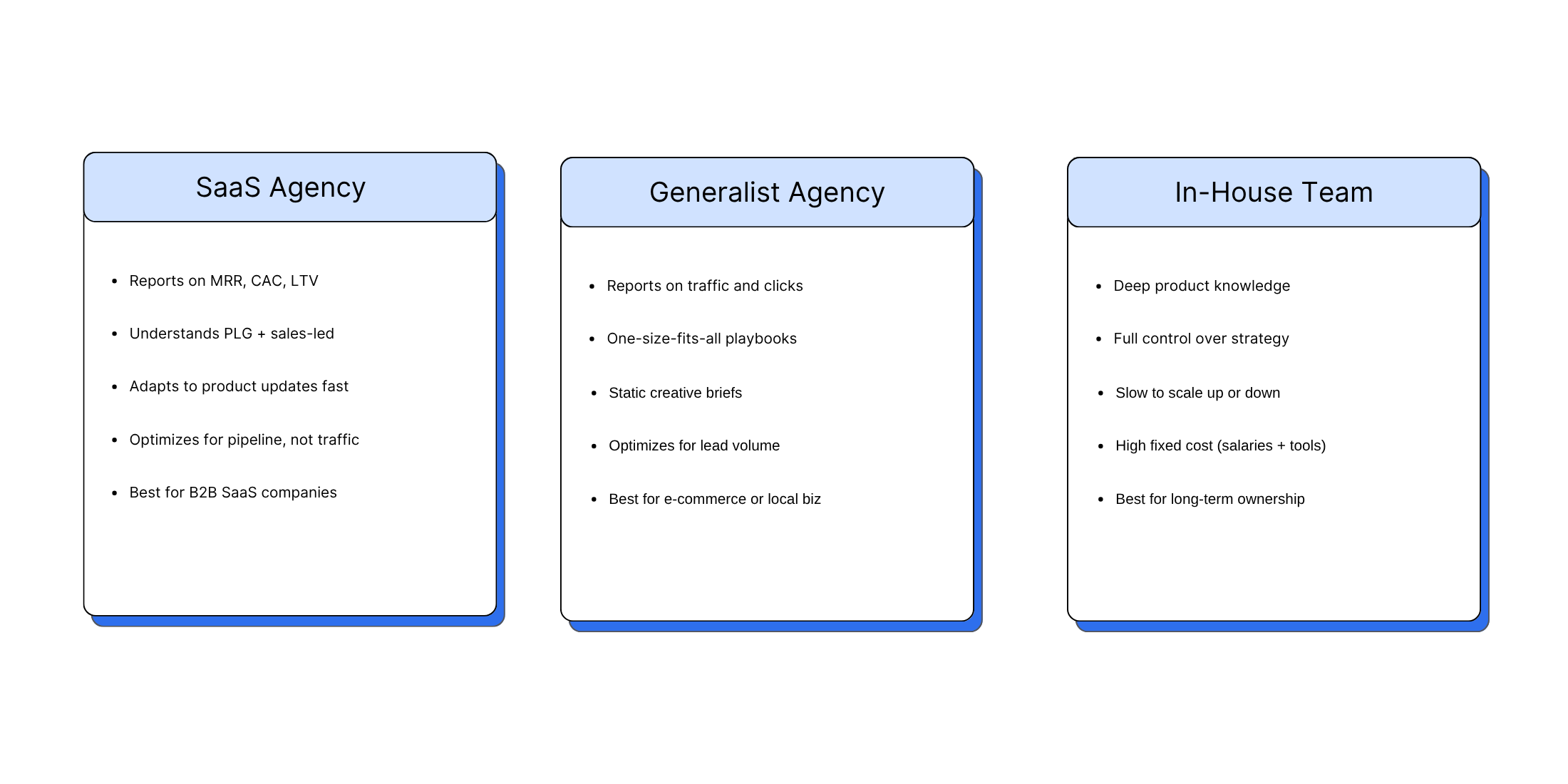
The short answer: they measure what matters for subscriptions, not one-time purchases. A generalist digital marketing agency might celebrate a 300% increase in blog traffic. A SaaS marketing agency asks whether that traffic converted to trial signups and, more importantly, whether those trials activated.
That difference in orientation changes everything downstream. Strategy. Channel selection. Reporting. How success is defined. All of it shifts.
They Speak MRR, CAC, and Churn, Not Just Impressions
SaaS marketing agencies build dashboards around monthly recurring revenue, customer acquisition cost, and churn rate. They understand that a $50 lead that converts at 2% to a $200/month plan is worth more than a $10 lead that never activates. They can model payback periods and tell you which channels will hit a 12-month CAC ratio. Generalist agencies often can't do this math, let alone optimize for it. This is why a specialized SaaS branding agency or marketing partner will structure every campaign around these metrics from day one.
According to a 2025 OpenView Partners report, top-quartile SaaS companies spend 40-50% of ARR on sales and marketing in their growth phase. An agency that doesn't understand how that budget connects to expansion revenue and net retention is flying blind.
They Understand Product-Led and Sales-Led Motions
SaaS isn't monolithic. A product-led growth company (think Slack, Notion, Calendly) needs content that drives self-serve signups and activation. A sales-led enterprise SaaS (think Salesforce, Workday) needs demand gen that fills a BDR team's pipeline with qualified accounts.
A SaaS marketing agency knows the difference and won't try to force a PLG playbook on an enterprise sales motion, or vice versa. They'll ask about your go-to-market model in the first call. If they don't, that's a red flag.
They Know How to Market a Product That Changes Every Sprint
SaaS products ship updates constantly. New features, changed pricing tiers, deprecated integrations. A SaaS-focused agency builds processes for this. They'll have systems to update landing pages when your product team ships, refresh comparison pages when competitors launch features, and adjust ad copy when you change your pricing page.
Generalist agencies typically work off a static creative brief. That falls apart fast when your product evolves every two weeks.
Core SaaS Marketing Services Worth Paying For
Not all SaaS marketing services deliver equal value at every stage. A pre-revenue startup needs different things than a Series C company optimizing for net retention. Here's what the core service categories look like and when each one matters most.
SEO and Content That Targets Buyer Intent, Not Vanity Traffic
SaaS SEO isn't about ranking for high-volume informational keywords. It's about owning the searches your buyers make when they're actively evaluating solutions. "Best project management software for remote teams" matters more than "what is project management."
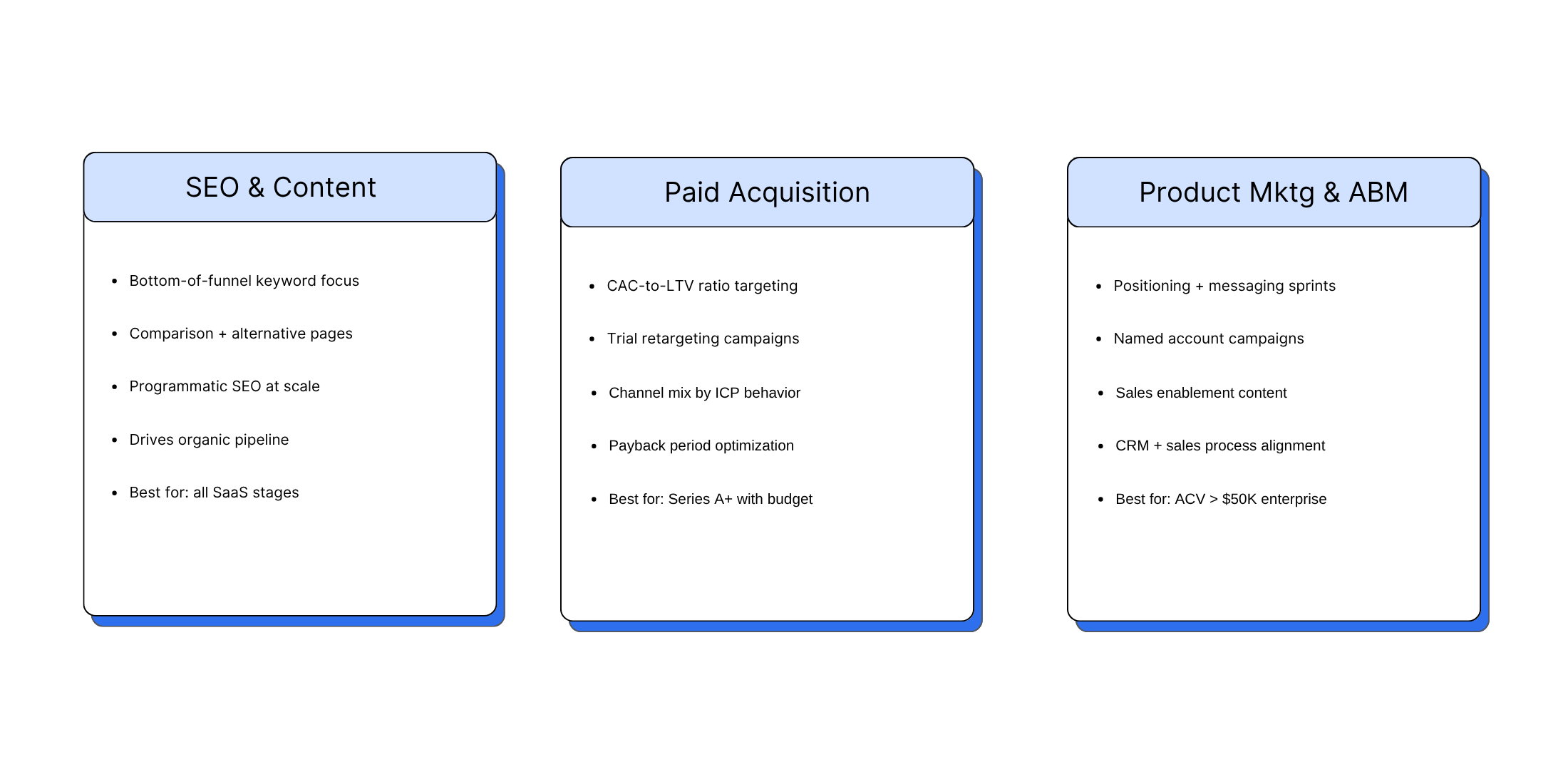
Good SaaS marketing agencies build content around bottom-of-funnel and middle-of-funnel intent: comparison pages, alternative pages, use-case specific landing pages, and integration guides. They'll also invest in programmatic SEO if your product serves multiple verticals or geographies. If you want to go deeper on SaaS-specific SEO strategy, the SEO agency for SaaS companies guide covers the tactical playbook.
Paid Acquisition Built Around SaaS Unit Economics
SaaS paid media isn't "spend more, get more leads." It's about maintaining a healthy CAC-to-LTV ratio while scaling. A competent agency will structure campaigns around payback period targets, not just cost-per-lead.
That means different bidding strategies for PLG vs. sales-led. It means retargeting trial users who didn't activate, not just net-new prospects. And it means knowing when to shift budget from Google Ads to LinkedIn or programmatic based on your ICP's buying behavior. Our B2B PPC agency list highlights firms that specialize in this exact model.
Product Marketing and Positioning
This is where many SaaS branding agency engagements start. Positioning work involves defining your category, differentiating from competitors, and crafting messaging that resonates with each persona in your buying committee.
Some SaaS marketing agencies offer this as a standalone sprint (4-8 weeks), while others bake it into the first phase of a retainer. Either way, if your positioning is muddy, no amount of ad spend or content will fix the conversion problem.
Account-Based Marketing for Enterprise SaaS
If your ACV is above $50,000 and you're selling to buying committees, ABM is likely part of your mix. SaaS marketing agencies that do ABM well will coordinate personalized content, targeted ads, and sales enablement for named accounts.
The key question: does the agency integrate with your CRM and sales process, or do they run ABM as a separate silo? The best results come from tight alignment between the agency's campaigns and your sales team's outreach sequences.
When You Should NOT Hire a SaaS Marketing Agency
Here's the contrarian take: most SaaS companies hire a marketing agency too early.
If you haven't nailed your ideal customer profile, an agency will just execute faster on the wrong audience. If your messaging hasn't been validated by at least 20-30 customer conversations, an agency will produce polished content that doesn't convert. If your founders aren't willing to invest time in the partnership (expect 3-5 hours per week for the first 90 days), the engagement will stall.
You're also better off without an agency if your monthly marketing budget is under $5,000 total (including ad spend). At that level, a fractional marketing hire or a specialized freelancer will outperform an agency that's spreading your retainer across three junior team members.
The agency vs. in-house decision guide breaks this down further. But the rule of thumb: hire an agency when you have a validated go-to-market and need to scale execution, not when you're still figuring out who you're selling to.
Another scenario where agencies struggle: deeply technical products with small TAMs. If your total addressable market is 500 companies and your buyers are all VPs of Engineering, a SaaS marketing agency's standard playbook won't work. You'll need someone embedded in the community, not running LinkedIn ads.
What SaaS Marketing Agencies Actually Charge in 2026
Pricing transparency is rare in the agency world, but here's what the market looks like based on publicly available data and directory listings from platforms like Aloa's marketing agencies directory and Clutch.
Monthly Retainers: What Each Tier Gets You
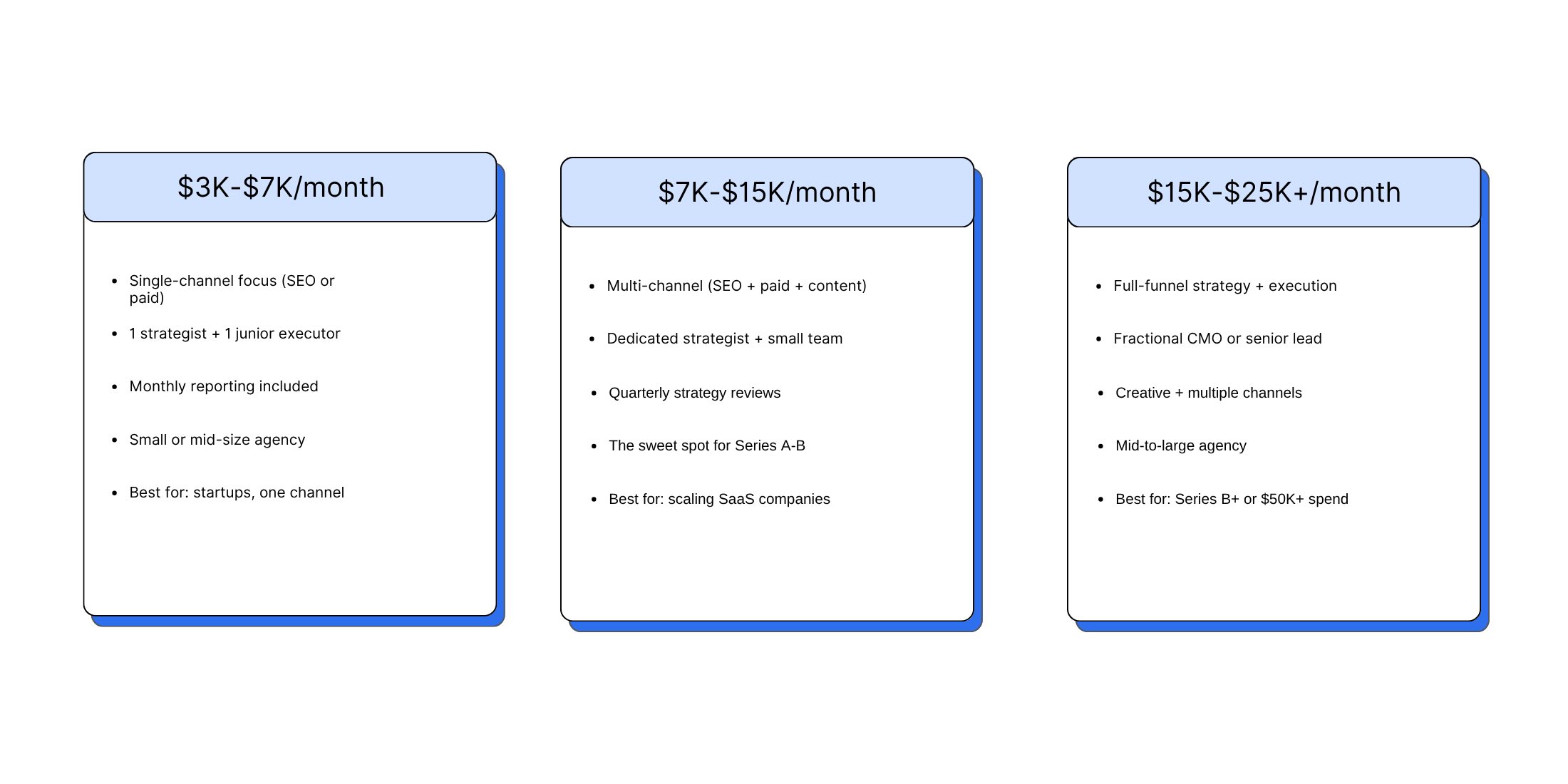
Most SaaS marketing agencies work on monthly retainers. The tiers break down roughly like this:
$3,000-$7,000/month: You're getting a focused service (SEO only, content only, or paid media only) from a small or mid-size agency. Expect one primary strategist and a junior executor. Good for startups with a clear single-channel need.
$7,000-$15,000/month: Multi-channel execution with a dedicated strategist and small team. This is the sweet spot for Series A-B companies that need SEO, content, and paid working together. You'll get monthly reporting and quarterly strategy reviews.
$15,000-$25,000+/month: Full-funnel SaaS marketing services from a mid-to-large agency. Includes strategy, creative, multiple channels, and usually a fractional CMO or senior strategist leading the account. Appropriate for Series B+ or companies spending $50K+/month on ads.
Project-Based Engagements
Some SaaS branding agency work doesn't fit a retainer model. Positioning sprints, website redesigns, and go-to-market strategy projects are often scoped as fixed-fee engagements.
Typical ranges: $10,000-$30,000 for a positioning sprint (4-8 weeks). $25,000-$75,000 for a full website redesign with conversion optimization. $15,000-$40,000 for a go-to-market strategy engagement. These work best when you need a specific deliverable, not ongoing execution.
Performance-Based and Hybrid Models
Some SaaS marketing agencies offer performance-based pricing, where part of their fee is tied to results (qualified leads, pipeline generated, or revenue influenced). This sounds appealing, but it comes with tradeoffs.
Performance-based agencies tend to optimize for the metric they're compensated on, which can create misalignment. If they're paid per MQL, expect volume over quality. If they're paid on pipeline, they may resist top-of-funnel experiments that don't show immediate attribution.
Hybrid models (lower base retainer + performance bonus) are a reasonable middle ground. Just make sure the attribution model is agreed upon before signing.
The 5-Question Framework for Evaluating Any SaaS Agency
Before you get into proposals and case studies, these five questions will eliminate 80% of bad fits in a single conversation.
Question 1: "What SaaS metrics do you report on, and how do you connect them to revenue?" If they say "impressions, clicks, and traffic," that's a generalist answer. You want to hear MRR impact, pipeline contribution, CAC by channel, and payback period.
Question 2: "Walk me through a campaign you ran for a SaaS company at our stage and ACV." Stage matters. An agency that's great at marketing to SMBs with a $29/month product may struggle with a $100K ACV enterprise sale. The specifics matter more than the brand names in their portfolio.
Question 3: "How do you handle product updates and messaging changes mid-campaign?" SaaS products change fast. You need an agency with processes for rapid iteration, not one that builds a campaign and locks it for six months.
Question 4: "What does onboarding look like, and how much of our time do you need?" Good SaaS marketing agencies are honest about the time investment required. If they say "we handle everything, you just approve," they're either overselling or planning to run a cookie-cutter playbook.
Question 5: "What's your typical client retention, and why do clients leave?" The answer tells you more than any case study. If they dodge this question, that's your answer.
How to Run the Vetting Process Without Wasting Time
You've got your shortlist. Now comes the evaluation phase. Most companies overcomplicate this with lengthy RFPs and multiple rounds of presentations. Here's a faster approach that actually reveals fit.
How to Review Their SaaS Portfolio
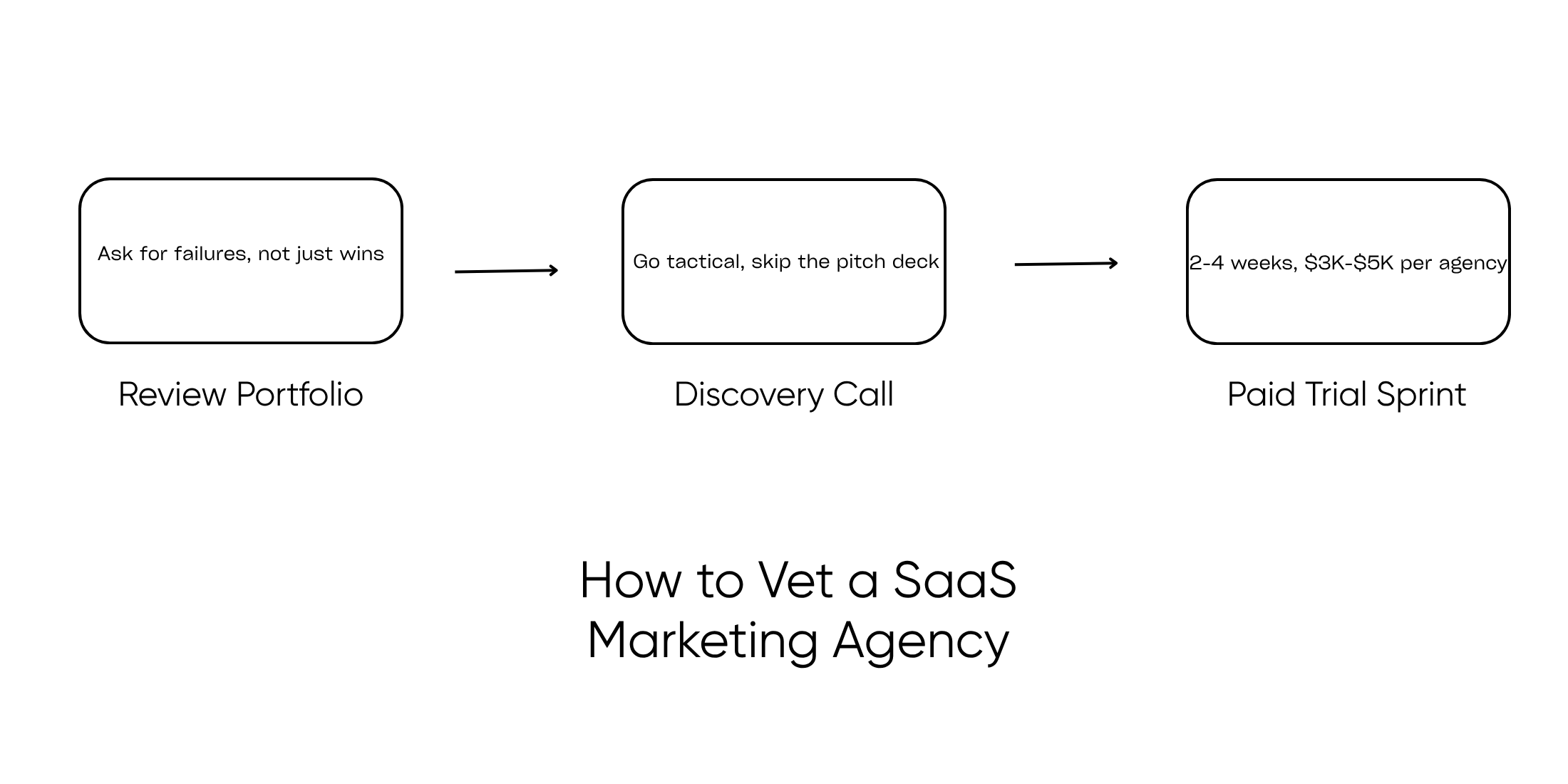
Don't just read case studies on their website. Those are curated highlights. Instead, ask for three specific things: a client reference you can call (not one they pre-arranged), access to a sample reporting dashboard, and a walkthrough of one campaign that didn't hit its targets.
How they talk about failures tells you more than how they talk about wins. An agency that can't articulate what went wrong on a campaign probably doesn't do real post-mortems. Our marketing agencies directory lists SaaS-focused agencies with verified reviews, which can speed up the initial screening phase.
The Right Questions to Ask in a Discovery Call
Skip the generic "tell us about your process" questions. Instead, go tactical. Ask them to audit one of your landing pages live on the call. Give them access to your Google Analytics for 15 minutes before the call and ask what they'd prioritize. Ask them how they'd structure the first 30 days.
Agencies that are genuinely good at SaaS marketing will have sharp, specific opinions. Agencies that just want to close the deal will defer to "we'd need to do a full audit first."
Why a Paid Trial Sprint Beats a Long Proposal Process
Here's an approach more SaaS companies should adopt: instead of choosing an agency based on a proposal deck, pay two finalists for a 2-4 week trial sprint on a specific, measurable project.
Say your conversion rate from trial to paid is stuck at 8%. Give each agency the brief: audit the trial experience, propose three changes, and implement the highest-impact one. Budget $3,000-$5,000 per agency for the sprint.
You'll learn more about their thinking, communication, and execution speed in two weeks than you would from six months of proposals. And the cost is tiny compared to committing to a $10K/month retainer with the wrong partner.
Red Flags That Kill Agency Relationships Early
Knowing what to look for is half the battle. These red flags consistently predict agency relationships that fail within the first six months.
They can't name a single SaaS company they've worked with in the last 12 months. "We work across industries" is code for "we don't specialize."
They promise results in 30-60 days. SaaS marketing, especially SEO and content, takes 3-6 months to show compounding results. Agencies that promise quick wins are either cherry-picking easy metrics or setting you up for disappointment.
They don't ask about your sales process. Marketing and sales alignment is non-negotiable in SaaS. If the agency only wants to talk about top-of-funnel and never asks about your sales cycle, handoff process, or close rates, they're going to generate leads that don't convert.
They resist connecting to your CRM. An agency that won't integrate with HubSpot, Salesforce, or your CRM of choice can't be accountable for downstream revenue. That's a dealbreaker.
They present a "proprietary framework" with no specifics. Every agency has a process. But if they can't explain their approach in plain language and instead hide behind trademarked methodology names, they're selling mystique, not capability.
They call themselves a SaaS branding agency but can't show brand work for a single SaaS company. Labels are cheap. Ask for proof.
Their team structure is opaque. Ask who will actually work on your account. If it's a senior strategist for the pitch and three junior coordinators for the work, you'll feel the difference immediately.
What to Do Next
Choosing the right SaaS marketing agency comes down to three things: verifying SaaS-specific expertise, testing fit through action (not just proposals), and having the discipline to walk away from agencies that talk big but can't get specific.
Start by defining your go-to-market model, your budget range, and the 2-3 channels that matter most. Then use the 5-question framework above to filter your shortlist fast. Run a paid trial sprint with your top 1-2 candidates before committing to a retainer.
If you're building your initial shortlist, browse the top marketing agencies for SaaS companies for a curated, ranked starting point. And when you're ready to compare options side by side, the marketing agencies directory has verified profiles with ratings, specialties, and client reviews.
Frequently Asked Questions
What does a SaaS marketing agency actually do?
A SaaS marketing agency plans and executes marketing campaigns specifically designed for subscription-based software businesses. That includes SEO, paid acquisition, and content marketing alongside product marketing and demand generation. Everything is optimized around SaaS metrics like MRR and CAC rather than generic traffic or lead counts.
How much does it cost to hire a SaaS marketing agency?
Monthly retainers typically range from $3,000 to $25,000+ depending on scope and agency size. Single-channel engagements (SEO only or paid media only) start at the lower end. Full-funnel, multi-channel programs with senior strategy leadership sit at the higher end. Project-based work like positioning sprints or website redesigns usually runs $10,000 to $75,000 as a one-time fee.
What's the difference between a SaaS marketing agency and a regular digital marketing agency?
The core difference is metrics orientation. A regular agency optimizes for traffic, clicks, and leads. A SaaS-focused agency ties everything back to subscription revenue: trial-to-paid conversion, expansion MRR, net revenue retention, and CAC payback period. They also understand SaaS-specific motions like product-led growth and multi-stakeholder enterprise sales cycles.
How long does it take to see results from a SaaS marketing agency?
For paid acquisition, expect initial performance data within 2-4 weeks and meaningful optimization within 60-90 days. For SEO and content marketing, plan for 3-6 months before seeing compounding organic traffic gains. Full-funnel programs usually need 6-9 months to demonstrate clear revenue impact. Any agency promising significant results in 30 days is either cherry-picking easy wins or overpromising.
Can a SaaS marketing agency help with product-led growth?
Yes, but not all of them. PLG requires a specific skill set: optimizing self-serve signup flows, driving activation through onboarding email sequences, building viral loops, and creating content that attracts end-users (not just decision-makers). Ask specifically about PLG experience and look for agencies that have worked with freemium or free-trial models.
Should I hire an agency or build an in-house marketing team for my SaaS?
It depends on your stage and budget. Agencies make sense when you need to scale execution quickly without the overhead of hiring a full team. In-house teams work better when marketing is a core competency you want to own long-term and you have the budget for senior hires. Many SaaS companies do both: an in-house marketing lead who manages one or two specialized agencies.
What SaaS marketing metrics should I expect an agency to report on?
At minimum: pipeline generated, marketing-sourced revenue, CAC by channel, trial or demo conversion rates, and content performance tied to revenue (not just traffic). Strong agencies also report on leading indicators like activation rate, time-to-first-value, and expansion revenue influenced by marketing.
How do I know when it's time to switch SaaS marketing agencies?
Three clear signals: the agency consistently misses agreed-upon KPIs for two or more consecutive quarters, communication has degraded (late reports, missed meetings, no proactive insights), or your business has outgrown their capabilities. Before switching, have a direct conversation about what's not working. Sometimes the fix is restructuring the engagement, not ending it.
Related Articles
How to Hire a Marketing Agency: Complete Decision Guide
Learn how to hire a marketing agency the right way. Our guide covers readiness signals, vetting tactics, and costs to avoid costly mistakes.
SEO Agency for SaaS Companies: A Buyer's Operating Manual
Most SaaS companies hire an SEO agency too early. Here's how to know when you're ready, run the process right, and measure what matters.
Marketing Agency vs In-House Team: The Math Most Companies Get Wrong
Agency vs in-house marketing compared on real costs, AI impact, and when hybrid actually works. Data-backed framework for 2026.
More Insights

What is a Lead Generation Agency? Complete Guide
Discover what a lead generation agency does, how lead generation specialists work, and whether outsourcing lead gen is right for your business in 2026.

Generative AI for Business: What It Actually Does, What It Costs, and Where It Fails
Most generative AI projects fail before production. Here's what the technology actually does, what it costs, and where businesses get real ROI.