
Ecommerce Digital Marketing Agency Red Flags (And What Works)
Five red flags that predict a bad ecommerce digital marketing agency fit, plus what works: pricing, platform matching, and a vetting checklist.


Your ad costs keep climbing every quarter, and the last agency you hired never got past reporting on traffic and impressions. You're staring down a wall of near-identical service pages, each one promising to grow your revenue with the same long list of services. SEO. PPC. Social. Email. Web design. CRO. Somewhere behind that list is a partner who actually understands margin, AOV, and repeat purchase rate. Nothing on the page tells you which one that is.
This guide exists because almost everything written about hiring an ecommerce digital marketing agency comes from the agencies themselves, not from an outside read on what actually works. What follows names the specific warning signs that predict a bad fit and describes what a genuinely capable partner looks like instead. Once you know what to look for, you can browse the marketing agencies directory with a sharper eye.
In this guide, you'll get five concrete red flags that should make you walk away from an ecommerce digital marketing agency. You'll also get a platform-by-platform breakdown for Shopify-first and marketplace-heavy sellers, plus a short vetting checklist you can run in your next sales call.
TL;DR
- An ecommerce digital marketing agency is built around checkout conversion and repeat purchase, not lead forms, so it needs a different channel mix than a generalist digital marketing agency.
- The biggest red flag is a service menu with seven or more items. Agencies that promise to do everything rarely do anything at a senior level.
- Narrow specialists, usually two or three tightly paired channels, tend to outperform generalist "full-service" shops for ecommerce brands.
- Watch for vanity-metric reporting and cookie-cutter case studies.
- Also watch for weak platform expertise and retainers with no exit clause.
- Pricing in 2026 runs anywhere from $2.5K to $25K or more a month depending on scope. The pricing structure itself can be a red flag if there's no spend cap.
Ecommerce Marketing Is Not Generic Digital Marketing
An ecommerce digital marketing agency has one job a generalist agency doesn't: turning storefront traffic into checkout completions and repeat customers, not filling out lead forms.
An ecommerce digital marketing agency exists to solve a different problem than the agency running lead-gen campaigns for a B2B software company. A lead-gen agency measures success in form fills and sales-qualified leads that get handed to a sales team. An ecommerce marketing agency measures success in checkout completions, average order value, and repeat purchase rate within 90 days. Those are different funnels with different KPIs and different skill sets, even though both agencies might call themselves "digital marketing."
Ecommerce marketing typically covers SEO and paid media tuned for transactional intent, not lead generation. It also includes retention through email and SMS, conversion rate optimization on the storefront, and marketplace management on channels like Amazon and Walmart. A generalist agency used to B2B lead-gen work often applies the wrong playbook here: gated content and long nurture sequences that don't map to a checkout decision made in under five minutes. If your last agency pitched itself as a general performance marketing agency and never mentioned AOV or repeat purchase rate, that's often the first sign of a mismatch.
Margin, inventory cycles, and seasonality change the math too. A campaign that drives revenue at a thin margin during your slowest month can hurt cash flow even while the dashboard looks great. Later in this guide, you'll see why the right partner also depends on whether you're Shopify-first or marketplace-heavy.
The Biggest Red Flag: An Agency That Does Everything
The single biggest warning sign when you're evaluating an ecommerce digital marketing agency is a service menu with seven or more items under one roof, everything from SEO and PPC to web design and graphic design.
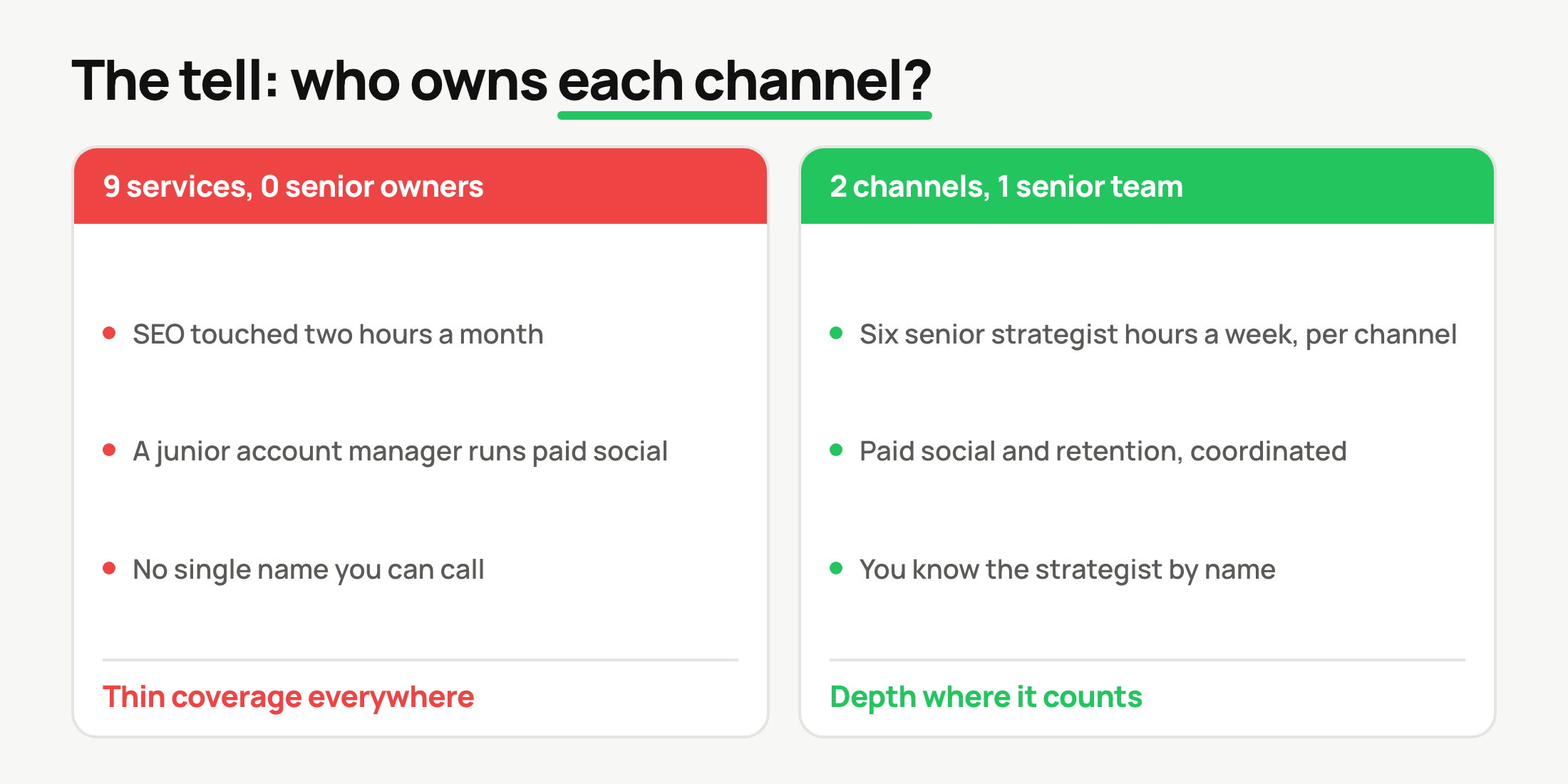
It sounds reassuring. One point of contact, one invoice, "full-service" convenience. But ask a basic question in the sales call: who, specifically, owns SEO day-to-day? If the answer is a name you'll never talk to, or just "the whole team collaborates," you've found the tell. A shop offering nine services with a team of twelve people has, at best, one senior person per channel. Often, it has none.
Why "Full-Service" Sounds Reassuring But Rarely Is
Senior talent is expensive and scarce. An agency that spreads its best people across nine disciplines is making a staffing bet, not a strategy. You end up with a junior account manager running your paid social while your SEO gets touched for two hours a month by someone who also handles three other clients' web design. The pitch deck says "full-service." What you actually get is thin coverage everywhere and depth nowhere.
This is exactly the pattern across most ecommerce digital marketing agency landing pages: a long grid of service icons, a handful of client logos, and no detail on who actually does the work. Compare that to a narrow ecommerce SEO specialist like Coalition Technologies or OuterBox, both of which built their reputation around one or two disciplines instead of trying to be everything to every client.
When a Broader Mix Actually Makes Sense
There's an honest exception. Picture a brand running aggressive, tightly coordinated paid acquisition alongside a retention program. The same team needs to see both sides of the funnel in real time to know when to shift budget. That brand can genuinely benefit from one agency handling both channels. The difference is scope, not scale: two coordinated channels under one roof is a reasonable ask. Nine unrelated services is a staffing problem wearing a sales pitch.
Why Narrow Specialists Tend to Outperform Generalists
The math behind specialization is simple: fewer channels means more senior hours per channel for the same monthly retainer.
Picture two agencies, both charging $8,000 a month. Agency A offers nine services and spreads that budget, and its people, across all of them. Agency B offers two: paid social and retention. Agency B can put its senior strategist on your account for six hours a week instead of ninety minutes split across three disciplines. That's not a philosophy. It's arithmetic.
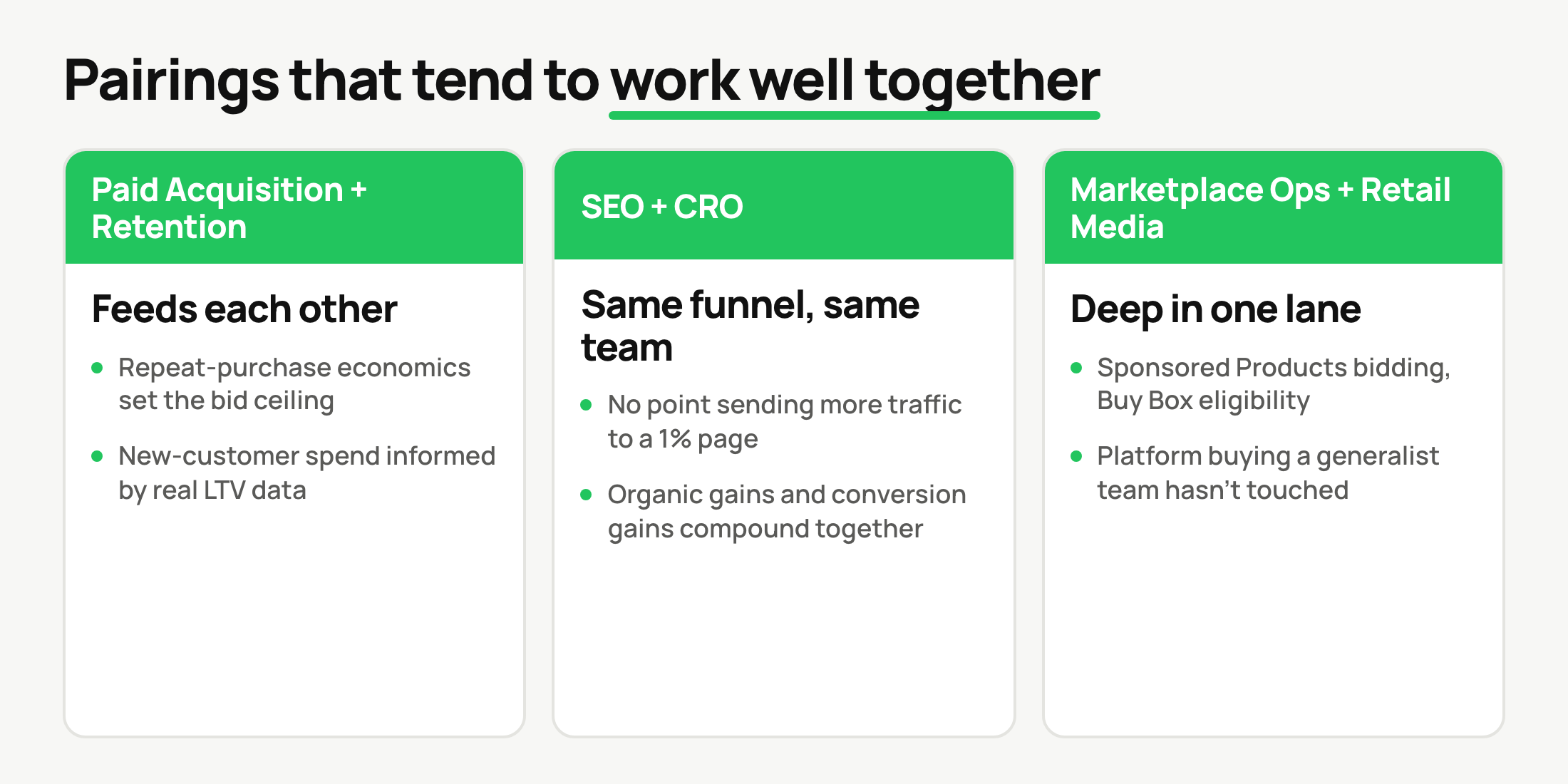
The pairings that tend to work best for ecommerce brands aren't random. Paid acquisition plus retention makes sense because the two feed each other: you need to know your repeat-purchase economics before you can decide how aggressively to bid on new customers. SEO plus CRO makes sense because there's no point driving more organic traffic to a product page that converts at 1%. Marketplace operations plus retail media makes sense because Amazon and Walmart require platform-specific ad buying that a generalist paid-search team usually hasn't touched. An ecommerce marketing agency built around one of these pairings will typically out-execute a shop juggling nine. You can see this play out in a three-way comparison of ecommerce-focused agencies that specialize rather than generalize.
Still, the opposite extreme is its own trap. Hiring seven disconnected point solutions instead of one focused pair creates the same coordination problem from a different angle. A separate vendor for SEO, email, and paid social means nobody owns the full funnel. Nobody is watching how a lift in paid traffic affects your email deliverability or how a CRO test interacts with your SEO metadata. The goal isn't the fewest vendors possible. It's the fewest vendors who still cover your actual growth bottleneck without gaps.
More Red Flags Worth Walking Away From
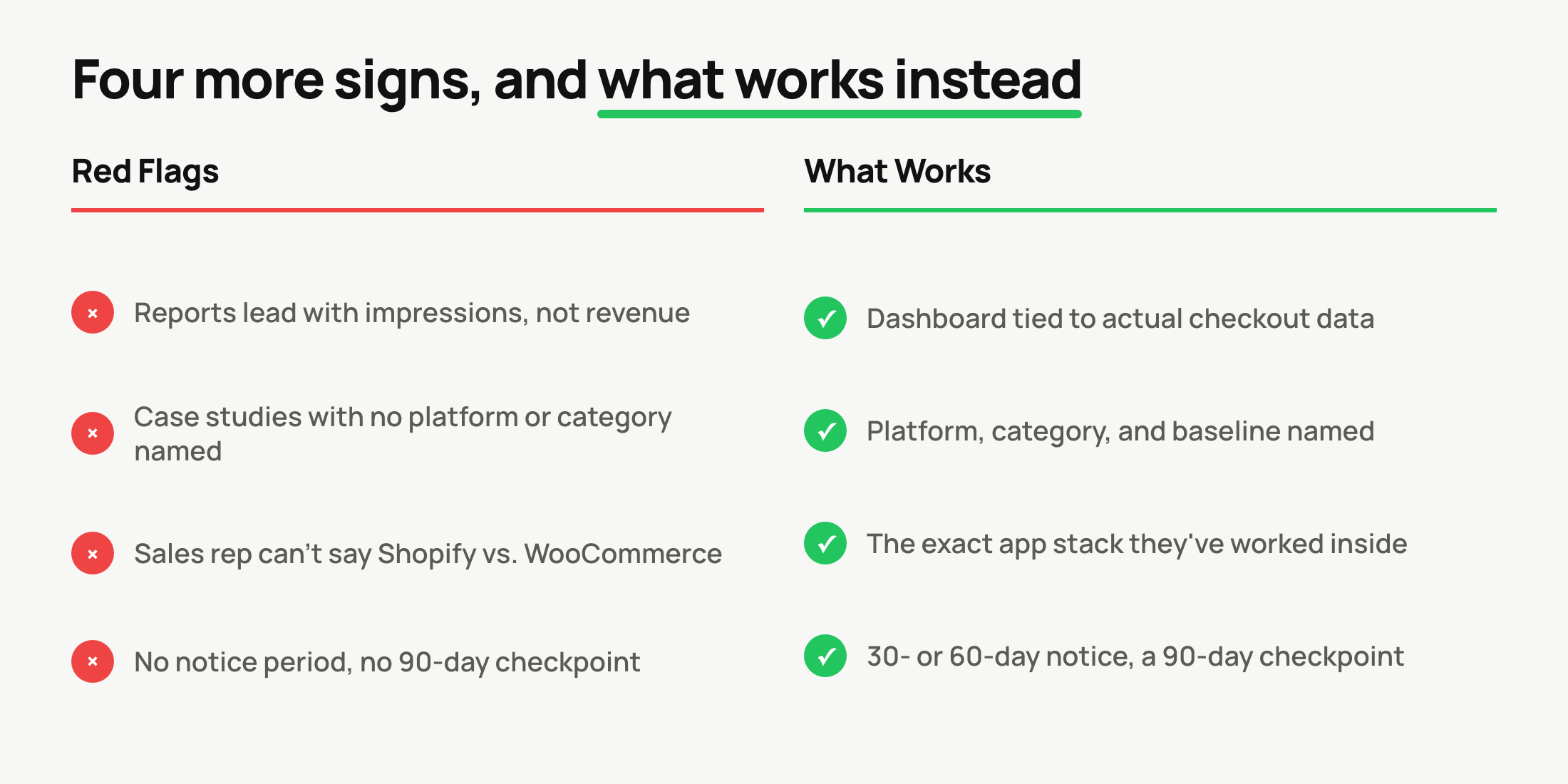
Beyond the service-list problem, four other patterns predict a bad fit before you've spent a dollar.
Vague or Vanity-Metric Reporting
If your monthly report leads with impressions and reach instead of revenue and margin, you're being sold activity, not results. Ask what an ecommerce digital marketing agency will report by week two, and if the answer doesn't include revenue attribution, walk. What this should look like instead: a dashboard tied to actual checkout data, not platform-reported clicks.
Cookie-Cutter Case Studies
Case studies that could belong to any brand in any category are a tell. If a "we grew revenue by X%" claim doesn't name the platform or product category, it likely wasn't specific to ecommerce at all. Legitimate ecommerce marketing agencies name the platform, the category, and the starting baseline. Shopify's own breakdown of what ecommerce marketing actually involves is a useful gut check for whether a case study describes real work or just fills space.
No Real Shopify or Platform Expertise
A sales rep who can't tell you which of their case studies ran on Shopify versus WooCommerce versus a custom cart hasn't actually worked the platform-specific constraints that matter: app conflicts, theme limitations, checkout customization rules. If you're shopping specifically for a Shopify marketing agency, ask for the exact app stack they've worked inside, not just a client logo.
Retainers With No Exit Clause
A contract with no defined off-ramp, no 30- or 60-day notice period, and no performance checkpoint at 90 days puts all the risk on you. A confident agency will build a review point into the contract because it expects to earn the renewal, not lock you into one.
Matching the Agency to Your Platform
The right ecommerce digital marketing agency for a Shopify store selling through one channel looks nothing like the right one for a brand selling across five marketplaces.
Shopify-First Brands
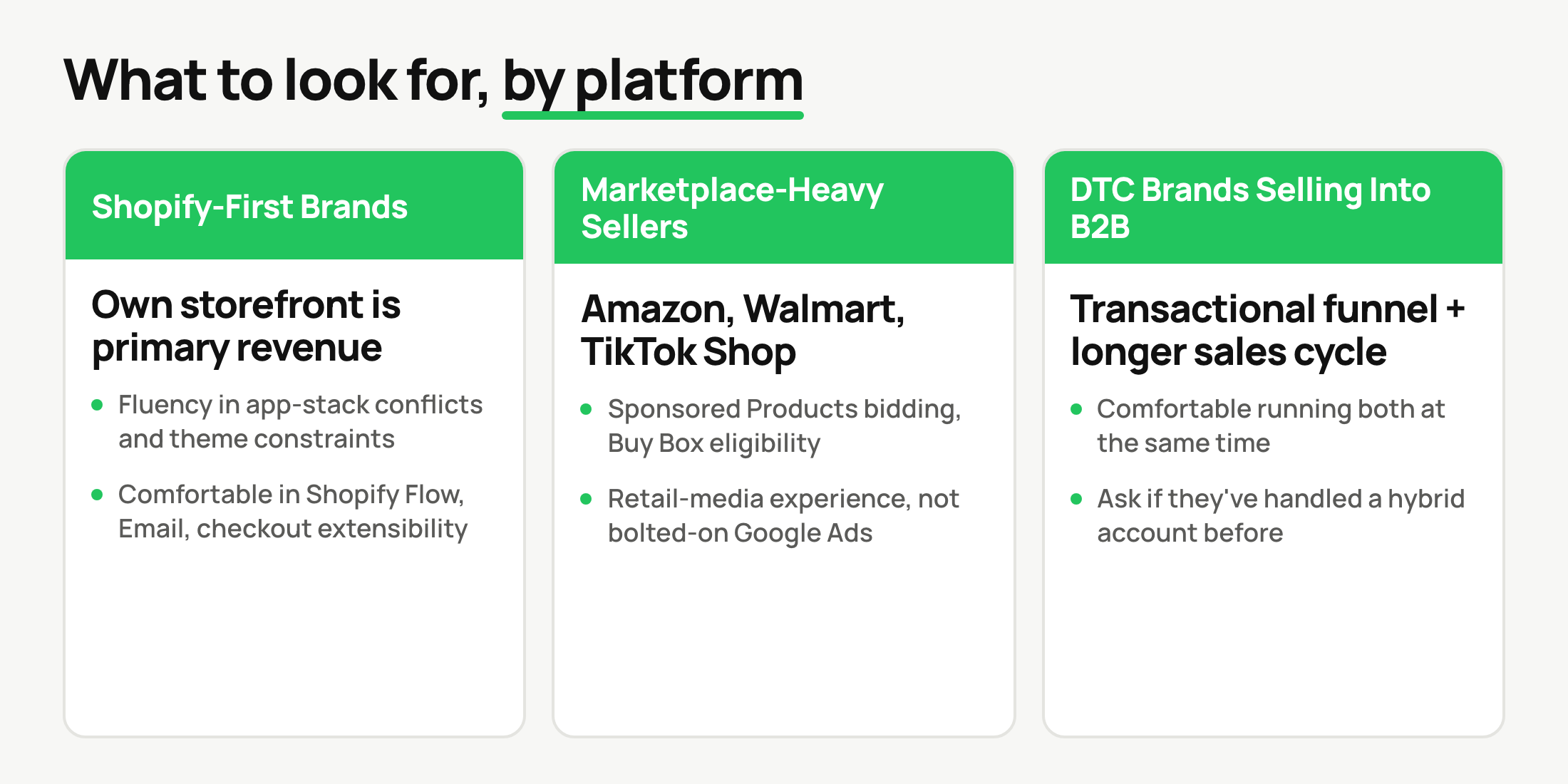
If most of your revenue runs through your own Shopify storefront, you need a Shopify marketing agency, not a generalist. Look for real fluency in app-stack conflicts, theme constraints, and checkout customization. A team that's comfortable in Shopify-native tools (Shopify Flow, Shopify Email, checkout extensibility) will move faster than one relearning the platform on your dime. Shopify's own guidance on evaluating outside marketing help is a reasonable starting checklist before you take a sales call.
Marketplace-Heavy Sellers (Amazon, Walmart, TikTok Shop)
Revenue from Amazon, Walmart, or TikTok Shop needs retail-media and marketplace-ops experience distinct from owned-site SEO and PPC. Bidding on Amazon Sponsored Products, managing Buy Box eligibility, and running TikTok Shop affiliate programs are specialized disciplines. Retail-media specialists like Tinuiti typically outperform a generalist shop bolting Amazon ads onto a Google Ads retainer. That's the kind of focused ecommerce growth agency this section is about: deep in one lane instead of spread across many.
DTC Brands Selling Into B2B
A hybrid brand selling direct-to-consumer and wholesale or B2B needs an agency comfortable running a transactional funnel and a longer sales cycle at the same time, without treating the B2B side like an afterthought. This is a narrower slice of the market, and fewer agencies do it well. Ask directly whether they've handled a hybrid account before, not just DTC or just B2B alone.
What Ecommerce Agencies Actually Charge
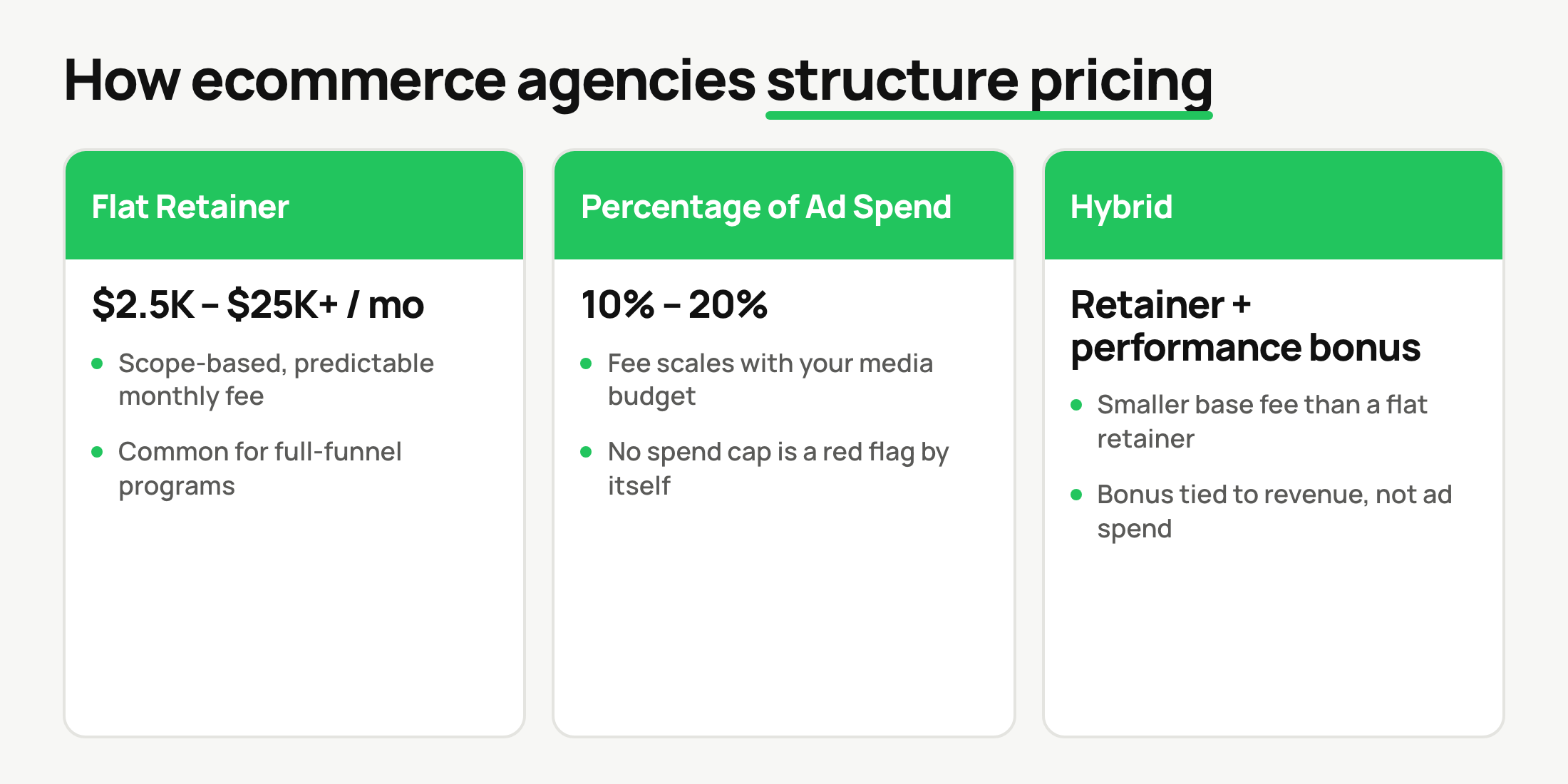
Pricing for an ecommerce digital marketing agency in 2026 runs anywhere from $2.5K a month for a narrow, single-channel retainer to $25K or more for a full-funnel engagement on a scaling brand.
Percentage-of-Ad-Spend vs. Flat Retainers
Most agencies use one of three structures: a flat monthly retainer, a percentage of ad spend (commonly 10-20%), or a hybrid of a smaller retainer plus a performance bonus tied to revenue. A small DTC brand spending $15K a month on ads might pay $1.5K to $3K under a percentage model. A $10M+ scaling brand running a full-funnel program across SEO, paid, and retention can reasonably expect to pay $10K to $25K or more a month. These are ranges, not quotes, since scope varies by brand.
Pricing Structures That Signal Trouble
A percentage-of-ad-spend model with no cap is a red flag by itself: it rewards the agency for spending more regardless of return, which is the opposite incentive you want. Ask whether there's a ceiling, and ask what happens to the fee if you need to cut spend during a slow season. A digital marketing agency for a small business may offer simpler flat-fee tiers precisely because percentage models don't make sense at lower spend levels, worth comparing if you're earlier-stage.
A Short Vetting Checklist Before You Sign
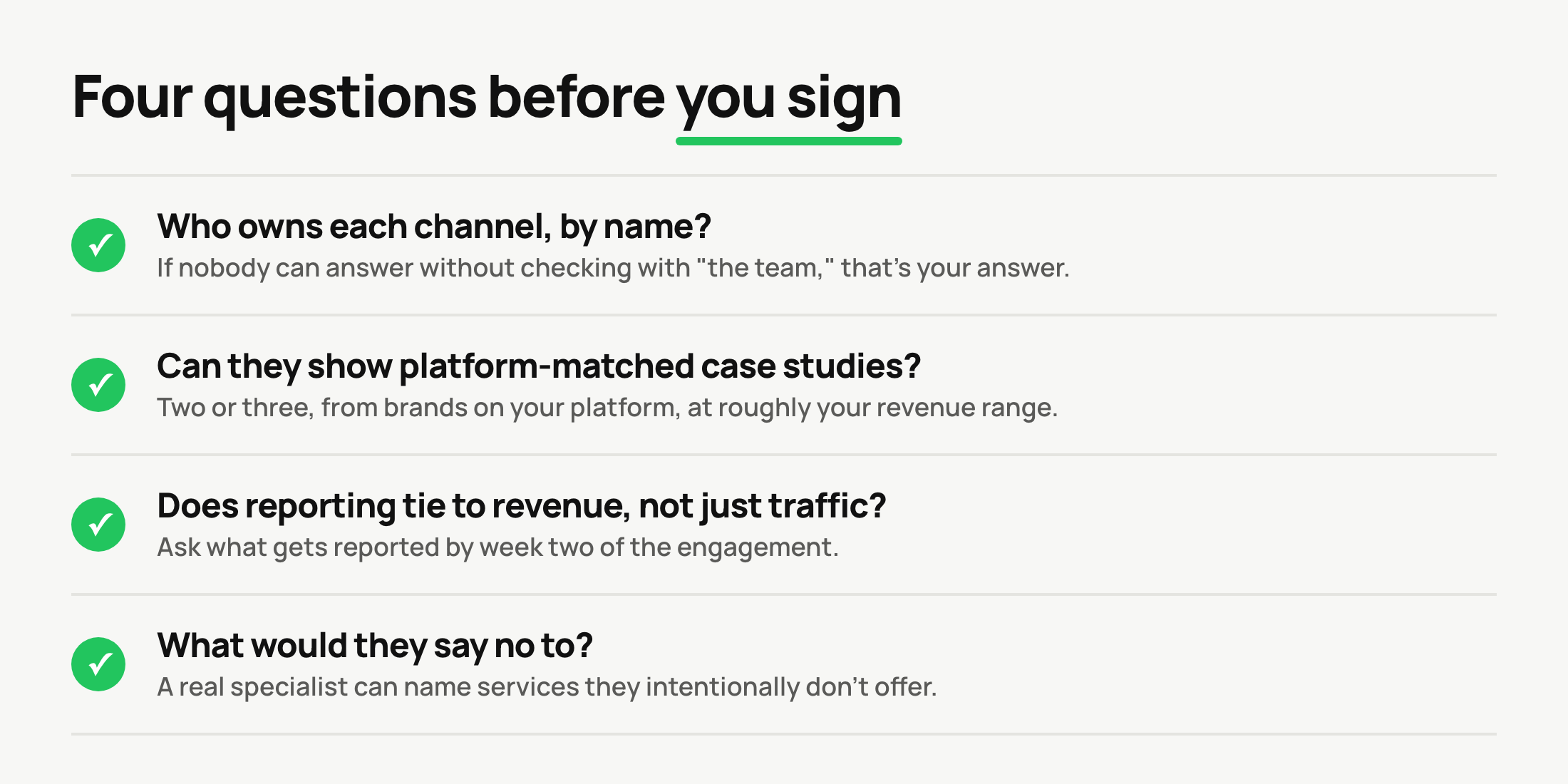
There's no single best ecommerce digital marketing agency for every brand. The right fit depends on platform and channel mix, but these five questions apply no matter who you're evaluating.
- Who owns each channel, by name? If nobody can answer without checking with "the team," that's your answer.
- Can you show two or three case studies from brands on my platform, at roughly my revenue range? Logos alone don't count.
- How does reporting tie back to revenue and margin, not just traffic or impressions?
- What's the exit clause, and how much notice do I need to give?
- What would you say no to? A real specialist can name services they intentionally don't offer.
That last question does more work than the rest combined. Most agencies will happily nod along to whatever you ask for, because saying yes to everything is how they fill a twelve-service menu in the first place. An agency that says "we don't do web design, we'll refer you out" has already told you more about how it operates than an hour of case studies would.
The Bottom Line
A long service list feels reassuring, but it's usually the opposite: a sign that no one on the team owns your channels at a senior level. The ecommerce digital marketing agency worth hiring is usually narrow, two or three channels done well. The right match also depends on your platform: Shopify-first, marketplace-heavy, or a DTC-B2B hybrid. Watch the red flags covered here: vague reporting, generic case studies, and open-ended retainers with no exit clause. Ask about pricing structure before scope, not after.
If you're ready to shortlist a Shopify marketing agency or a broader ecommerce marketing agency, the marketing agencies directory is a good place to start comparing candidates side by side.
Frequently Asked Questions
What is an ecommerce digital marketing agency, exactly?
An ecommerce digital marketing agency is a firm built around transactional storefronts, not lead-generation funnels. It doesn't count form fills. It tracks checkout completions, average order value, and repeat purchase rate. Channels typically span SEO, paid social, and email/SMS retention. Marketplace management often factors in too. A generalist agency applying a B2B lead-gen playbook (gated content, long nurture sequences) doesn't map to a five-minute checkout decision.
How much does a digital marketing agency cost for an ecommerce brand?
Expect one of three structures: a flat retainer, a percentage of ad spend (commonly 10-20%), or a hybrid of both. Smaller DTC brands often pay $1.5K to $5K a month. Brands scaling past $10M in revenue with full-funnel programs can pay $10K to $25K or more. A percentage-of-spend deal with no cap is itself a red flag worth asking about before signing.
Is it worth it to hire a Shopify expert or agency instead of a generalist?
Usually, yes, if most of your revenue runs through your own store. A Shopify-fluent partner understands app-stack conflicts, theme constraints, and checkout customization that a generalist bolting ecommerce onto a broader service list typically hasn't touched. The tradeoff shows up fastest in launch speed: a specialist can often ship a checkout change in 2-3 days instead of the 2-3 weeks a generalist team needs to learn the platform.
How much does it cost to hire a Shopify marketing agency specifically?
A Shopify marketing agency often prices similarly to a general ecommerce marketing agency. Narrower engagements (CRO-only or retention-only) tend to run cheaper, sometimes $1K to $3K a month. That's because they aren't bundling unrelated services into the retainer. That narrower scope is usually a feature, not a limitation: you're paying for depth in one or two channels instead of shallow coverage across seven.
What services should actually be included in an ecommerce marketing retainer?
The right services are the two or three that map to your actual growth bottleneck, not the longest list an agency can pitch. If your traffic is fine but conversion is weak, you need CRO and possibly paid social retargeting, not five additional channels. If retention is your gap, prioritize email and SMS over adding a second paid channel. A focused set of services usually outperforms a nine-item menu.
How long does it take to see results from an ecommerce marketing agency?
It depends on the channel. Paid acquisition can show signal within 2-4 weeks. SEO and retention programs typically need 2-3 months before results are durable enough to judge. Be skeptical of any agency promising fast wins across every channel at once. That's often the same "does everything" red flag, just showing up in the sales pitch instead of the service list.
How do I know if an agency is actually driving revenue, not just traffic or impressions?
Ask for reporting tied to checkout data, not platform-reported clicks. A legitimate partner can show revenue attribution by channel within the first 30 days of the engagement, even if the volume is still small. If your reports still lead with impressions or reach two months in, that's the vanity-metric red flag covered earlier. Raise it directly before renewal.
What if I've already had a bad experience with a generalist agency?
A prior bad fit is usually a full-service mismatch problem, not proof that outside help doesn't work. If your last agency offered seven or more services and never mentioned AOV or repeat purchase rate, that's the pattern this guide walks through, not a reason to write off agencies altogether. Run the vetting checklist above before the next contract, and look for a narrower specialist this time.
Should I hire one full-service agency or separate specialists for different channels?
Neither extreme works well. One generalist agency covering nine services usually means shallow coverage everywhere; seven disconnected point solutions means nobody owns your full funnel. The best ecommerce digital marketing agency setup for most brands pairs two or three specialists who talk to each other regularly, paid plus retention, or SEO plus CRO.
Top Marketing Agencies in 2026
Ranked by our editorial score across 1,462 listed marketing agencies.


Related Articles
Digital Marketing Agency for Small Business: 3 Service Tiers
A digital marketing agency for small business runs $500 to $25,000 a month. The 3 service tiers, what each buys, and when each stops making sense.
What a Performance Marketing Agency Is vs PPC or Growth
A performance marketing agency is paid for incrementality and MER, not last-click ROAS. How it differs from PPC or growth, plus a 30-day proof.
Best Content Marketing Agencies: How to Pick the Right Type
Learn to identify the four types of content marketing agencies and match the right one to your content maturity, budget, and business goals.
How to Choose a Marketing Agency: What Actually Matters
Learn how to choose a marketing agency that fits your goals and budget. Covers evaluation criteria, pricing models, red flags, and a pre-hire checklist.
More Insights

Top Healthcare Software Development Companies for Every Specialty
Find top healthcare software development companies by specialty: EHR integration, telehealth, FDA-regulated devices, and patient engagement apps compared.

What is a Lead Generation Agency? Complete Guide
Discover what a lead generation agency does, how lead generation specialists work, and whether outsourcing lead gen is right for your business in 2026.