
What a Performance Marketing Agency Is vs PPC or Growth
A performance marketing agency is paid for incrementality and MER, not last-click ROAS. How it differs from PPC or growth, plus a 30-day proof.


You've already been burned by a retainer labeled "performance" that lived in last-click dashboards. CAC is up. The weekly PDF still looks healthy while pipeline or MER doesn't move. Now every new pitch sells you the same scoreboard, and you're the one who has to explain it to finance. A wrong retainer labeled performance can burn a quarter of budget before you've even run a real test.
Vendor listicles still own this search, and they rank themselves first. This article exists so you can hire a performance marketing agency with a real filter instead of another catalog. Use the marketing agencies directory when you're ready to inspect live profiles, not a self-ranked shortlist.
This guide walks you through a three-way taxonomy, a filter for "performance-based" stickers, and a 30-day proof you can write into the contract before you sign. You'll leave knowing whether you even need the hire.
TL;DR
- A performance marketing agency is accountable for lift and unit economics. Running the ads is the easy part of the brief.
- A PPC shop buys media and stops at platform CPA or ROAS. A growth agency owns a wider funnel (product, lifecycle, experiments) and may not live in paid.
- "Performance-based" on a homepage is often a sticker on a retainer. Pay-for-results can be riskier when the agency owns the attribution window.
- Vet incrementality, creative throughput after fatigue, and CRM/RevOps access. Last-click ROAS in a pitch deck is theater.
- Don't trust a self-ranked top-18. Shortlist from the directory and side-by-side comparisons instead.
The Mandate a Performance Marketing Agency Is Paid to Own
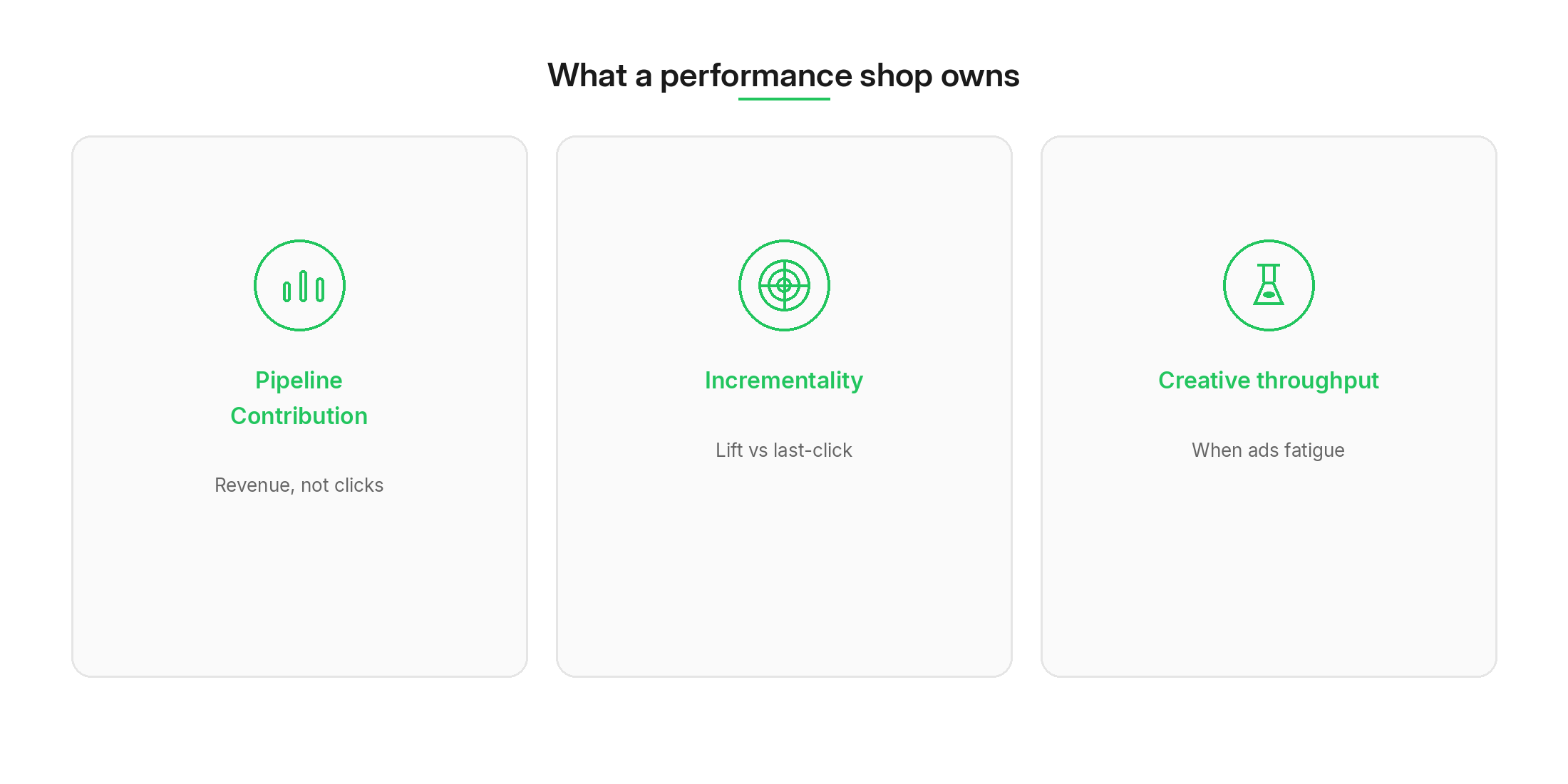
A performance marketing agency is a paid-media operator with a measurement loop and a creative-testing loop. You hold it to business results, not to whether someone logged into Google Ads this morning. That's the definition the title asked for. Hold it against every capabilities slide you see.
A generic digital marketing agency will also sell SEO, organic social, and brand. Fine. Different mandate. Performance work starts in the auctions and ends in a number your CFO will sign. Pipeline for B2B. MER (marketing efficiency ratio: revenue divided by marketing spend) for a blended view. Contribution margin when media is eating product profit. Incremental conversions when branded search is stealing credit. Platform ROAS is a diagnostic. It isn't the scoreboard.
Metadata's B2B writeup frames the same job as analytics into sales workflows, targeting, and ad-spend management. That's the SaaS flavor. M+C Saatchi's Los Angeles page sells the paid-search flavor plus optional influencer and creator work. Treat creator as optional. Don't treat it as universal.
The process skeleton is boring on purpose. Audit the account. Build campaigns. Add negatives. Fix landing pages. Set a budget. Report against a pre-agreed business metric. If a pitch skips tracking or creative testing, you're buying a media assistant.
If you need the adjacent-type explainer for brand shops, read marketing agency vs advertising agency. Advertising isn't this article's job.
Which channels sit in the brief?
Paid search and paid social sit in the core. That's the usual performance marketing services bundle. Google Ads and Microsoft Ads. Meta. Sometimes LinkedIn or TikTok. Conversion tracking and audience tests travel with that bundle. Offer tests and landing-page CRO (conversion-rate optimization) usually do too. Influencer and creator media can sit in the mix. They don't have to.
What they don't automatically own: brand strategy and TV. Out-of-home and organic social calendars sit elsewhere. So does full-funnel product growth. Those belong to other hires. A performance marketing agency in USA pitches will still try to stretch into all of them. Ask what they actually staff. Ask who is on the account on Tuesday, not who is on the website.
Think of the brief like a kitchen ticket. Paid search and paid social are the dish. Tracking and tests come with it. Brand films and a six-month organic calendar are a different restaurant.
Which numbers is the agency actually on the hook for?
M+C lists CPA and ROAS as KPIs. Retention, LTV, and incremental lift sit on the same list. Decode that. CPA (cost per acquisition) and ROAS (return on ad spend) are platform-easy. Retention and LTV (lifetime value) need CRM access and time. So does incremental lift. If the SOW only names in-platform ROAS, the shop is on the hook for a dashboard that can't lose.
Ask which number they will defend in month two. Pipeline for B2B. MER or contribution margin for ecommerce. Incremental new-customer purchases if branded search is soaking the report. Pick one primary. Secondary diagnostics can live in the appendix. If they won't pick, they want the metric that moves after the fact.
Where a PPC Shop Stops and a Growth Agency Starts
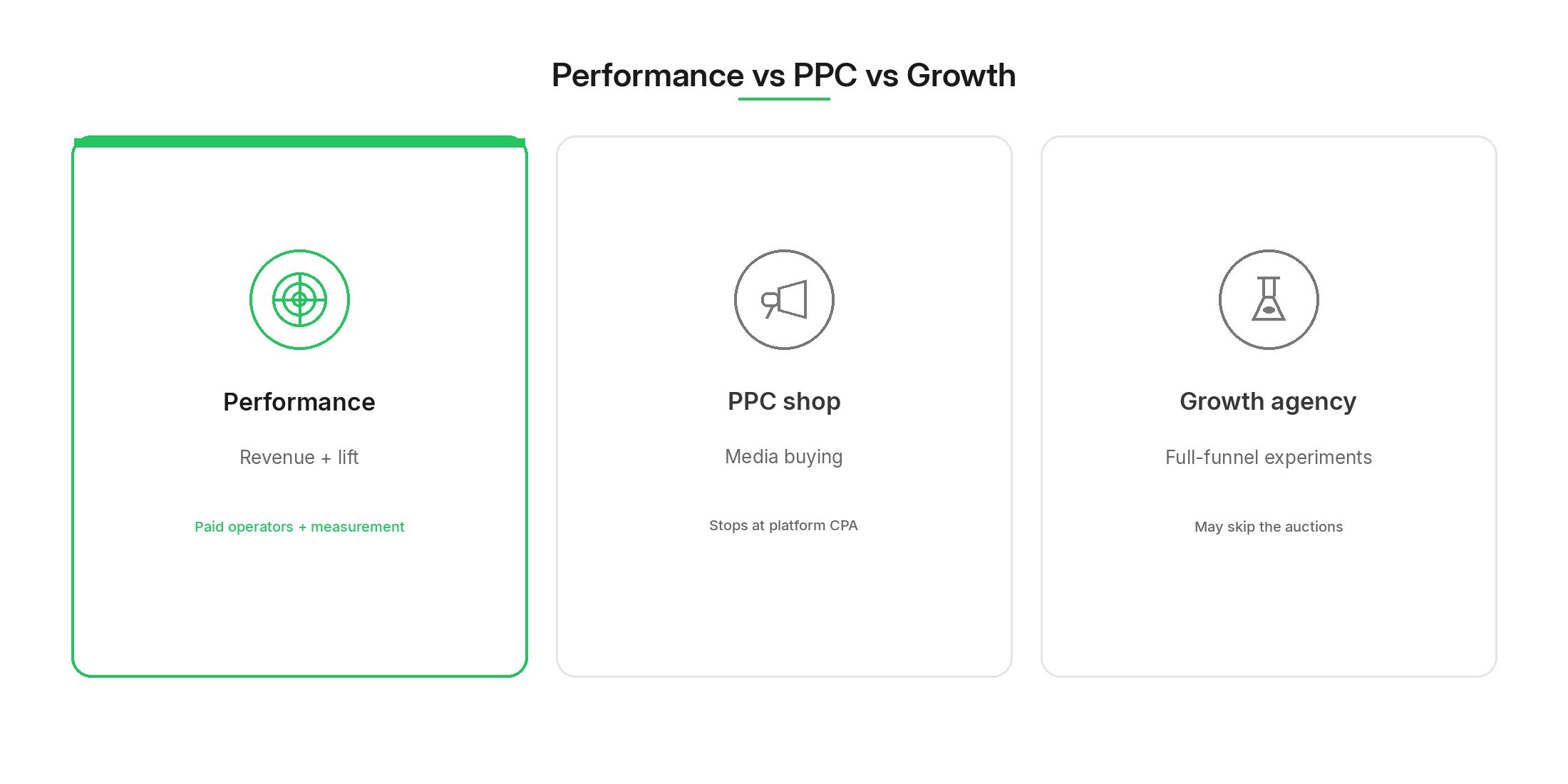
The failure mode isn't "PPC is bad" or "growth is fake." It's buying the wrong label. A performance marketing agency owns revenue and incrementality across paid channels. Creative testing and measurement sit in-scope. Success language is MER or contribution margin. Pipeline or incremental conversions also count. The other two models are the right hire for someone else.
| Performance shop | PPC shop | Growth agency | |
|---|---|---|---|
| Who you hire | Paid operators plus measurement | Media buyers | Experimenters across the funnel |
| What they optimize | MER and lift | Platform CPA | Activation and retention |
| Where they stop | Brand TV and organic calendars | Strategy you already own | May skip the auctions |
| Typical buyer | US brand that already spends | In-house team with a brief | Bottleneck isn't only media |
Treat Wpromote and Tinuiti as performance marketing agency examples of the category. Add Directive, Disruptive Advertising, and Power Digital to that same set. They show up on public shortlists and in the directory. Those names are performance marketing agency examples, not a ranking. We won't order them. If you want a head-to-head, use Directive vs Disruptive Advertising and Power Digital vs Directive. A performance marketing agency list that ranks the publisher first is a brochure.
There is no honest best performance marketing agency ranking on this SERP. Directive puts itself first. Darkroom puts itself first. Eight Oh Two puts itself first. Read them as catalogs. Don't read them as judges.
How is a PPC shop different in practice?
A PPC shop lives in Google Ads and Microsoft Advertising. Sometimes Meta. The work is bids and queries. Negatives, feed hygiene, and landing-page notes sit next to that. It stops at platform CPA or ROAS and "account hygiene." That's useful when you already own strategy, creative, and measurement. You need a buyer, not a revenue operator.
Picture an in-house media lead who already writes the brief and already owns pixels. They don't need a "performance" wrapper. They need someone who will mine queries at 8 a.m. If that's you, start with the B2B PPC agency shortlist for startups and SaaS. Don't hire a performance shop to do account hygiene.
What does a growth agency own that a performance shop does not?
A growth agency works a wider surface. Onboarding and lifecycle email. Pricing experiments and SEO. Sometimes paid as one lever. Reddit's r/DigitalMarketing thread titled "Need a Performance Based Marketing Agency (I think)" is proof buyers say "performance-based" when they mean a growth partner. The page itself returned 403 when we tried to read comments. The title is enough.
A growth shop can be the right hire and still not be a performance marketing agency. Performance marketing services stay inside paid media and tracking. Creative tests and landing pages sit in the same bundle. Growth services wander into the product. If your bottleneck is activation or payback, don't buy more ad accounts. Buy experiments that sit after the click.
Where does an advertising agency still belong?
An advertising agency still belongs on brand campaigns, integrated creative, and retainers you score on awareness or brand lift. That's a different market from paid-media incrementality. Don't rebuild that decision here. Use how to find advertising agencies for your budget when the gap is brand, not MER.
Each model is the right hire for someone. Buy the work, not the sticker. If you hire a performance shop to make a Super Bowl-style film, you'll get media math on a brand problem. If you hire an advertising shop to fix contribution margin, you'll get a mood board.
"Performance-Based" Is Usually a Label, Not the Invoice
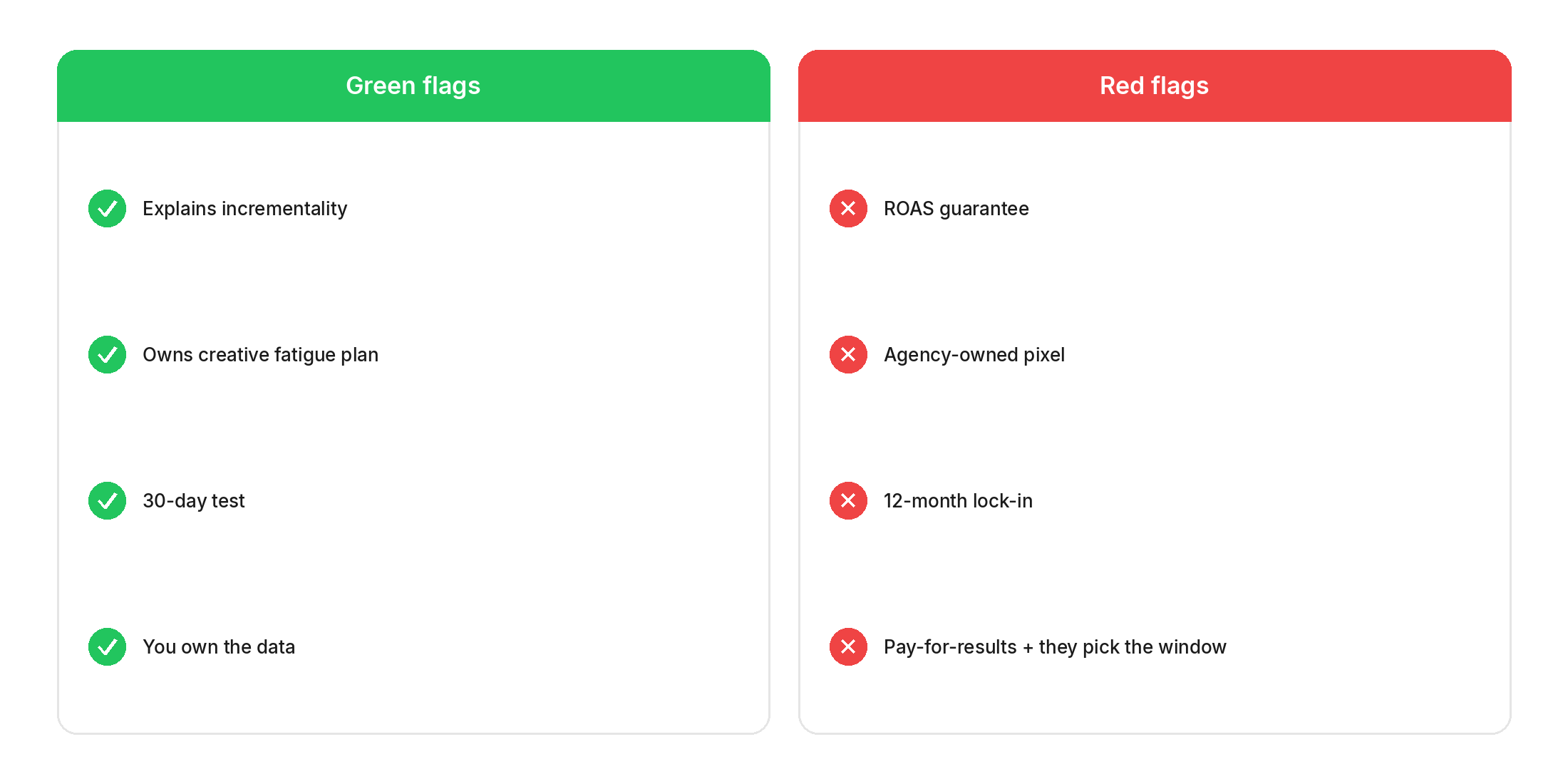
"Performance-based" on a homepage is often a sticker on a retainer. Many firms still bill monthly, optimize to platform ROAS, and call it performance. If they can't explain incrementality or MER, they're a media buyer in a performance costume. Same if they can't explain contribution margin or what they do when creative fatigues.
You're allowed to feel naive in the pitch. A prior glossy deck probably trained that reflex. Ask for the contract exhibit. Skip the case-study reel until the fee mechanics are on one page.
Darkroom's useful anti-sticker test is simple: ask for one recent win they can causally defend. Not a ROAS screenshot. Their 2026 shortlist even weights commerce fluency and creative OS. Measurement and team model sit on the same scorecard. Steal the scorecard. You don't have to hire them.
Once you strip the label, what actually matters in choosing a marketing agency is the same boring stack. Measurement. Access. Commercial alignment.
Why "performance-based" rarely describes the fee
The phrase sounds like you pay for results. In practice the invoice is still a retainer, a percent of media, or a hybrid. The "performance" part is a bonus rider or a homepage adjective. We won't invent a percentage of shops that still bill retainers. The pattern is qualitative and loud.
Picture a deck that says "we're aligned with your outcomes." Then the SOW bills a flat monthly fee regardless of MER. That's not alignment. That's rent. Ask them to walk the fee on a whiteboard. If they can't, the homepage did the selling.
Why pay-for-results can be riskier than a retainer
Pay-for-results can be more dangerous than a retainer when the agency controls the attribution window, the converting keyword set, or the CRM definitions that mint the bonus. They're grading their own exam.
Say your SaaS team is about to sign a CPA-share. The shop also sets the Salesforce stage that counts as a "qualified" opportunity. Every extra stage they loosen prints money for them. A clean retainer with a holdout test and a kill-clause can be the more performance-aligned commercial model. You keep the definitions. They keep the work. You do not want the vendor writing the rubric they get paid on.
What US Shops Charge Once You Peel Off the Sticker
A performance marketing agency in USA almost never publishes a single public rate card for media management. What they will describe, if you push, is the commercial structure. Four shapes show up.
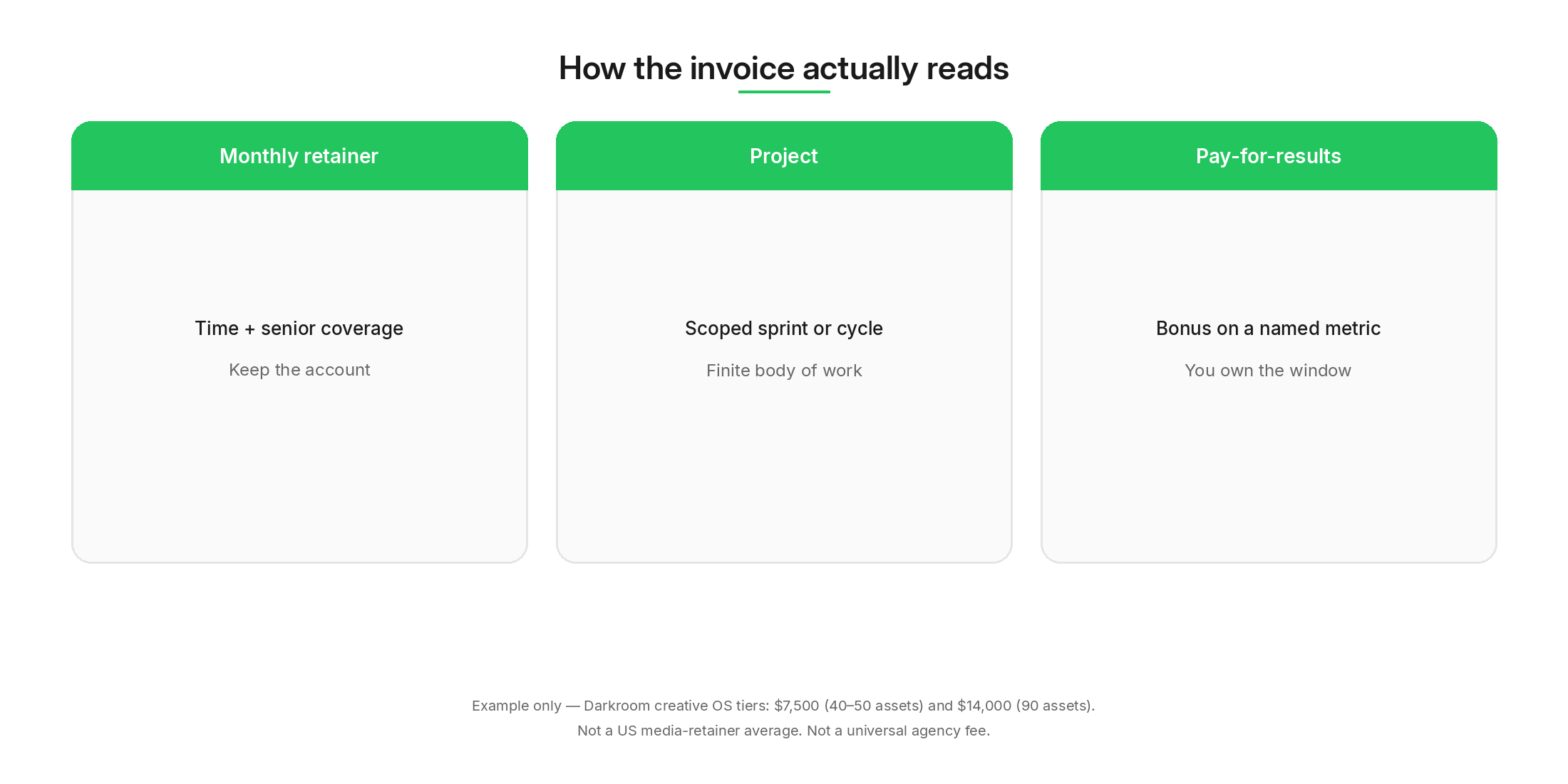
Monthly retainer: they bill for time and senior coverage. The incentive is to keep the account, not to inflate spend. Percent of media: they earn more when you spend more. That can punish MER. Hybrid retainer plus media fee: a floor plus a tax on spend. Bonus or pay-for-results rider: extra cash when a named metric hits. Fine only if you own the window.
The only hard figure we'll cite from the competitor scrape is creative. Darkroom publishes performance-creative tiers at $7,500 per month for 40 to 50 assets and $14,000 per month for 90 assets. That's their creative-OS packages. It's not "the US average for performance creative." Don't treat it as a benchmark for media retainers. Don't copy the number into your budget as if every shop bills that way.
What the fee must include, or the performance marketing services package is incomplete: tracking and analytics. Creative production or a named creative partner. Landing pages. Reporting time. Metadata flags cost and reporting alignment as post-hire challenges. Translate that: if creative and pixels weren't in the PDF, you'll meet them as change orders.
Contract terms that change the real price include notice period and 12-month minimums. Who owns ad accounts and pixels matters. So does a kill-clause after a failed incrementality test. Push those in writing before legal gets a redline dump. This is how US shops quote. It isn't the India or UAE "near me" autocomplete noise on the same keyword.
Incrementality vs a Dashboard That Cannot Lose
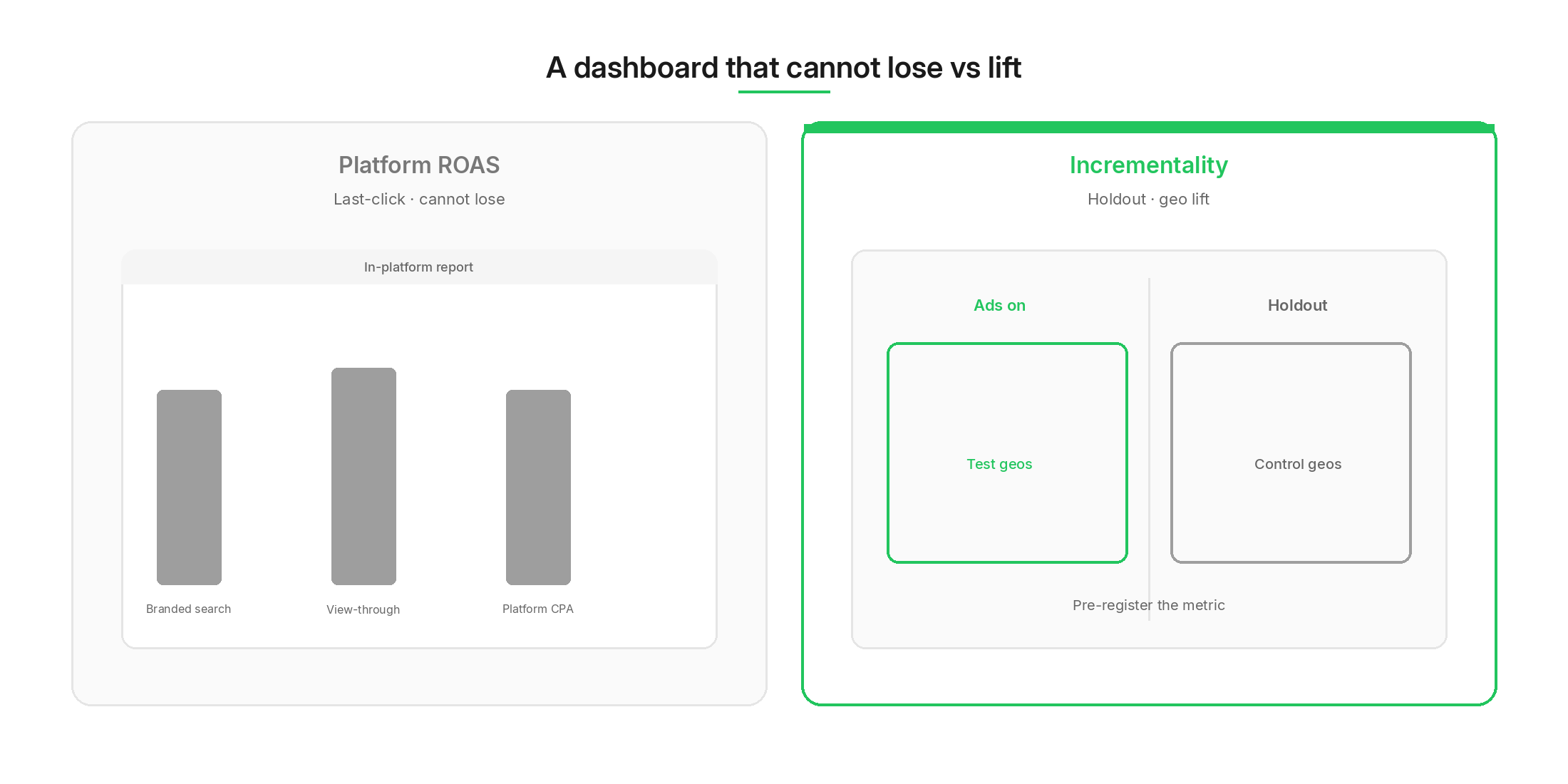
Hire on incrementality, not on a dashboard that can't lose. Incrementality means: would this conversion or purchase have happened without the spend? Last-click ROAS and platform-reported "incremental conversions" are the theater. If you want the wider hire process, use the 2026 marketing-agency hiring guide. This section is the filter that guide doesn't specialize in.
Directive's hiring topics (not their copy) are the right three: measurement philosophy, CRM/RevOps access, and how they read discovery. If they can't sit in the CRM, they can't claim pipeline. Darkroom's "one recent win" test still applies. Steal their scorecard weights too. Commerce fluency. Creative OS. Measurement. Team model.
Picture a DTC brand whose Meta ROAS looks healthy while contribution margin shrinks. Last-click is stealing branded search credit. A shop that brings a 4-week ROAS screenshot into that room is selling theater. A shop that proposes a holdout geo is selling work.
What does a real incrementality test look like?
A real test names the method before kickoff. Geo split: some regions get the ads, some don't. PSA or placebo: spend goes to a public-service ad so auction conditions stay similar. Holdout: you exclude a customer slice or campaign family. Pre-register the success metric. Don't harvest a winner after the fact.
We won't invent lift percentages. If a shop quotes a magic incrementality number from a named study they can't link, treat it as a pitch prop. Your test is the evidence. Write the method in the SOW. Write the date you'll read it. Write who can kill the program if it misses.
Which reported metrics are easy to game?
CPA and ROAS are easy because the platform wants you to see them. Last-click branded search looks like a genius media buyer. View-through conversions look like a genius social buyer. Platform "incremental conversions" use the platform's own model. None of those prove lift.
Retention and LTV are harder to fake. So are MER, contribution margin, and a holdout-based lift number. They need access and time. That's why shops avoid putting them in the SOW. If the weekly PDF leads with in-platform ROAS, ask where MER went. If they can't show MER, they aren't in the books.
Can they show what happens after creative fatigues?
Creative fatigue is when the winning ad stops winning. Frequency climbs. CPA follows. A shop that can't describe the next 20 concepts is optimizing an auction, not a business.
Ask who writes and designs. Ask the weekly testing cadence. Ask what happens to CPA when the hero ad dies. Darkroom's published $7,500 and $14,000 creative tiers exist because someone has to fund that volume (40 to 50 assets at the lower tier, 90 at the higher). If the pitch has no fatigue plan, it's media buying. Walk.
Thirty Days of Proof Beats Twelve Months of Hope
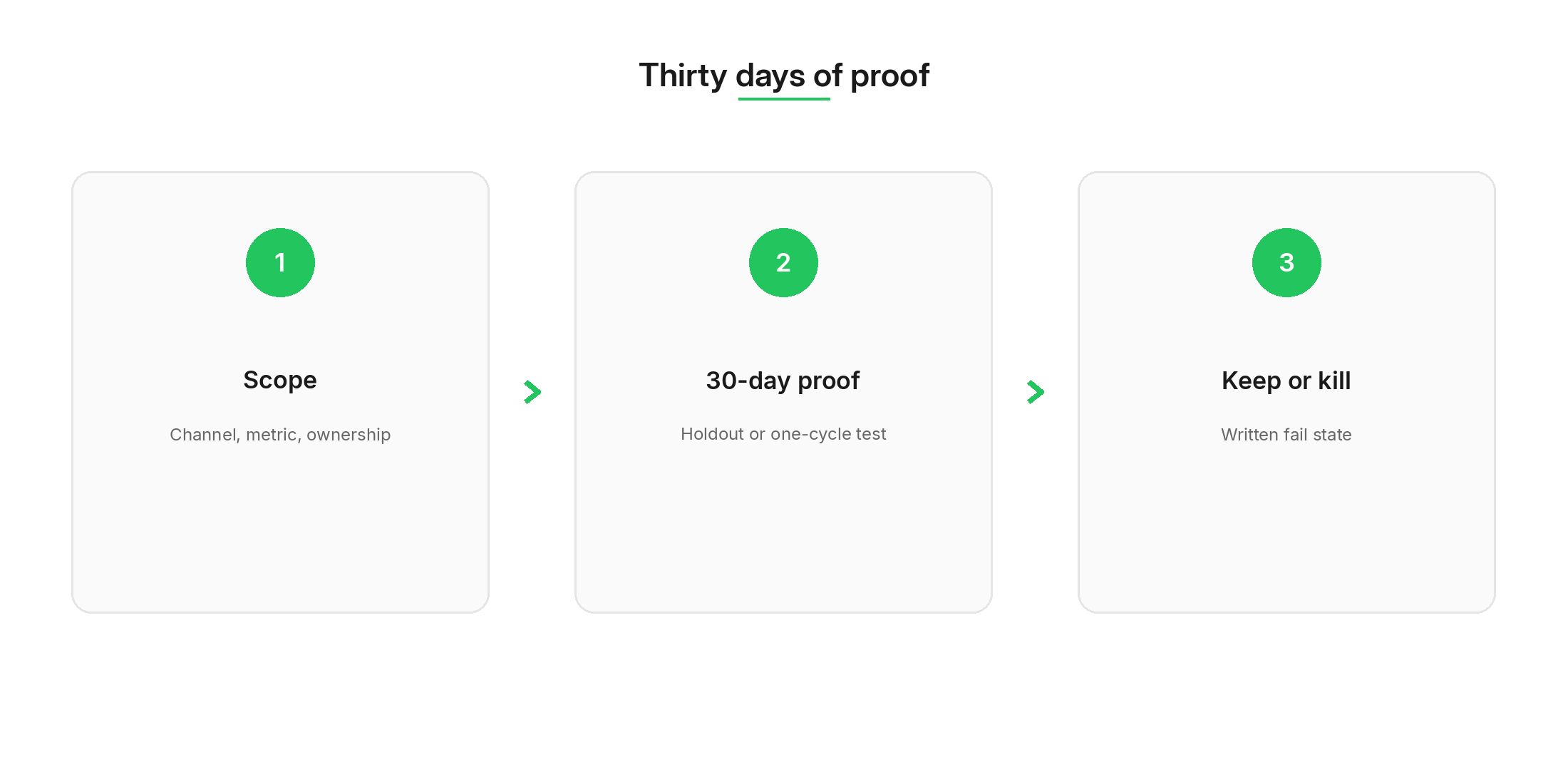
Don't sign twelve months of hope. Buy thirty days of proof, or one full media cycle if your sales cycle is longer. Name the channel or campaign family. Pre-agree one incrementality proxy: a holdout geo, new-customer MER, or qualified pipeline. Pick one. Set a creative volume expectation. Set a reporting cadence. Put ad-account ownership on day one.
Write the kill-clause before kickoff. "Fail" has to be a number, a date, and an exit. Imagine a 30-day Meta test with two holdout DMAs (designated market areas) and a written fail state if new-customer MER doesn't beat the prior 30 days. That's a test. A 12-month SOW with "we'll optimize" is a lease.
You may not need a performance marketing agency. Stay in-house if your media team is already incrementally literate. Don't hire if spend can't support professional fees and media at the same time. We won't invent a dollar cutoff. If the real gap is brand, that's an advertising problem. If the real gap is a PPC specialist and you already own creative plus measurement, go back to a PPC shortlist rather than a performance wrapper.
Alternatives: a fractional media lead, a specialist PPC shop, or stay in-house and buy a measurement consultant. No vendor pitch. A consultant who only owns the holdout design can be cheaper than a retainer you don't need.
Don't use a best performance marketing agency listicle as the shortlist. Build a performance marketing agency list from the directory, the comparisons hub, and live profiles. Inspect Wpromote and Tinuiti as performance marketing agency examples to open, not as a ranked top two. For a broader marketing shortlist, use best digital marketing agencies in 2026. Never "our top 18 performance agencies."
Shortlist From the Directory, Not Another Top-18
A performance marketing agency is a paid-media operator you hold to lift and unit economics, not to a busy ads account. A PPC shop stops at platform CPA. A growth agency owns a wider funnel and may not live in paid. A clean retainer with a 30-day test can beat a pay-for-results rider the vendor can tune.
Skip another best performance marketing agency roundup. Skip another performance marketing agency list that ranks its author first. Browse the marketing agencies category and verify profiles in the directory. That's how you shortlist a performance marketing agency in USA without another top-18. Ranking methodology lives on the methodology page if you want to see how we build ratings.
Frequently Asked Questions
What does a performance marketing agency do?
It plans and buys measurable paid media. You hold it to lift and unit economics. Pipeline or MER. Contribution margin or incremental conversions. The usual performance marketing services bundle is 2 core channels (paid search and paid social) plus tracking, creative testing, and landing pages. Brand, organic calendars, and product growth aren't automatic. A performance marketing agency that only "runs the ads" is a media buyer.
Who are the top performance marketing agencies?
Don't trust a ranked best performance marketing agency page that puts the publisher first. Directive's 18 and Darkroom's ecommerce shortlist fail that test. So do Hawke Media's LinkedIn 25 and Eight Oh Two's self-#1. Shortlist from the directory and compare pages. Treat Wpromote and Tinuiti as performance marketing agency examples on public lists, not as our top two. Build your own performance marketing agency list.
How do I know if a marketing agency is legit?
Legitimacy is operational. The firm grants ad-account ownership and sits in the CRM. It defends one causal win and writes a kill-clause. Don't judge "legit" by a city landing page, a "performance-based" homepage sticker, or a paid best-of list. Check directory profiles and the hire/choose guides. One causal win beats 10 ROAS screenshots.
What are the big 5 marketing agencies?
PAA inherits a generic "big 5 agencies" pattern that doesn't map onto US growth-stage paid media. We won't dump holding-company trivia or fabricate a performance "big 5." Holding companies sell creative and advertising. Performance shops sell lift in paid. Use directory filters and compare pages instead of a five-name canon.
Which questions are worth asking before you sign?
Ask who owns attribution and the ad accounts. Ask for one causal win they can defend. Ask the creative SLA after fatigue. Ask whether CRM/RevOps access is in the SOW. Ask what happens at day 30 if the proxy metric misses. Five questions beat a 40-page deck. Ask them before you sign with a paid-media partner.
What challenges show up after kickoff?
Three show up constantly: analytics/reporting alignment, CRM or sales-team handoff, and cost surprises when creative and tracking weren't in the retainer. The burned-buyer version is simpler. Platform ROAS looks healthy while MER doesn't. Budget the unpriced line items in week 1.
Who should own the attribution window in a pay-for-results deal?
You should. If the shop that earns the bonus also sets lookback windows or converting-query filters, the contract is a circular reference. Same if they set the CRM opportunity stages. Prefer a retainer plus an independent holdout (or a third-party measurement owner) over a CPA-share the vendor can tune. One holdout beats a 7-day click window they picked.
Why do so many shops insist on a 12-month retainer?
Learning cycles, creative testing, and incrementality reads take more than a media-buying sprint. That part is real. The burned-buyer part is locking spend before a causal test. Counter with a 30-day or one-cycle paid proof with a written fail state, then a longer SOW. We won't invent an "industry-standard" length.
What is the plan when ads fatigue a month in?
A real partner can describe a creative OS. Volume and testing cadence. Who writes and designs. What happens to CPA when the winning ad dies. Darkroom's published $7,500 / $14,000 creative tiers (40 to 50 assets vs 90 assets) are the only scrape-backed price example. Cite them as Darkroom's packages, not a market benchmark. No fatigue plan means media buying.
Top Marketing Agencies in 2026
Ranked by our editorial score across 1,481 listed marketing agencies.


Related Articles
How to Choose a Marketing Agency: What Actually Matters
Learn how to choose a marketing agency that fits your goals and budget. Covers evaluation criteria, pricing models, red flags, and a pre-hire checklist.
How to Hire a Marketing Agency: Complete Decision Guide
Learn how to hire a marketing agency the right way. Our guide covers readiness signals, vetting tactics, and costs to avoid costly mistakes.
Marketing Agency vs Advertising Agency: Key Differences
Understand the key differences between a marketing agency vs advertising agency. Learn which type fits your business goals and budget.
How to Find the Best Advertising Agencies for Your Budget
Agency costs range from $5K to $100K+/month across four tiers. Use this framework to find the best advertising agencies for your budget and goals.
More Insights

Top Healthcare Software Development Companies for Every Specialty
Find top healthcare software development companies by specialty: EHR integration, telehealth, FDA-regulated devices, and patient engagement apps compared.

Best Content Marketing Agencies: How to Pick the Right Type
Learn to identify the four types of content marketing agencies and match the right one to your content maturity, budget, and business goals.

What is a Lead Generation Agency? Complete Guide
Discover what a lead generation agency does, how lead generation specialists work, and whether outsourcing lead gen is right for your business in 2026.