
Top Healthcare Software Development Companies for Every Specialty
Find top healthcare software development companies by specialty: EHR integration, telehealth, FDA-regulated devices, and patient engagement apps compared.


Every software agency with a wellness tracker in its portfolio calls itself a healthcare company. That makes your job harder. You're looking for a development partner who can actually ship software in a regulated environment, not one that built a step counter and slapped "HIPAA-compliant" on the landing page. Healthcare IT spending continues to accelerate, with market analysts projecting double-digit annual growth through the end of the decade. The demand is real. The problem is separating vendors who've navigated FDA submissions from those who've never touched a BAA.
Most "top healthcare software development companies" lists rank 20-30 agencies in a flat numbered list and call it useful. They treat EHR integration firms and patient engagement app shops as interchangeable. They aren't. This article groups companies by the type of healthcare software they actually build, so you can skip to the category that matches your project.
In this guide, you'll find top healthcare software development companies organized by specialty: EHR integration, telehealth, FDA-regulated medical devices, and patient engagement apps. You'll also get a vetting framework specific to healthcare vendors. Plus answers to the questions buyers forget to ask.
TL;DR
- Not all top healthcare software development companies are equal. A firm that builds wellness apps is fundamentally different from one that ships FDA-cleared medical device software.
- For EHR integration and clinical workflows, look for vendors with live HL7 FHIR connections and Epic or Cerner experience.
- Telehealth platforms need more than a video call API. You want a partner who's scaled RPM data pipelines and managed device pairing.
- FDA-regulated projects (SaMD, Class II/III companion apps) require ISO 13485 quality management and regulatory submission track records. Generalist agencies fail here.
- Patient engagement and health app development companies should demonstrate strong health-literacy UX, not just pretty screens.
- Use a third-party directory like the software agencies hub to cross-check vendor claims against verified profiles.
Why "Healthcare Experience" Means Almost Nothing on a Vendor's Website
Most agencies claiming healthcare expertise have built one or two health-adjacent apps. That doesn't qualify them for your regulated clinical platform.
Here's the reality: HIPAA compliance is table stakes. Any competent development shop can encrypt data at rest and in transit, sign a BAA, and implement access controls. If a vendor leads with "we're HIPAA-compliant" as their healthcare differentiator, that tells you nothing. It's like a restaurant bragging about having running water.
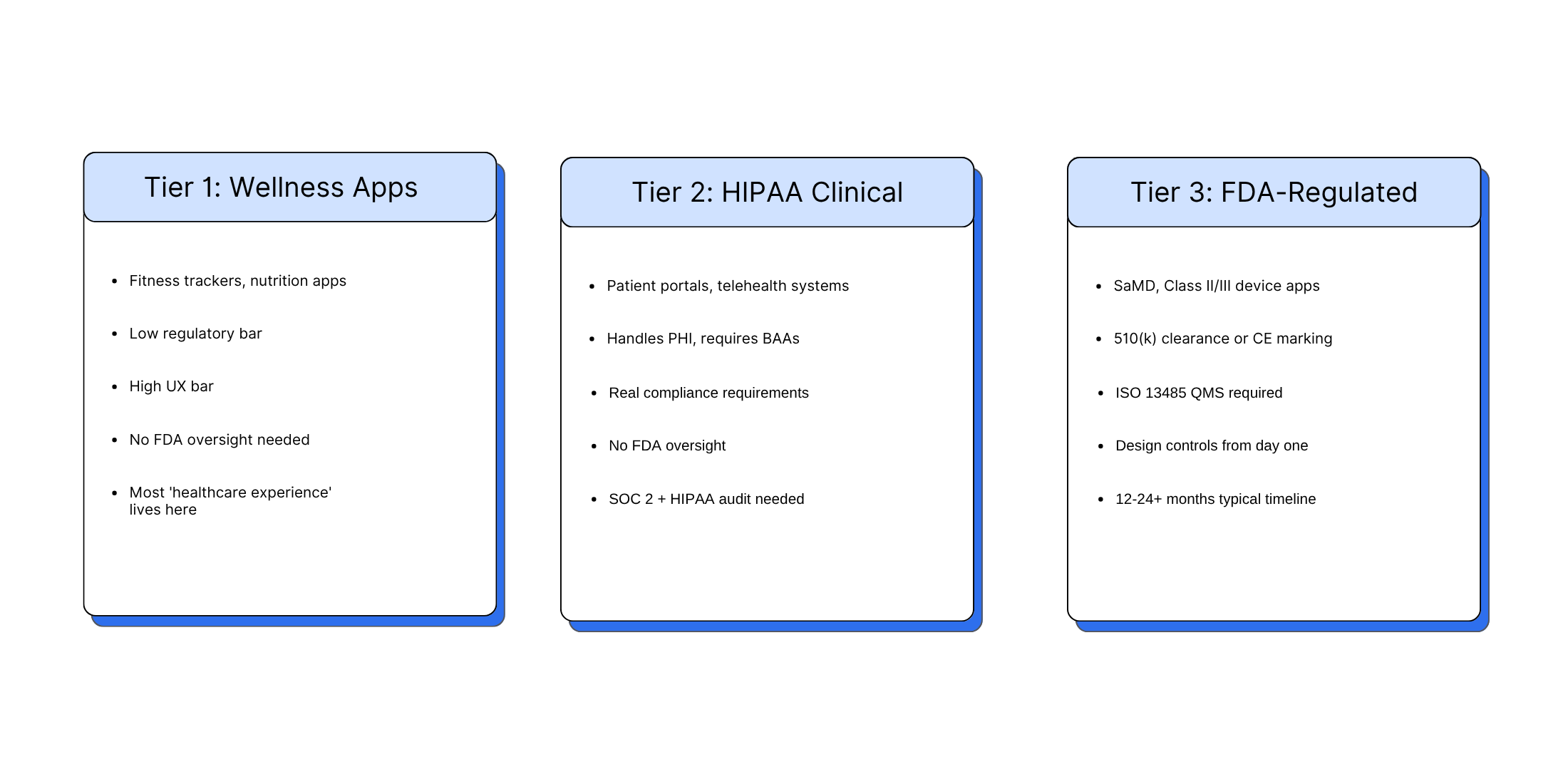
The real signal is what sits above HIPAA. Three tiers exist in healthcare software, and most ranking articles treat them as one:
Tier 1: Wellness and consumer health apps. Fitness trackers, nutrition apps, general wellness platforms. Low regulatory bar. High UX bar. Most "healthcare experience" lives here.
Tier 2: HIPAA-compliant clinical platforms. Patient portals, telehealth systems, clinical workflow tools that handle PHI. Real compliance requirements, but no FDA oversight.
Tier 3: FDA-regulated software. Software as a Medical Device (SaMD) and companion apps for Class II/III devices. Anything requiring 510(k) clearance or CE marking lands here. Different development process entirely. Think design controls, risk analysis, V&V documentation, and quality management systems.
When you're evaluating top healthcare software development companies, ask which tier they've actually operated in. A company that's only shipped Tier 1 projects won't know how to handle Tier 3. And if your project is Tier 2, hiring a Tier 1 shop means you're paying them to learn compliance on your dime.
Top Companies for EHR Integration and Clinical Workflow Software
EHR integration is one of the most technically demanding specialties in healthcare software development. It requires deep knowledge of data standards, legacy system APIs, and the politics of health system IT departments.
What EHR Integration Projects Actually Require
Building software that connects to electronic health records isn't just API work. EHR systems like Epic, Cerner (now Oracle Health), and Athenahealth each have their own data models and certification requirements. Authentication flows differ across all of them. You need HL7 FHIR (Fast Healthcare Interoperability Resources) expertise at a minimum. Many older systems still use HL7 v2 messaging, which means your development partner needs to handle both modern and legacy protocols.
Say your health system wants to build a clinical decision support tool that pulls patient data from Epic in real time. The vendor needs Epic App Orchard certification, SMART on FHIR integration experience, and an understanding of clinical workflows well beyond what the API documentation covers. If they've never sat in a clinical environment and observed how nurses and physicians actually use these systems, the software will technically work but practically fail. Top custom healthcare software development companies have staff who've spent time in hospitals, not just behind screens.
Companies With Proven EHR and Clinical System Builds
Glorium Technologies has built a sustained practice around healthcare IT, including EHR integrations and clinical data pipelines. Their team includes dedicated healthcare domain specialists, not just developers who've read the FHIR spec once. Belitsoft brings deep experience in health system workflow automation and has completed projects involving HL7 integration with multiple EHR platforms. For buyers specifically looking at US-based options among top healthcare software development companies in USA, both firms serve North American health systems directly.
Smaller specialized firms also compete here. Look for companies that can name specific EHR vendors they've integrated with and describe the certification process they followed. Vague references to "interoperability experience" without naming systems are a red flag.
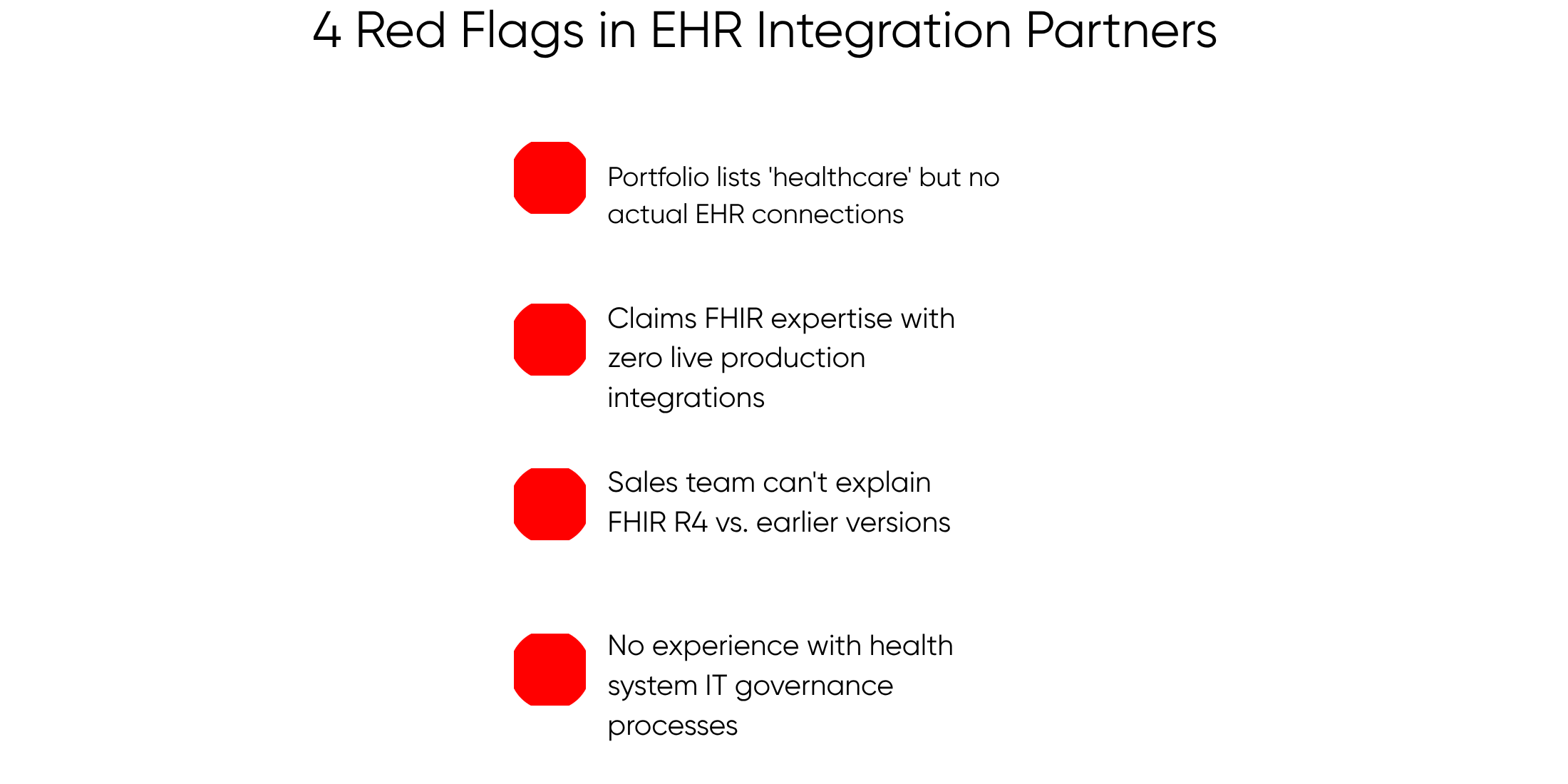
Red Flags When Evaluating EHR Integration Partners
Watch for these: a portfolio that lists "healthcare" projects but none involving actual EHR connections. Claims of FHIR expertise without any live integrations in production. A sales team that can't explain the difference between FHIR R4 and earlier versions. And most critically, no experience working inside a health system's IT governance process. EHR integration projects don't just require good code. They require navigating procurement, security reviews, and clinical validation that can take months before a single line of code ships.
Top Companies for Telehealth and Remote Patient Monitoring
Telehealth development goes far beyond embedding a video call. The companies worth hiring have built platforms that scale under real clinical load, handle device data from dozens of RPM hardware vendors, and manage the regulatory patchwork of state-by-state licensing requirements.
What Separates a Telehealth Platform From a Video Call Widget
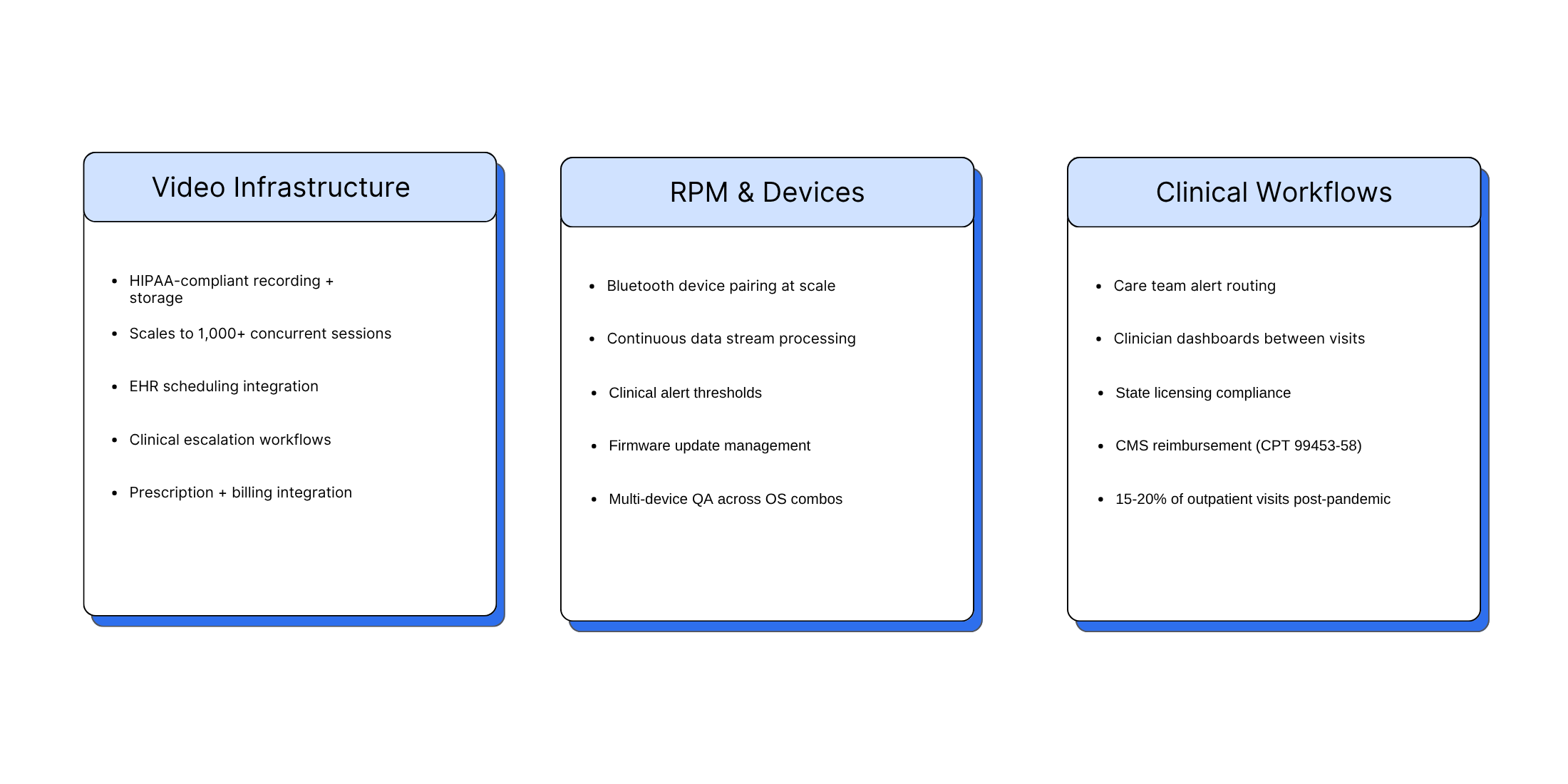
A video call is one feature. A telehealth platform includes scheduling integrated with EHR systems, HIPAA-compliant recording and storage, and clinical escalation workflows. Add prescription management and billing integration on top of that. Remote patient monitoring (RPM) adds another layer: ingesting data from wearables and IoT sensors, setting clinical alert thresholds, and building dashboards that clinicians actually use between visits. Telehealth utilization has stabilized at roughly 15-20% of outpatient visits post-pandemic, which means the market has matured past MVP. You need a partner who's built for production scale, not a prototype.
Companies That Have Shipped Scalable Telehealth Products
Top custom healthcare software development companies in the telehealth space tend to be firms with 5+ years of video infrastructure and device integration work. Cafeto Software, rated 10 on our directory, has delivered custom platforms spanning real-time communication and clinical workflow integration. For remote monitoring builds, look for firms that have handled the hardware-software gap. That means pairing Bluetooth medical devices, managing firmware updates, and processing continuous data streams without dropping packets.
If you're comparing options, side-by-side comparisons like Cafeto Software vs. Innowise can help you weigh verified profiles against your specific telehealth requirements.
Remote Patient Monitoring: Who Handles the Hardware-Software Gap
RPM is where projects get complicated fast. You're not just building software. You're integrating with pulse oximeters, blood pressure cuffs, and glucose monitors. Sometimes custom hardware too. Each device has its own Bluetooth profile, data format, and firmware quirk. The top healthcare app development companies working in RPM have dedicated QA processes for device pairing across dozens of Android and iOS device combinations.
Picture a cardiology practice deploying RPM to 2,000 patients with heart failure. The software needs to ingest data from three different weight scale manufacturers, flag clinically significant weight changes within hours, and route alerts to the right care team member. That's not a feature request you hand to a generalist agency.
Questions to Ask Before Hiring a Telehealth Development Partner
Ask these: How many concurrent video sessions has your platform handled in production? Which RPM device manufacturers have you integrated with? Do you have experience with CMS reimbursement codes for RPM (CPT 99453-99458)? Can you show a live integration with an EHR scheduling system? The answers separate top healthcare software development companies from agencies that built one telehealth MVP during the pandemic rush.
The Short List for FDA-Regulated Medical Device Software
This is the highest-stakes category in healthcare software development. Whether you're looking at healthcare software development companies in USA or internationally, getting it wrong doesn't just cost budget. It costs market access.
Why FDA-Regulated Software Requires a Different Development Process
Software as a Medical Device (SaMD) and companion apps for Class II/III devices follow a fundamentally different development lifecycle. You need design controls documented from day one and risk analysis per ISO 14971. Verification and validation (V&V) is required at every stage. Your quality management system (QMS) must align with ISO 13485. The FDA's guidance on software as a medical device makes clear that SaMD classification depends on the clinical significance of the information the software provides. A diagnostic algorithm that recommends treatment is regulated differently than a wellness app that tracks steps.
Generalist software agencies almost always fail here. Among healthcare software development companies worldwide, only a small fraction maintain QMS processes or understand design history files. Fewer still have prepared a 510(k) submission package. Hiring the wrong partner for an FDA-regulated build can add 12+ months to your timeline and cost hundreds of thousands in rework.
Companies With FDA 510(k) or CE Marking Track Records
The pool of top healthcare software development companies with genuine regulatory submission experience is small. Glorium Technologies has worked on healthcare projects requiring regulatory documentation and compliance frameworks. For companies specifically seeking FDA-regulated device expertise, the key question during evaluation is: "Can you name a 510(k) submission you supported, and can we speak with that client?"
When browsing top software development companies in the 2026 rankings, filter specifically for firms listing medical device or regulatory experience. Many companies list "healthcare" broadly without specifying regulated vs. unregulated work.
SaMD vs. Companion Apps: Different Regulatory Paths, Different Partners
Not all FDA-regulated healthcare software follows the same path. SaMD (software that is itself the medical device, like a diagnostic algorithm) faces different classification criteria than a companion app that connects to physical hardware. A companion app for a Class II blood glucose monitor goes through a different review process than standalone SaMD that analyzes radiology images.
This distinction matters when you're selecting a vendor. Some top custom healthcare software development companies specialize in SaMD validation and clinical algorithm development. Others focus on companion app builds where the primary regulatory burden sits with the hardware manufacturer. Ask your potential partner which path they've walked.
What a Realistic Timeline Looks Like for Regulated Builds
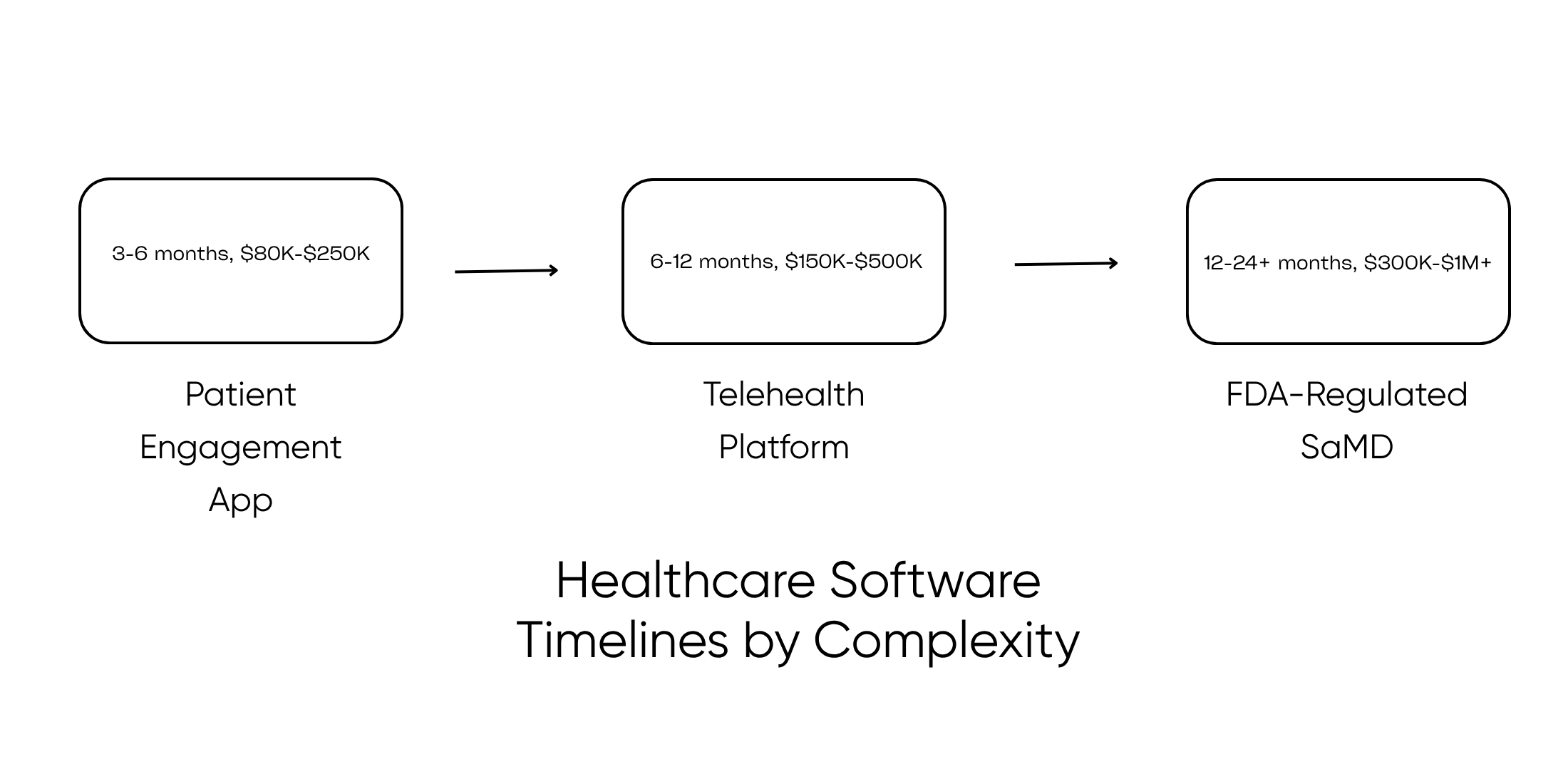
Patient engagement app MVP: 3-6 months. HIPAA-compliant telehealth platform: 6-12 months. FDA-regulated SaMD from concept to 510(k) clearance: 12-24 months, sometimes longer. The regulatory documentation often takes more time than writing the code. Design history files, risk management reports, and V&V protocols don't write themselves. Budget for a regulatory consultant in parallel with development unless your software partner has in-house regulatory science staff.
Any company promising an FDA-regulated build in under 9 months should raise immediate skepticism. Either the scope is smaller than you think, or they don't understand the process.
Who Builds Patient Engagement and Health Apps That Actually Get Used
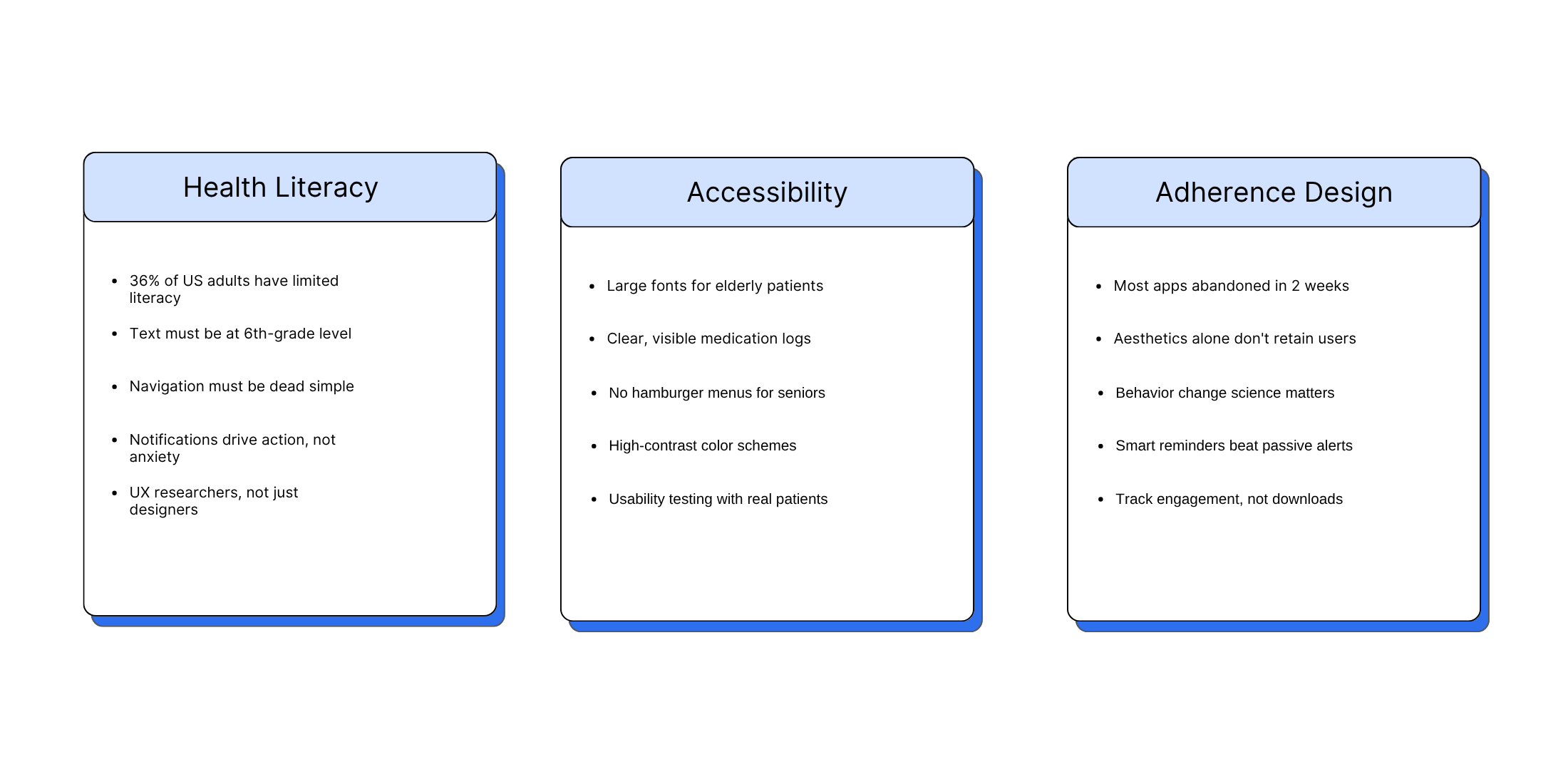
Patient engagement apps have the lowest regulatory bar in healthcare software but the highest UX bar. Health literacy, accessibility, and adherence design are where these projects succeed or fail.
What Patient Engagement Apps Get Wrong (and How to Spot It)
Most patient engagement apps look great in a demo and get abandoned within two weeks. The reason is almost always the same: the design team optimized for aesthetics instead of health literacy. Nearly 36% of U.S. adults have limited health literacy, which means your app's text needs to be at a 6th-grade reading level. Your navigation must be dead simple and your notifications must drive action without causing anxiety. Top healthcare app development companies understand this. Generalist app shops don't.
Imagine a medication adherence app designed for elderly patients managing diabetes. The developer uses 12-point font, pastel icons, and a hamburger menu. The patient can't read the screen, can't find the medication log, and stops using the app in a week. That's not a product failure. It's a design partner failure. The top custom healthcare software development companies employ health literacy experts alongside their UX designers.
Companies Known for Health-Focused UX and Consumer Apps
Cafeto Software and Cheesecake Labs both carry top ratings in our directory and have portfolios spanning consumer-facing application development. For healthcare-specific UX, look for agencies that employ UX researchers (not just designers) and can show usability testing results with actual patient populations.
If you're comparing options broadly, the guide on how to choose a software development company walks through vetting criteria that apply directly to top healthcare app development companies and patient engagement app partners. Healthcare software development companies worldwide compete for this segment because the regulatory barrier is lower, so the differentiator becomes design quality and user research rigor.
When a "Simple" Health App Actually Needs Regulatory Oversight
Here's where it gets tricky. A patient engagement app that provides medication reminders is unregulated. But add a feature that adjusts dosing recommendations based on patient data, and you've crossed into digital therapeutics territory, which the FDA regulates. Clinical decision support features, diagnostic screening tools, and treatment adherence algorithms that make clinical claims can all trigger regulatory requirements.
Before scoping your project, map every feature against the FDA's digital health framework. If any feature makes a clinical recommendation, you may need a development partner from the regulated tier, not the patient engagement tier. Top healthcare software development companies will flag this during discovery. Less experienced firms won't even think to ask.
How to Evaluate a Healthcare Software Development Company Before You Sign
You've identified your project's specialty tier and built a shortlist. Now you need to separate genuine expertise from polished sales decks.
Portfolio Red Flags That Signal Shallow Healthcare Experience
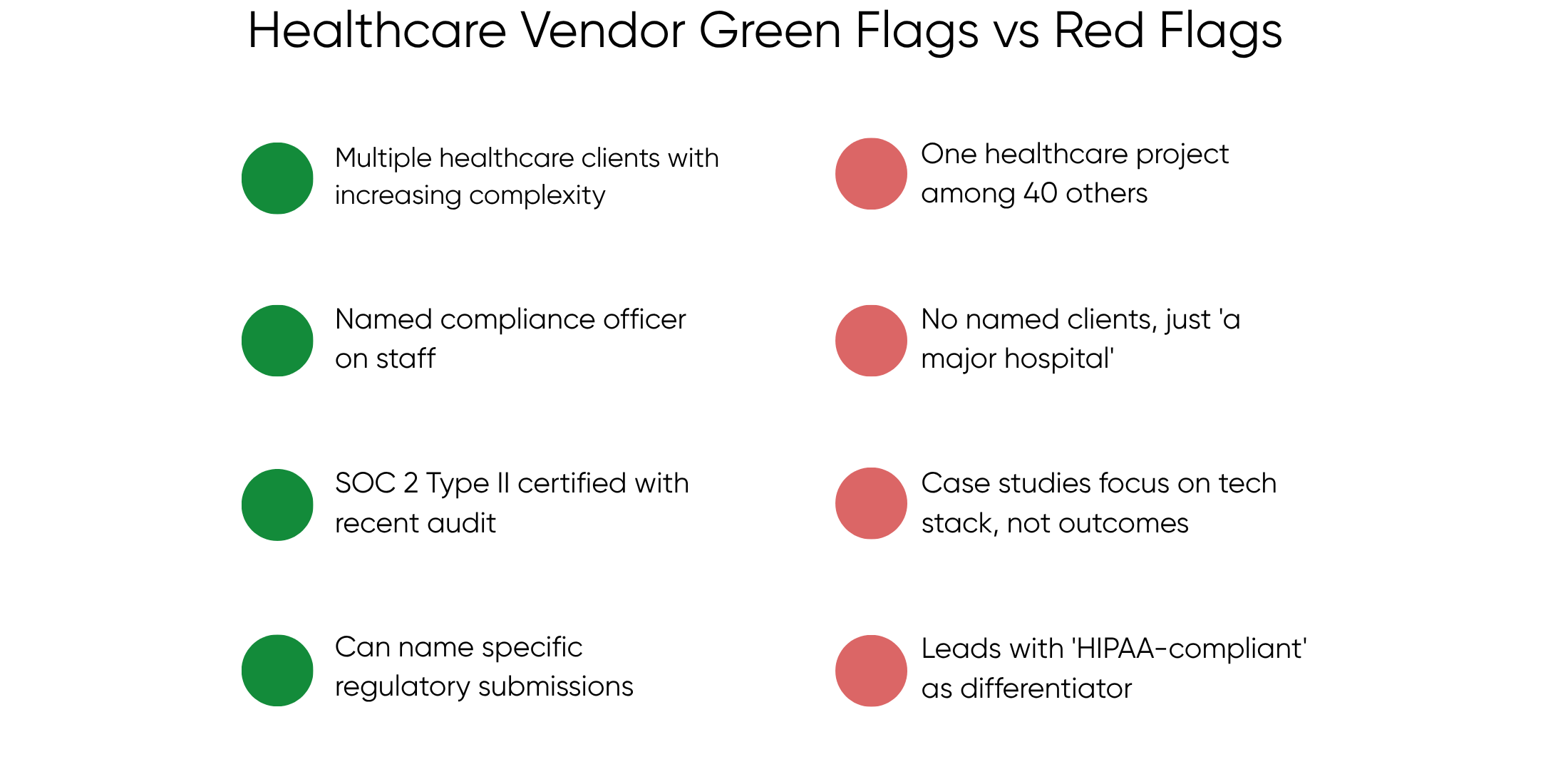
A portfolio showing one healthcare project among 40 e-commerce builds isn't healthcare experience. It's a one-off. Look for patterns: multiple healthcare clients and repeat engagements with health systems. Case studies should discuss regulatory or compliance outcomes, not just features shipped.
Other red flags: no named clients (just "a major hospital system"), no mention of compliance frameworks beyond HIPAA, and case studies that focus entirely on technology stack rather than clinical outcomes or user adoption. Top healthcare software development companies in USA and globally will show 3+ healthcare clients with increasing complexity over time. That progression signals a genuine practice, not opportunistic project-taking.
The Compliance Questions Most Buyers Forget to Ask
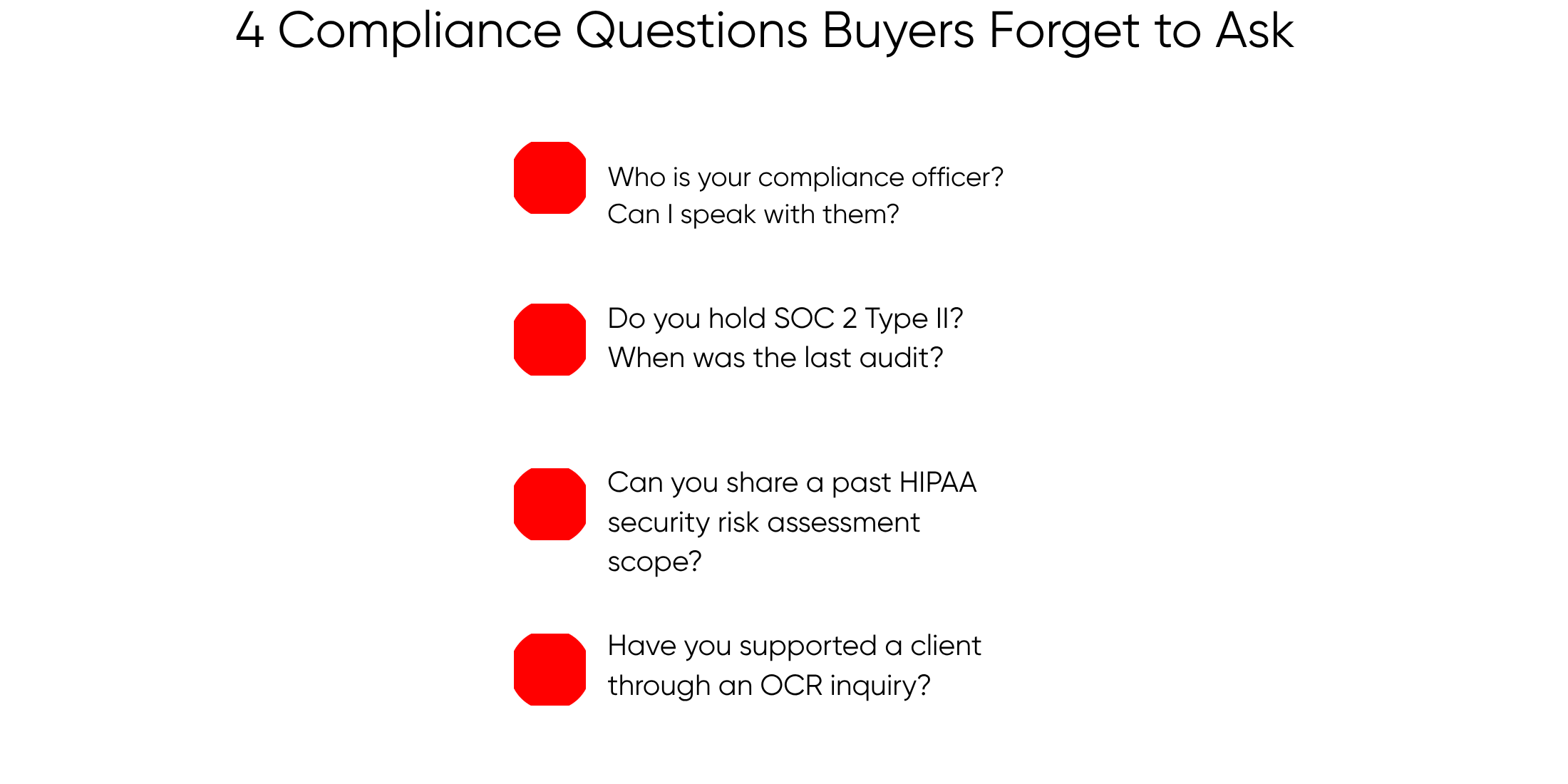
Go beyond "are you HIPAA-compliant?" Everyone says yes. Ask these instead:
Who is your compliance officer, and can I speak with them before we sign? Have you completed a HIPAA security risk assessment with a previous client, and can you share the scope? Do you hold SOC 2 Type II certification, and when was your last audit? Can you provide the name of your most recent HIPAA audit firm? Have you ever supported a client through an OCR (Office for Civil Rights) inquiry or breach notification?
These questions separate vendors who've built compliance into their operations from those who treat it as a checkbox. Most healthcare software development companies worldwide will struggle with at least two of these questions, which tells you everything you need to know.
How to Use Third-Party Directories to Verify Vendor Claims
Agency websites are marketing tools. They'll always present the best version of the story. That's why third-party verification matters. The ranking methodology behind our directory evaluates agencies on verified criteria rather than self-reported data. Use it to cross-check claims you hear in sales calls.
Run side-by-side comparisons like Brainhub vs. ScienceSoft to see how agencies stack up on objective metrics. Browse the software agencies directory to filter by rating and specialization. If a vendor ranks highly on independent directories and backs it up with specific healthcare case studies, that's a stronger signal than any pitch deck.
What to Do Next
Your project's regulatory complexity should drive your vendor selection. An EHR integration build requires a different partner than a telehealth platform or an FDA-regulated device project. Match the tier to the track record.
Start by defining which specialty tier your project falls into using the framework above. Then build a shortlist of 3-5 top healthcare software development companies from that tier. Run every shortlisted vendor through the compliance questions in the evaluation section. Ask for references specifically from healthcare clients, not generic software references.
If you're ready to start comparing, the software agencies directory gives you verified profiles and side-by-side comparison tools. It's the fastest way to move from research to shortlist without relying on vendor marketing alone.
Frequently Asked Questions
What Are the Top Healthcare IT Companies?
It depends on your project type. For EHR integration, companies like Glorium Technologies and Belitsoft have strong track records. For telehealth, look at firms with 5+ years of video infrastructure work. For FDA-regulated software, the pool narrows to vendors with documented 510(k) submission experience. There's no single "top 10" list that applies across all specialties. Healthcare software development companies in USA tend to lead in FDA-regulated work due to proximity to the regulatory process.
What Is the Most Popular Healthcare Software?
The most widely used healthcare software products are EHR systems: Epic holds roughly 38% market share among U.S. hospitals, followed by Oracle Health (formerly Cerner). But these are commercial products, not custom development. When organizations need specialized workflows or regulated device software that off-the-shelf systems can't handle, they hire healthcare software development companies to build custom solutions.
How Much Does Healthcare Software Development Cost?
Costs vary dramatically by regulatory tier. Patient engagement apps typically run $80K-$250K. HIPAA-compliant clinical platforms range from $150K-$500K. FDA-regulated SaMD builds start at $300K and frequently exceed $1M when you include regulatory submission costs. The biggest cost driver isn't feature count. It's regulatory complexity and the documentation burden that comes with it.
How Long Does It Take to Develop Healthcare Software?
Timeline ranges by project type: patient engagement MVP in 3-6 months, telehealth platform in 6-12 months, FDA-regulated device software in 12-24+ months. Regulatory documentation often takes longer than the actual coding. Any vendor promising an FDA-cleared product in under 9 months either has a very narrow scope or doesn't understand the submission process.
What Services Do Healthcare Software Development Companies Provide?
Most firms advertise 6 core services: custom application development, EHR/system integration, regulatory consulting, QA/validation testing, cloud infrastructure, and data analytics. The more important question is which of those services the company has delivered in a regulated context. A firm offering "HIPAA consulting" as an add-on is different from one with a full-time compliance team that has supported multiple audits.
What Are the Benefits of Custom Healthcare Software Over Off-the-Shelf Solutions?
Custom software makes sense when commercial products can't handle your specialized clinical workflows or proprietary system integrations. Top healthcare app development companies fill this gap by building solutions tailored to specific clinical needs. If Epic or Athenahealth covers 80% of your needs, customize within those platforms. If you need the remaining 20% to be a standalone product, that's where custom development earns its cost. For a deeper comparison, see the guide on custom software vs. off-the-shelf.
How Do I Know If a Healthcare Software Company Actually Understands HIPAA Compliance?
Ask for specifics: a named compliance officer and their last HIPAA security risk assessment scope. Also request the SOC 2 Type II certification date and the audit firm they used. If they can't answer these four questions clearly, their "HIPAA expertise" is likely limited to encrypting data and signing BAAs. That's baseline, not expertise.
What Happens If We Need to Switch Healthcare Software Vendors Mid-Project?
Expect 2-4 months of lost momentum and a 20-40% budget overrun for knowledge transfer. This is true whether you're working with healthcare software development companies worldwide or a local firm down the street. Mitigate this before signing: insist on code ownership clauses, require documentation standards in the contract, and run a paid discovery phase (4-6 weeks) before committing to a full build. Discovery is your cheapest insurance against a bad match.
Should I Hire a Specialist Healthcare Development Company or a Generalist Agency?
For patient engagement apps and wellness platforms, a strong generalist with 2-3 healthcare projects can work. For FDA-regulated software or deep EHR integrations, you need a specialist with dedicated QMS processes and regulatory science staff. Multiple healthcare clients is non-negotiable. The specialty tier framework in this article helps you determine which category your project falls into.
Top Software Agencies in 2026
Ranked by our editorial score across 1,802 listed software agencies.


Related Articles
Top Custom Software Development Companies by Project Type
Find top custom software development companies matched to your project type. MVP specialists, enterprise modernizers, and AI engineers compared with pricing.
How to Choose a Software Development Company Without Getting Burned
Learn how to choose a software development company with a 5-point framework, real cost breakdowns, and red flags to avoid getting burned.
Best Mobile App Development Companies: How to Choose in 2026
Compare the best mobile app development companies by use case. Covers costs, evaluation criteria, and company recommendations for 2026.
More Insights

Best HVAC Lead Generation Companies Ranked by Real Cost
HVAC lead gen companies charge $20-$250/lead, but cost per booked job is the real metric. We ranked providers by what you actually pay per job won.

Best Content Marketing Agencies: How to Pick the Right Type
Learn to identify the four types of content marketing agencies and match the right one to your content maturity, budget, and business goals.

What is a Lead Generation Agency? Complete Guide
Discover what a lead generation agency does, how lead generation specialists work, and whether outsourcing lead gen is right for your business in 2026.