
Account Based Marketing Agency: Which Tier You Actually Need
ABM comes in three tiers. Which one your revenue math supports decides whether an account based marketing agency is worth the retainer at all.


Your CRO wants pipeline from 40 named accounts. Your team has a spreadsheet, a LinkedIn budget, and about six months to show something real. So you start booking calls with agencies. Every one of them says the same three words inside the first ten minutes: intent, orchestration, personalization. None of them tells you which part of your problem they actually solve.
Most articles about hiring an account based marketing agency are lists of agencies. This one is about the decision underneath the list. ABM comes in three shapes, and the shape you need determines whether any shop in the marketing agencies directory is worth a retainer at all.
This guide covers the three program tiers and how to tell which one you're in, what an account based marketing agency charges in 2026, and the questions that separate real operators from rebranded demand gen shops.
TL;DR
- Three program shapes exist: 1:1, 1:few, and 1:many. Pick your tier before you compare a single vendor.
- At 1:1 and 1:few, a good account based marketing agency earns its fee on research your team can't staff.
- At 1:many you're usually buying paid media at consulting prices. Buy a data platform and an operator instead.
- Budget $7,000 to $15,000 a month for a working mid-market program. Media spend and platform licenses sit on top of that.
- Only 13% of B2B marketers report closed-won revenue from target accounts to leadership. Settle measurement before you sign.
1:1, 1:Few, or 1:Many: The Tier Decides Whether You Need an Account Based Marketing Agency
Account based marketing strategies come in three shapes, and the shape you need should drive the entire hiring decision. Nearly every buyer skips this step and goes straight to comparing vendors. That's backwards, because the tier determines whether you're buying senior research time or paid media management.
Two numbers place you: how many accounts are on your list, and what an average deal is worth. Run those before you take a single sales call.
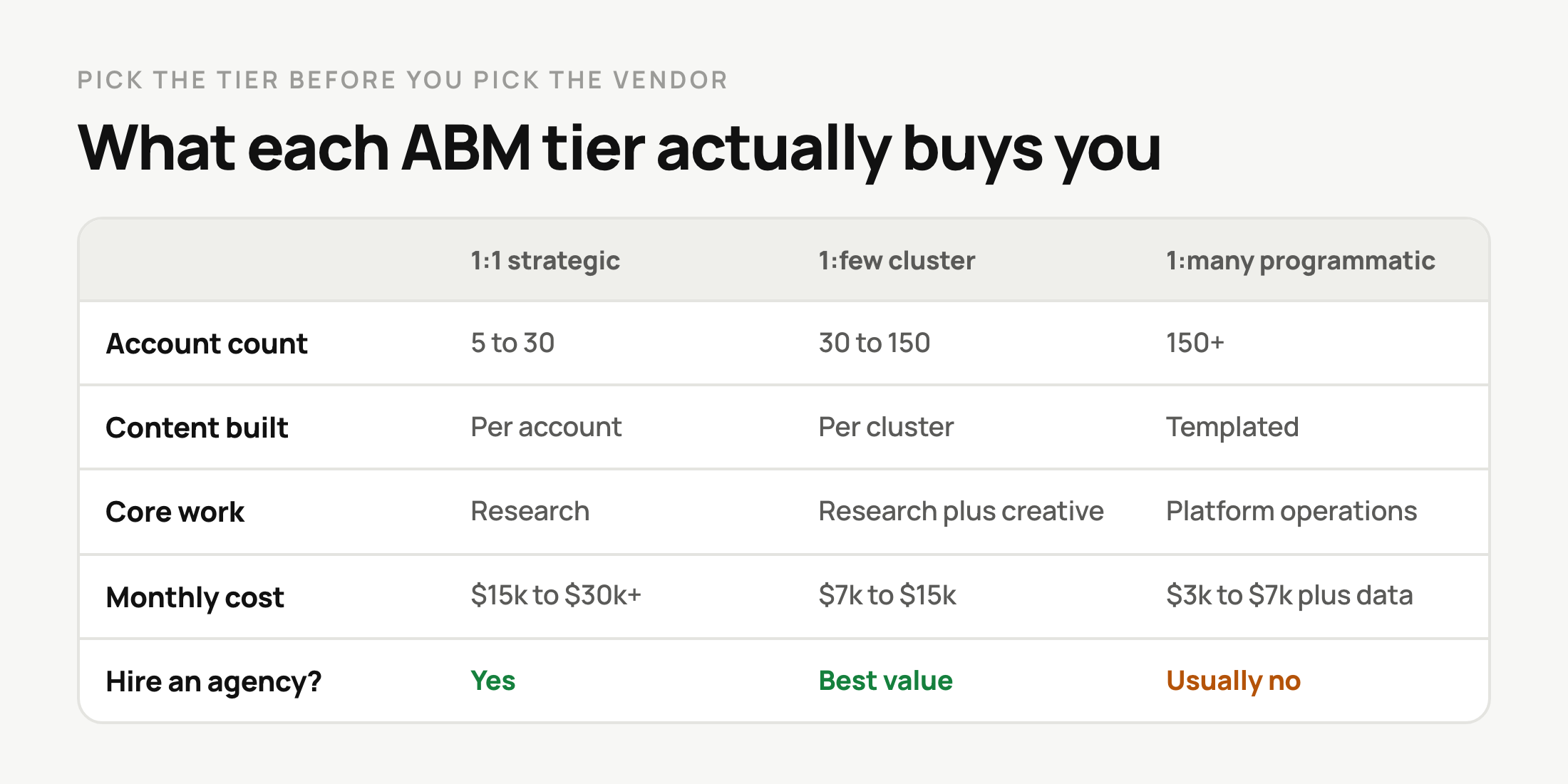
1:1 Strategic ABM (5 to 30 Accounts)
Custom everything. Bespoke research per account, tailored value propositions, sometimes a microsite built for one company. This is what ABM meant originally, and it's where agencies earn their money. The work is research and senior strategy that doesn't scale.
Picture a business selling a $400,000 platform into 12 named hospital systems. Each one has a different procurement path and a different clinical champion. No automation covers that. A strong agency will beat a two-person internal team here, and this tier is where account based marketing companies with real senior benches separate themselves from the rest.
1:Few Cluster ABM (30 to 150 Accounts)
Accounts grouped by shared traits like industry, growth stage, or a recent trigger event. Content gets built per cluster instead of per account. Five clusters of 20 accounts means five sets of messaging rather than 100.
This is the sweet spot for mid-market B2B. It's also the tier where a good agency adds the most value per dollar, because you get the research discipline of 1:1 at a cost structure that survives a CFO conversation.
1:Many Programmatic ABM (150+ Accounts)
Intent data and account-level advertising, plus automated plays across a large list. It's mostly a data-and-operations problem. The work is running the platform well rather than researching accounts.
Here's the uncomfortable part. This tier is what most buyers actually need, and it's the tier where an agency is the weakest purchase. You're paying strategic rates for paid media management with a target account filter on it. A skilled performance marketing operator plus a proper intent data platform usually gets you further for the same money.
Most ABM Programs Never Get Past Half-Built
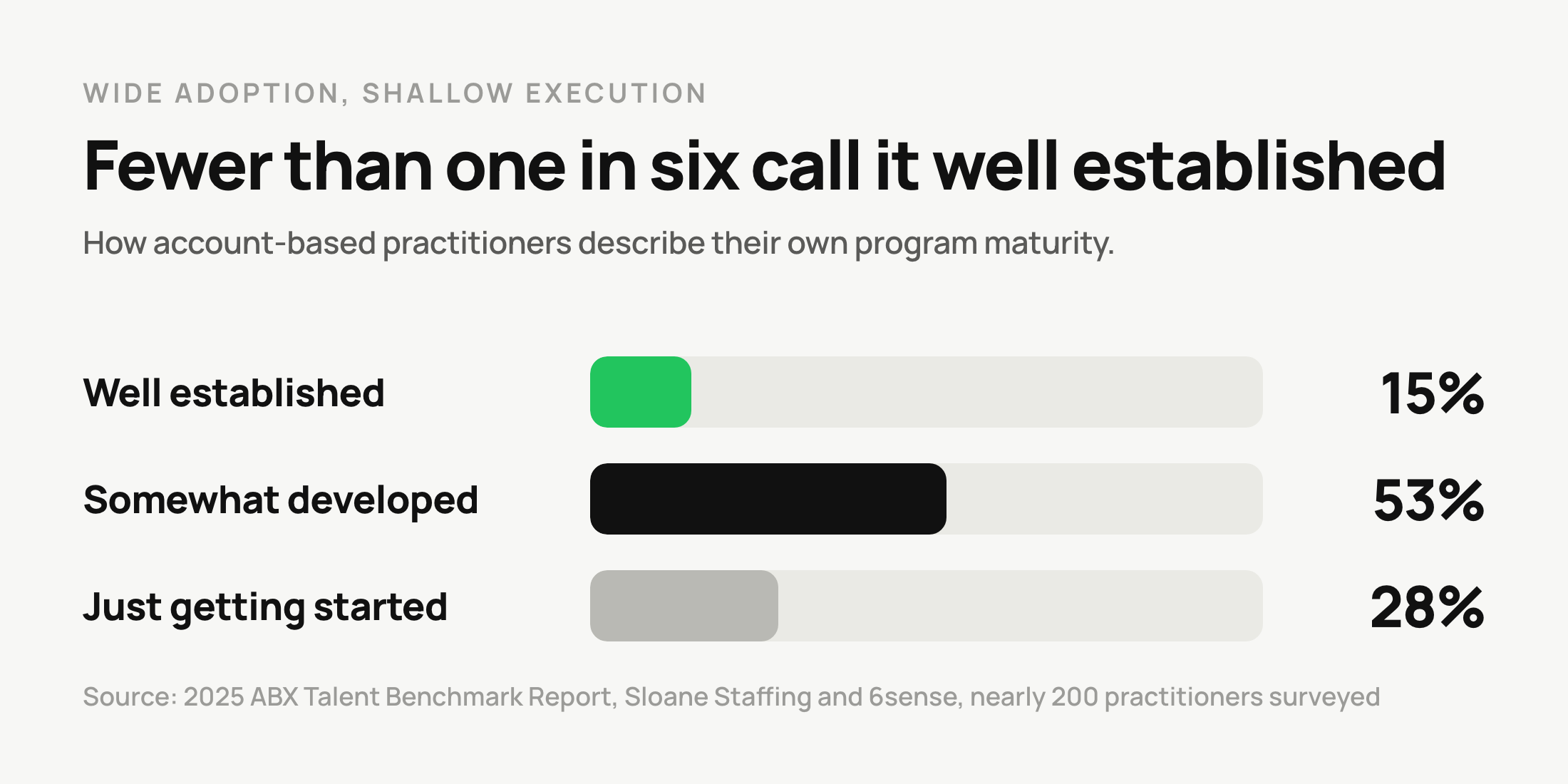
ABM adoption is wide and shallow, which is the second thing to know before you brief an account based marketing agency. 6sense's 2024 benchmark survey found 64% of marketing teams say they have an ABM approach. Now look at what practitioners say about their own work. The 2025 ABX Talent Benchmark Report from Sloane Staffing and 6sense surveyed nearly 200 account-based professionals. Only 15% called their program well established. Another 53% said it was somewhat developed, and 28% were just getting started.
Read that again. Among people who do this for a living, fewer than one in six has a program they'd call finished.
What the Well Established 15% Do Differently
They staff it. The same benchmark found 70% of these teams have a dedicated account-based team, averaging four to five people. They fund it too, putting 29% of the marketing budget behind the program.
Four or five people. That number matters more than it looks. If you're planning to hand ABM to one demand gen manager and an agency, you're staffing at roughly a third of what working programs carry. An agency can cover the research and creative load. It can't cover the internal coordination between marketing and sales, and that coordination is where most programs stall.
Why the Case Studies Look Better Than the Results
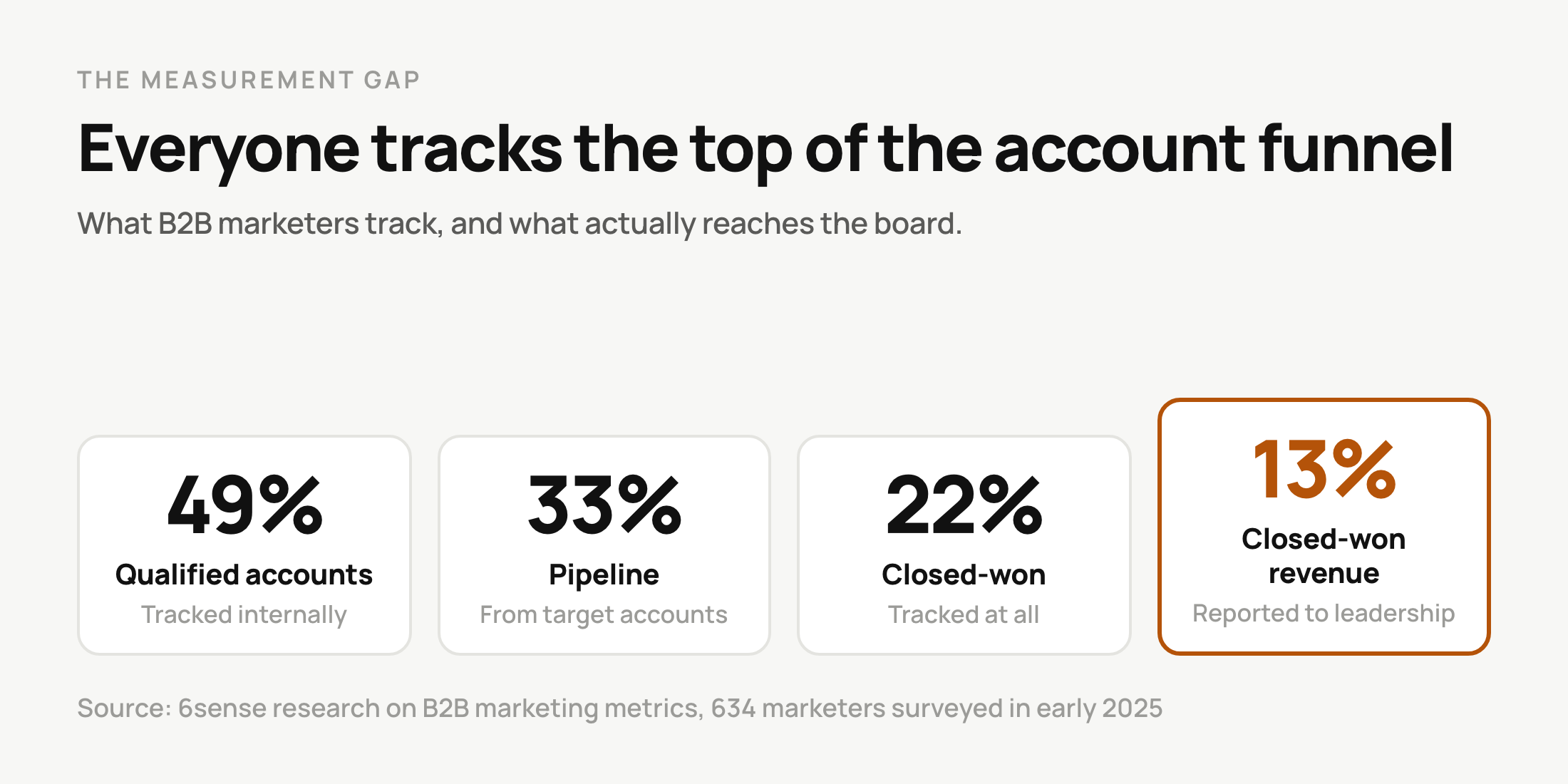
Agency case studies lean on engagement numbers because engagement is what most teams measure. 6sense research on B2B marketing metrics, based on 634 marketers surveyed in early 2025, found 49% track marketing qualified accounts from target lists. Only 33% track pipeline from those accounts. Fewer than 22% track closed-won deals.
So when an agency shows you an 800% lift in account engagement, that's a real number measuring the thing almost everyone measures. It isn't evidence the program produced revenue. Ask what happened to the 22% metric instead.
What an ABM Marketing Agency Actually Delivers
An abm marketing agency runs six workstreams, and they group into three buckets you should price and evaluate separately. Most buyers assume they're purchasing all six. Most contracts cover three or four.
Account Selection and Research
This is the part that justifies the fee. The agency builds or sharpens your ideal customer profile and scores your target list. Then it researches each account: who sits in the buying group, what's changing at the company, which priorities the buying committee is measured on.
Say your list has 60 accounts. Real research means a named-contact map and a point of view on each one, not a firmographic filter. Demandbase Labs research on buying groups puts typical B2B committees at 13 to 17 stakeholders, and teams that align sales and marketing around the right members see two to three times higher win rates. If an agency's research output is a spreadsheet of job titles pulled from a database, you paid consulting rates for a list.
Content, Creative, and Channel Orchestration
Value propositions, account-specific landing pages, and ad creative. Add direct mail, event support, and the sequencing across all of it. This is where account based marketing strategies stop being a deck and turn into things a prospect actually sees.
LinkedIn usually carries the paid load, since it's the only major platform where company-level targeting works cleanly. If that's the bulk of what you need, read how LinkedIn marketing agencies split into four different lanes before assuming an ABM shop is the right buyer for that work.
Sales Alignment and Enablement
Play cards, talk tracks, and outreach sequences for SDRs. Add the meeting cadence that keeps both teams looking at the same account list. A capable abm marketing agency insists on this. Weak ones treat it as your homework.
Watch the boundary here. An agency can write the plays. It can't make your VP of Sales run them. If sales isn't in the room during vendor selection, that's your first real problem and no retainer solves it.
What Account Based Marketing Companies Charge in 2026
Retainers for account based marketing companies cluster into three bands, and the band tracks the program tier rather than agency quality.
The Three Retainer Bands
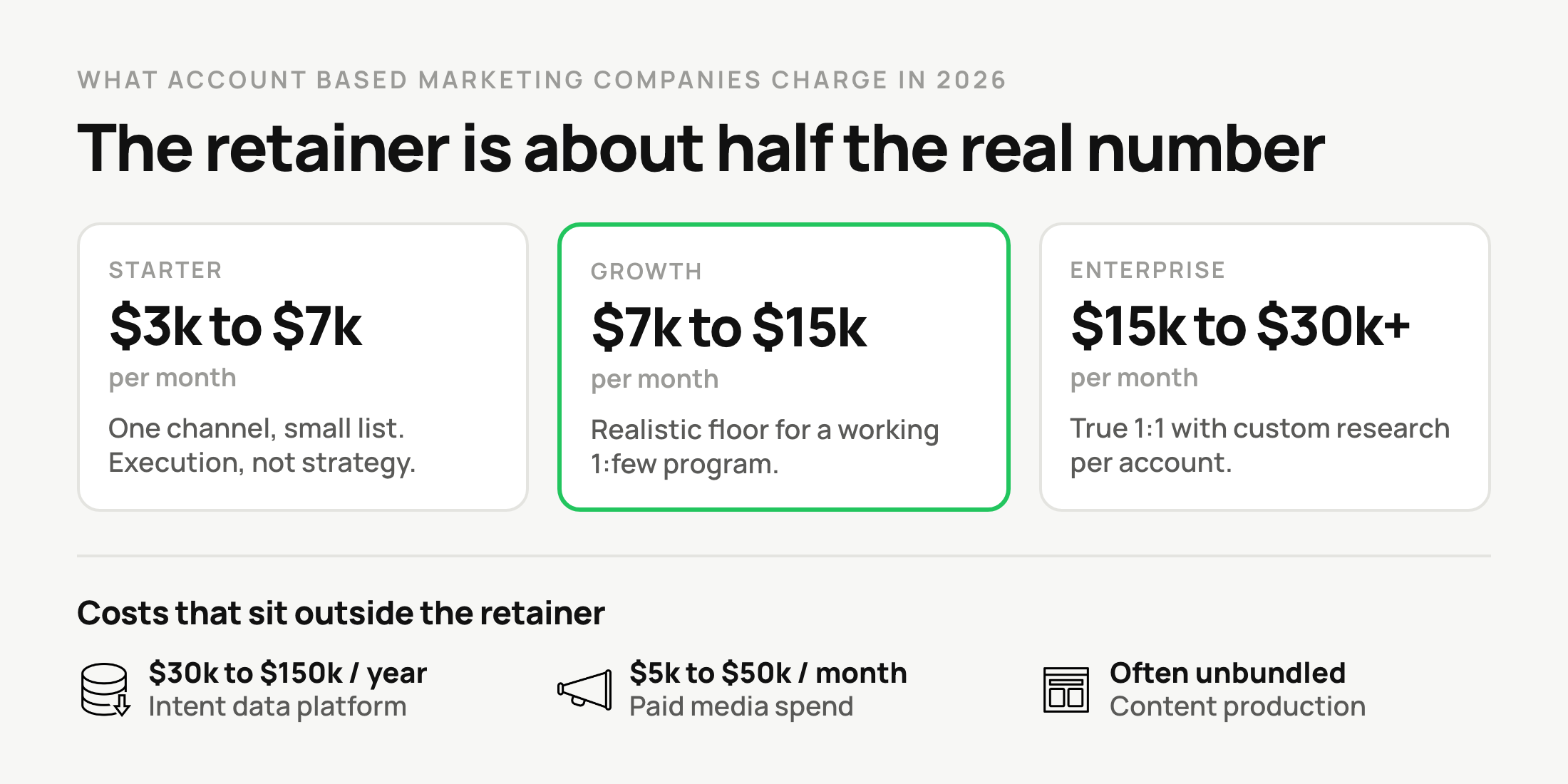
Starter: $3,000 to $7,000 a month. Usually one channel and a small target list. At this level you're buying execution rather than strategy. Expect a shared account manager and templated research.
Growth: $7,000 to $15,000 a month. The realistic floor for a working mid-market 1:few program. You get named strategists, cluster-level content, and sales enablement material. Most companies that succeed with an agency sit here.
Enterprise: $15,000 to $30,000+ a month. True 1:1 programs with custom research per account. Hourly rates at specialist firms in this band run $200 to $350.
The Costs That Aren't in the Retainer
The retainer is roughly half the real number. Intent and account data platforms run $30,000 to $150,000 a year depending on seats and data volume. Paid media is separate and typically $5,000 to $50,000 a month. Add content production if it isn't bundled.
A functioning program lands between $10,000 and $40,000 a month all in. Budget the platform license before you budget the account based marketing agency. Teams that do it the other way around end up with strategists and no data to point them at, which is the most expensive way to run ABM badly. The same mistake shows up across agency versus in-house marketing decisions, where sticker prices get compared and the surrounding costs don't.
When Hiring an Account Based Marketing Agency Is the Wrong Purchase
Four situations where the retainer is a mistake, and none of them are about agency quality.
You need 1:many and you're being sold 1:1. This is the most common mismatch in the category. If your target list is 400 accounts and your average deal is $25,000, the unit economics don't support custom research. Buy the data layer and a media operator.
Sales isn't aligned yet. If your sales team doesn't agree on the target account list, an agency will produce beautiful campaigns aimed at accounts nobody follows up on. Fix the list first. That's a two-week internal exercise rather than a six-figure engagement.
You have fewer than about 25 accounts with real buying signals. Below that threshold the whole thing is closer to strategic selling than marketing. Your AEs and a decent researcher will outperform any program. Account based marketing strategies need enough accounts to justify building repeatable assets.
Your actual problem is top-of-funnel volume. ABM concentrates effort on accounts you've already picked. If you don't have a defensible list yet, you have a demand generation problem, and those are different vendors entirely. Settle the difference between demand generation and lead generation before you go shopping, because agencies will happily sell you ABM for a problem ABM doesn't touch.
How Do You Tell a Real ABM Agency From a Rebranded Demand Gen Shop?
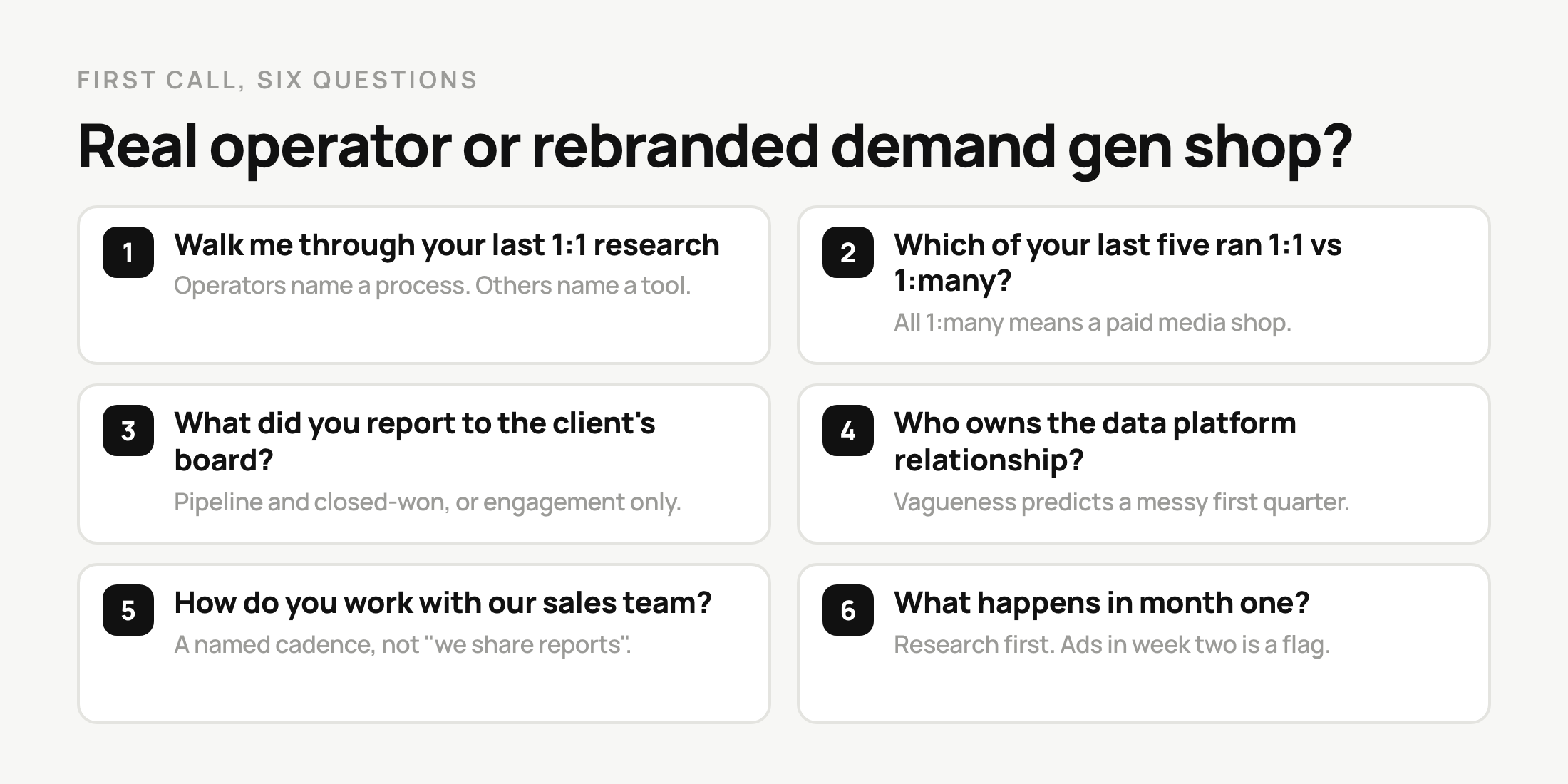
Ask six questions on the first call. The answers separate operators from repositioned lead gen vendors faster than any case study review.
"Walk me through the account research on your last 1:1 program." Real operators describe a process: sources, buying group mapping, and how insights reached the creative team. Repositioned shops describe a tool.
"Which of your last five clients ran 1:1 versus 1:many?" If everything was 1:many, you're talking to a paid media agency with ABM in the deck. That may be fine, but price it accordingly.
"What did you report to the client's board?" The good answer names pipeline and closed-won from target accounts. Only 13% of marketers report closed-won revenue to leadership, so an account based marketing agency that does it routinely stands out immediately.
"Who owns the data platform relationship?" You want a clear answer about whether they operate your instance, recommend one, or need you to own it entirely. Vagueness here predicts a messy first quarter.
"How do you work with our sales team?" Listen for a cadence and named roles. A weekly account review with SDR leadership is a real answer. "We share reports" isn't.
"What happens in month one?" Strong agencies front-load research and produce an account plan before any campaign runs. If the answer is "we launch ads in week two," the research isn't happening.
Cross-check whatever you hear against how these firms show up elsewhere. A head-to-head like Power Digital versus Directive tells you more about positioning than a sales deck does, and our ranking methodology explains what the directory weighs.
The Measurement Fight You Need to Win Before Month Three
Agree on measurement at contract signature, because by month three everyone has an incentive to move the goalposts. Most buyers skip this and most regret it.
The numbers make the case. Among 634 B2B marketers, 39% report marketing qualified accounts to their board and 22% report pipeline from target accounts. Just 13% report closed-won revenue. Marketing is measuring the top of the account funnel and calling it ABM performance.
Instrument Three Account-Level Metrics at Signing
Track account coverage, meaning the share of the buying group you've reached at each target account. Track qualified account conversion, which is target accounts that became real opportunities. Then track pipeline value from the named list, separated from everything else in your CRM.
Set these up before the first campaign launches. Retrofitting account-level reporting into a CRM built around leads takes six weeks, and no agency will pause the program while you do it.
Agree on the Timeline Before Anyone Reports a Number
Practitioner reports put the first closed deal from a new program somewhere around eight to nine months out, with positive return closer to 14 months. If your sales cycle is nine months, no set of account based marketing strategies produces revenue proof in two quarters. That's arithmetic rather than agency performance.
Write the review schedule into the contract. Month three reviews coverage and research quality. Month six reviews qualified accounts and opportunity creation. Month twelve is the first honest revenue conversation. Anyone promising closed-won proof by month four is selling to a very short sales cycle or selling you something else. The same discipline applies when you choose a B2B lead generation agency, where short-cycle promises are equally common and equally unreliable.
Bottom Line
The question isn't which account based marketing agency is best. It's which tier your revenue math supports, and whether that tier needs an agency or a data platform and a good operator. At 1:1 and 1:few, the retainer buys research and senior strategy your team can't staff. At 1:many, you're usually buying paid media at consulting prices.
Get your target list agreed with sales. Pick your tier. Budget the data layer first, then settle account-level measurement before signing anything. Do those four things and the vendor choice gets much easier.
When you're ready to build a shortlist, the marketing agencies directory is a reasonable place to start comparing.
Frequently Asked Questions
What are account-based marketing services?
They cover six areas. Those are ICP development and target account research. Then value proposition and content creation, campaign orchestration, sales enablement, and account-level reporting. Smaller engagements usually include only execution and reporting. Confirm which of the six are actually in scope, since research is the piece most retainers quietly drop.
How much does ABM typically cost?
Agency retainers run $3,000 to $7,000 a month at the starter level. A working mid-market program costs $7,000 to $15,000. Enterprise 1:1 work starts around $15,000. Add $30,000 to $150,000 a year for an intent data platform. Media is separate again. Full programs generally land between $10,000 and $40,000 a month.
What is paid ABM?
Paid ABM is the advertising layer: ads targeted at companies on your account list rather than at individual interest profiles. LinkedIn and account-level display platforms carry most of it. It's one channel inside a broader program. Buying it alone gives you targeted advertising without the research and sales alignment that make ABM work.
What is the difference between an ABM agency and an ABM platform?
A platform is software that identifies accounts, scores intent signals, and serves account-level ads. An abm marketing agency is a team that decides which accounts matter and builds the messaging. Platforms cost $30,000 to $150,000 a year and still need someone to operate them. Most companies need both, and buying the agency first is the more common ordering mistake.
How long does it take to see results from an ABM agency?
Engagement signals appear within 60 to 90 days. Qualified accounts and opportunities take four to six months. Practitioner reports put the first closed deal around eight to nine months, with positive return closer to 14 months. It tracks your sales cycle more than anything a vendor controls. Any promise of closed revenue inside two quarters deserves a hard follow-up question.
Can a small marketing team run ABM without an agency?
Yes, at the 1:few and 1:many tiers, if you have one person who can own account research and a data platform to work from. Well established programs average four to five dedicated people. A two-person team should narrow to 30 or 40 accounts rather than attempting a broad program. The constraint is research hours rather than skill.
How many target accounts do you need before ABM makes sense?
Roughly 25 accounts with real buying signals is the practical floor. Below that, your AEs working the accounts directly will outperform any program, because there aren't enough accounts to justify building repeatable content and plays. Above 150 accounts you're into programmatic territory, where the data platform matters more than the agency you hire.
What happens to the program if we end the agency relationship?
That depends entirely on what you negotiated. Ask who owns the account research, the ICP documentation, and the platform instance. Good account based marketing companies hand over a documented playbook and keep the data platform in your name. Put the transition terms in the contract, because the research is the asset you're paying for and it should survive the relationship.
Top Marketing Agencies in 2026
Ranked by our editorial score across 1,481 listed marketing agencies.


Related Articles
LinkedIn Marketing Agency: 4 Lanes Hiding Behind One Label
A LinkedIn marketing agency can mean four different businesses. Compare the lanes, 2026 pricing and the budget math before you sign.
What a Performance Marketing Agency Is vs PPC or Growth
A performance marketing agency is paid for incrementality and MER, not last-click ROAS. How it differs from PPC or growth, plus a 30-day proof.
Marketing Agency vs In-House Team: The Math Most Companies Get Wrong
Agency vs in-house marketing compared on real costs, AI impact, and when hybrid actually works. Data-backed framework for 2026.
More Insights

Top Healthcare Software Development Companies for Every Specialty
Find top healthcare software development companies by specialty: EHR integration, telehealth, FDA-regulated devices, and patient engagement apps compared.

Best Content Marketing Agencies: How to Pick the Right Type
Learn to identify the four types of content marketing agencies and match the right one to your content maturity, budget, and business goals.

What is a Lead Generation Agency? Complete Guide
Discover what a lead generation agency does, how lead generation specialists work, and whether outsourcing lead gen is right for your business in 2026.