
7 Things to Vet Before Hiring a Web Application Development Company
7 things to vet before hiring a web application development company, from data design to code ownership. Third-party breaches doubled to 30% in 2025.


You search for a web application development company in the US and get ten lists in a row. Each one is written by a firm that ranks itself first. Half the "web development" shops on those lists build marketing sites, not software with logins, data and business rules. And you won't find out which half until the backend starts falling apart.
You don't need another self-ranked web application development company list. You need a way to judge any firm you find, including the ones in the software agencies directory. So this article sticks to the checks that predict whether a web app survives real users.
This guide covers seven things to vet before you sign: how to spot a website shop dressed up as a software firm, which app-specific skills to test for, and the ownership terms that keep you from being held hostage after launch.
TL;DR
- Confirm the firm builds web applications with logins, databases and business logic, not websites that only look like apps.
- Ask for two case studies of the same type of app you're building: SaaS (software as a service) product, customer portal, internal tool or marketplace.
- Judge how a web application development company explains its stack, not which framework it names.
- Press hard on data design, permissions and integrations. That's where web apps break in production.
- Get the code repository, cloud account, domain and post-launch terms in your name and in writing before you sign.
1. Is It a Web Application Development Company, or a Website Shop?
The first filter is simple: does this firm build software, or does it build sites? A real web application development company ships products where users sign in, data changes per person and business rules run on a server. Plenty of agencies sell both under the label "web development," and the portfolio is where the difference shows.
A web application is software you use in a browser. It has authenticated users, a database and rules about who can do what. It usually connects to other systems too. Think of a customer portal where clients pay invoices. Or a booking system, a SaaS dashboard, or an internal tool where managers approve purchase requests. A website is mostly content: pages, a CMS (content management system, the editor your marketing team uses) and a few forms.
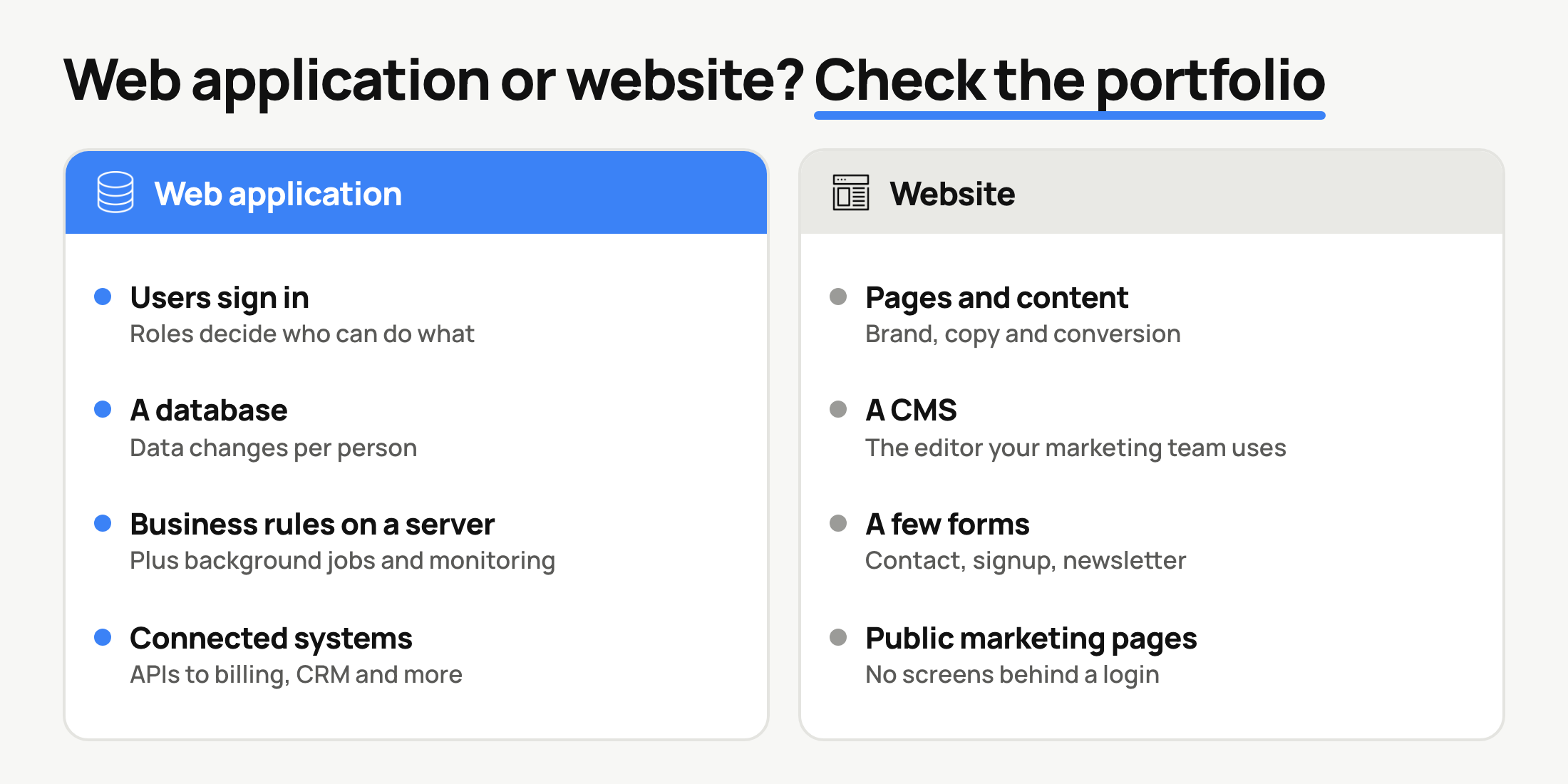
What does a web application company do that a web design agency doesn't?
It designs data, not just pages. A good web design agency is excellent at brand, copy, CMS setup and conversion. Those are real skills. But they run out at the backend: user roles, data migrations and background jobs. The same goes for uptime monitoring and the API (application programming interface, the way two systems exchange data) that connects your app to billing or your CRM.
Picture a firm that built a beautiful marketing site for a logistics company. Now ask it to build a shipment-tracking portal where 400 customer accounts each see only their own loads. That's a different job. It needs a data model, permission checks on every request and a plan for what happens when the carrier's API goes down at 2 a.m.
If what you actually need is a marketing site, don't overpay a software firm for it. The best web design agencies list is the right starting point for that job.
Portfolio signals that give a website shop away
Before a firm makes your shortlist, read three of its case studies and check for these signals:
- Users and roles. Real app case studies describe who logs in and what each role can do. Website case studies describe "a fresh look."
- Logged-in screens. Look for dashboards, tables and admin panels, not only homepages and hero images.
- A named backend and hosting setup. Strong firms say what runs on the server and where it's hosted, and they often still run it.
The red flag is easy to spot: every case study links to a public marketing site and nothing else. If the firm can't show you a single screen behind a login, it hasn't proven it can build one. Ask for a recorded walkthrough of a live app under NDA. A custom web application development company that does this work will have one ready.
2. Experience With Your Kind of Web App
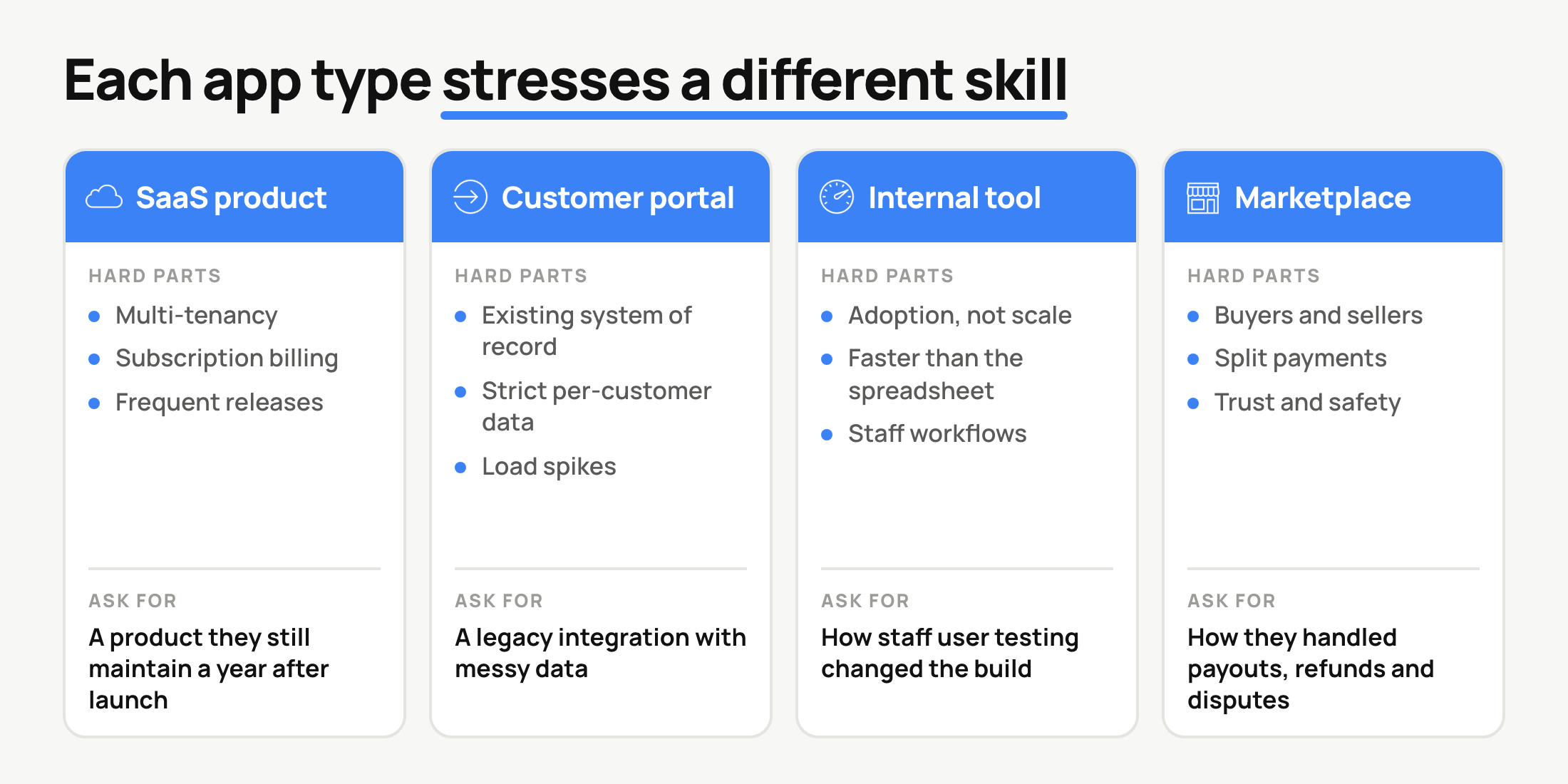
"Web app" covers very different builds, and each one stresses a different skill. Ask every web app development company on your list for two case studies of the same kind of app you're building. Then use the notes below to judge whether those case studies prove anything. There's no single best web application development company for every project. There's the best one for your type of app.
SaaS products
A SaaS product sells subscriptions to many customers from one codebase. That means multi-tenancy, where one app serves many customer accounts and keeps their data separate. It also means subscription billing, self-serve onboarding, usage analytics and releases every week or two. The OWASP Multi-Tenant Security Cheat Sheet puts the stakes plainly: a single vulnerability can expose every tenant's data.
Ask for: a product the firm still helps maintain at least a year after launch. Launching is easy. Year two is the test.
Customer portals
A portal gives your existing customers a logged-in view of their account, orders, documents or payments. The hard parts are connecting to your existing system of record (your ERP, short for enterprise resource planning system, or whatever database already holds the truth) and scoping data strictly per customer. Load is usually read-heavy and arrives all at once, like on the first of the month when invoices go out.
Ask for: an example of how they connected a portal to a legacy system and what they did when that system's data was messy.
Internal tools and dashboards
Internal tools replace spreadsheets, email chains and copy-paste between systems. Scale rarely matters here. Adoption does. Say your operations team runs approvals through a shared spreadsheet that six people edit. The new tool fails if it's slower than the spreadsheet, no matter how clean the code is.
Ask for: how they ran user testing with staff before launch, and what changed because of it.
Marketplaces
Marketplaces have two kinds of accounts, buyers and sellers, plus payments that split money between parties. Tools like Stripe Connect exist for exactly that: collecting a payment and paying out a portion to the seller. Add trust and safety, search and dispute handling, and a marketplace becomes one of the hardest web apps to get right.
Ask for: how they handled payouts, refunds and disputes on a past marketplace build.
If your project doesn't fit any of these types, step back and check whether you need custom software at all. The guide to custom software vs off-the-shelf tools walks through that call. For shortlists organized by project size and type, see these custom software development companies by project type.
3. Why They Picked the Stack, Not Which One They Use
The framework debate is mostly a distraction for buyers. Most "best web application development company" roundups spend thousands of words on React vs Angular and Node vs .NET. But nearly every competent web app development company ships on a mainstream stack, and projects rarely fail because of the framework.
The basics are shared by everyone. Every web app runs on HTML, CSS and JavaScript in the browser. The popular tools on top of them are popular for a reason. In the Stack Overflow 2025 Developer Survey, 48.7% of respondents reported using Node.js and 44.7% used React. And GitHub's Octoverse 2025 report found that TypeScript overtook Python and JavaScript in August 2025 to become the most used language on GitHub. Any of those choices gives you a deep hiring pool.
So what should you actually test? Whether the firm can explain its choice in terms of your app. Ask three questions:
- Could I hire developers for this stack in my market? You'll want that answer if you ever bring the app in-house. The guide to in-house vs outsourced development covers when that shift makes sense.
- What will hosting cost at our expected usage? A good firm gives you a rough monthly figure and the assumptions behind it.
- Which parts are proprietary to your firm? This is the question that matters most.
"We use the same stack on every project because our team knows it well" is an honest answer. It's fine if that stack is mainstream. The real red flag is "we built our own framework" or a niche platform only that firm supports. That's not a technical choice. It's lock-in.
Once the stack answer checks out, move on fast. The questions that actually predict success are about data, permissions and ownership.
4. How Will They Design Your Data and Permissions?
This is where web apps break in production, and where website shops have no answers. Before any code gets written, ask each custom web application development company you're vetting to walk you through how it would model your data and who can see what. Its answer shows whether it thinks in users, roles and tenants or in pages.
The stakes are real. The OWASP Top 10:2025 ranks broken access control as the number one web application security risk. OWASP also reports that 100% of the applications tested showed some form of it. Access control is the logic that decides whether a user may see or change a given record. When it breaks, one customer sees another customer's invoices.
How do they keep one customer's data away from another's?
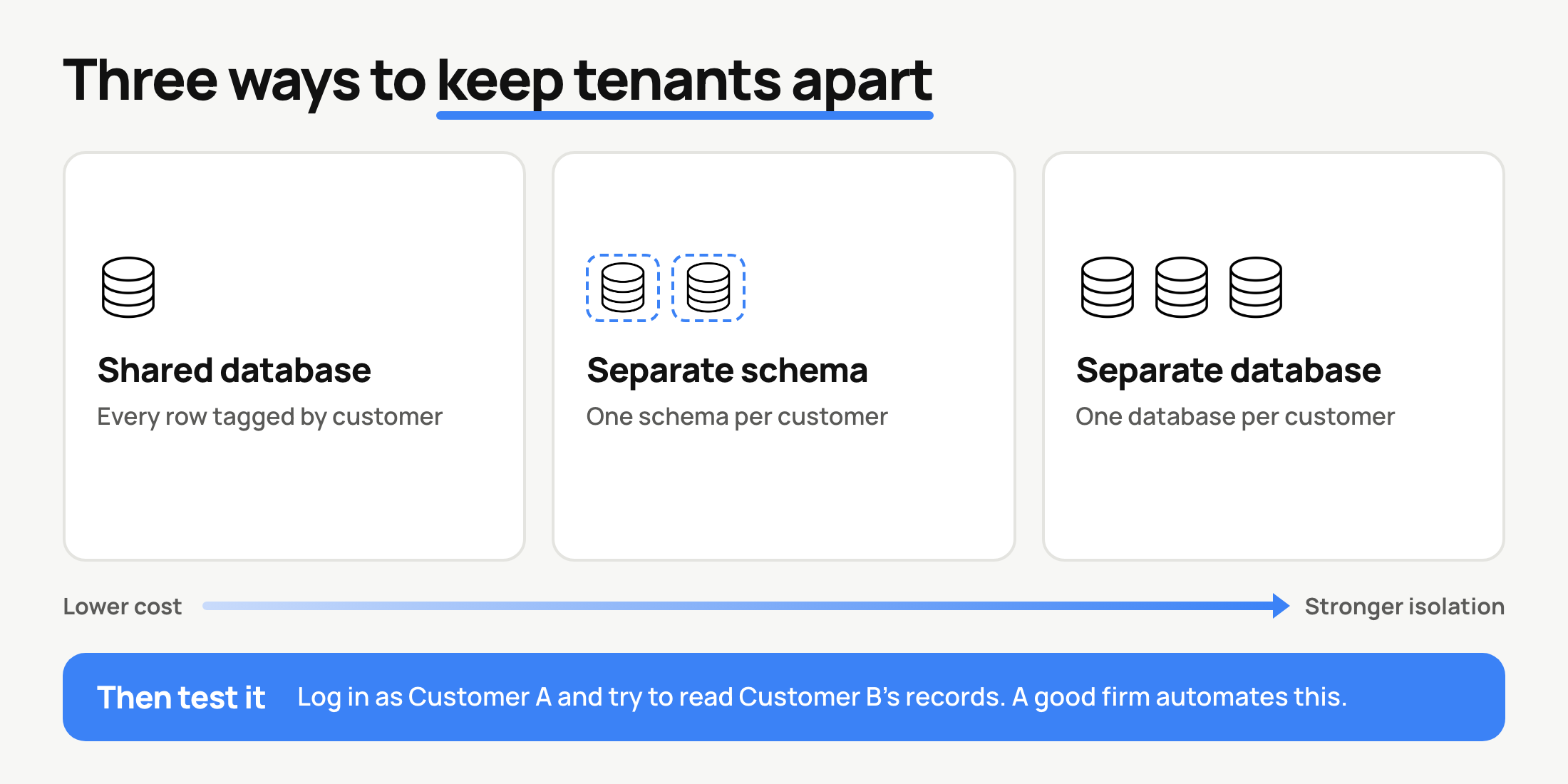
If you're building a SaaS product or a portal, ask how tenant isolation works. There are a few common patterns. All customers can share one database with every row tagged by customer. Each customer can get a separate schema. Or each one gets a separate database. Each pattern trades cost against isolation, and a good firm explains why it picked one for your case.
Then ask how they test it. OWASP's multi-tenant guidance recommends verifying tenant isolation directly rather than assuming it. A strong answer mentions automated tests that log in as Customer A and try to read Customer B's records. A vague answer, or no answer, is a red flag.
Who can see and change what?
Ask the firm to sketch the roles for your app on a whiteboard, such as admin, manager and external user. This is role-based access control, often shortened to RBAC, where permissions attach to roles instead of to individual people. Then ask where the checks live.
The right answer is "on the server, on every request." The wrong answer is hiding buttons in the interface. A hidden button doesn't stop anyone who calls the API directly, which is exactly the kind of flaw that puts broken access control at the top of OWASP's 2025 list.
Request a sample permissions matrix or data model from a past project. Redacted is fine. A firm that does this work has one.
What will sign-in look like for your users?
Authentication is how users prove who they are. For most apps that means email and password plus MFA (multi-factor authentication, such as a code from an app). If you sell to larger companies, add SSO (single sign-on). It lets employees log in through their company's identity provider using standards like SAML or OIDC. Enterprise buyers will ask for it, usually right before they sign.
Authentication failures hold the A07 spot in the OWASP Top 10:2025 list. And NIST's current digital identity guidelines (SP 800-63B-4) now require systems at AAL2, the assurance level NIST describes as giving high confidence in a user's identity, to offer a phishing-resistant sign-in option. You don't need to read either document. You do need a firm that uses a proven auth provider rather than writing its own login system from scratch. Ask which one they use and why.
5. Integrations and Performance Under Real Data
Most web apps live or die on two things. The first is what they connect to: payments, CRM, ERP and email tools. The second is how they behave once the database holds three years of real records instead of 50 demo rows. "Do you do integrations?" tells you nothing, since every firm says yes. Ask these instead:
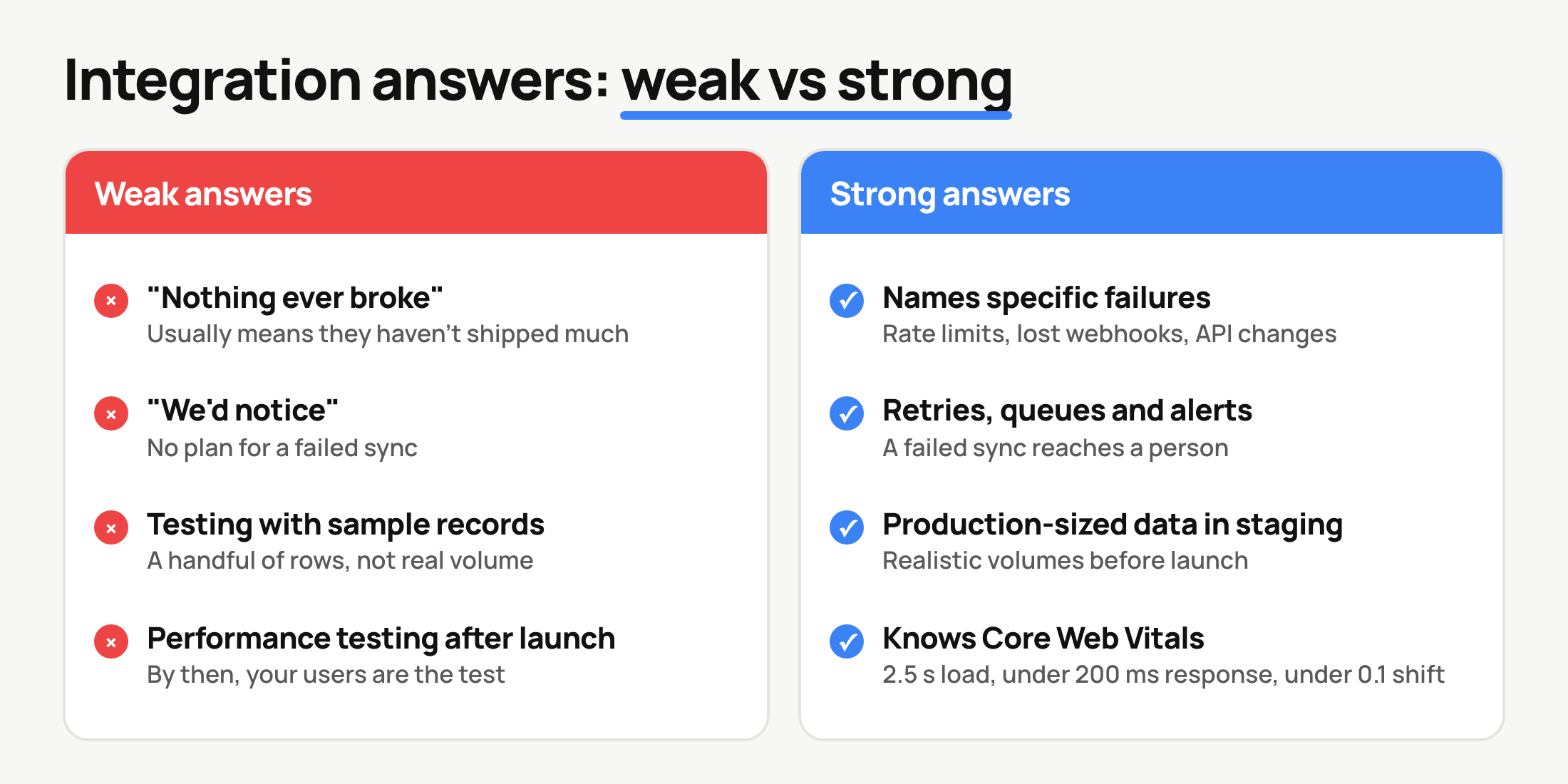
- "Which third-party APIs have you shipped against, and what broke?" A good answer names specific failures: rate limits (caps on how many requests an API accepts per minute), webhooks that failed silently, or a vendor that changed its API without warning. A firm that says nothing ever broke hasn't shipped much.
- "What happens when a sync fails?" Listen for retries, queues and alerts that reach a person. Webhooks are automatic messages one system sends another when something happens, and they do get lost. The weak answer is "we'd notice."
- "How do you test with production-sized data?" Good firms load realistic volumes into a staging environment (a private copy of the app used for testing) before launch. Weak firms test with a handful of sample records.
- "What's your plan for a slow page?" Expect database indexes, caching and background jobs for heavy work like report exports.
- "How do you measure front-end speed?" Google's Core Web Vitals give a shared yardstick. They target loading within 2.5 seconds, responses to clicks in under 200 milliseconds and a layout-shift score under 0.1. A firm should know those numbers without looking them up.
Integrations also widen your attack surface. The 2025 Verizon Data Breach Investigations Report found that third-party involvement in breaches doubled to 30%. Ask how the firm stores API keys and limits what each integration can access.
The red flag here is "we'll do performance testing after launch if needed." By then, your users are the test.
To see how two web-app-focused firms compare on this kind of work, look at a side-by-side such as LaunchPad Lab vs The Gnar Company.
6. Who Owns the Code, Cloud, and Accounts
This is the check buyers skip and later regret. Even the best web application development company can get acquired, lose key staff or go quiet, and you need a clean way out. An IP (intellectual property) clause in the contract isn't enough. A web app also runs on a cloud account, a domain and DNS settings (the records that point your domain at your servers). Add an email sender, a payment account and a dozen keys for third-party services. If the firm holds those, switching vendors turns into a hostage negotiation.
A custom web application development company that's confident in its work has no reason to hold your accounts. If one resists putting them in your name, treat that as an answer.
What should you own on day one?
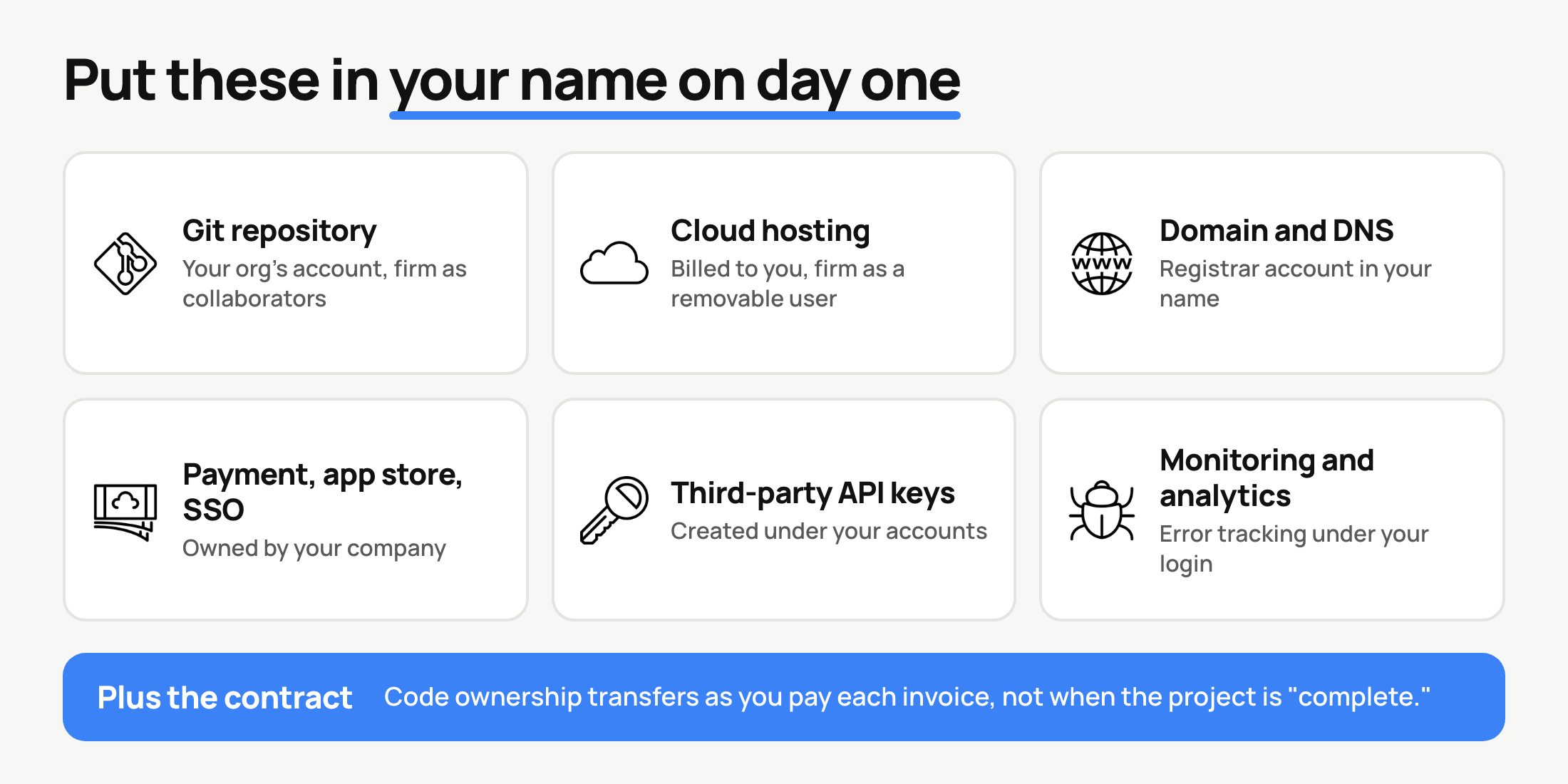
Put this checklist in the contract, not in a kickoff email:
- Git repository in your organization's account, with the firm added as collaborators.
- Cloud hosting account (AWS, Google Cloud, Vercel or similar) billed to you. Add the firm as a user you can remove.
- Domain and DNS registrar in your name.
- Payment processor, app store and SSO accounts owned by your company.
- Third-party API keys created under your accounts.
- Error monitoring and analytics under your login.
Then check the IP assignment clause. Code ownership should transfer when you pay each invoice, not when the whole project is "complete." A finish line that never comes is a common way to keep you stuck. For the rest of the contract terms, the guide on how to choose a software development company covers the general checklist, so it isn't repeated here.
What does a clean handoff look like?
Run a simple test. Could a new developer get the app running locally from the README, the setup guide stored with the code, in one working day? If the answer is "you'd need to call us," the documentation isn't done.
Then ask the firm when it last handed a project to another team or to a client's in-house staff. Ask if you can call that client. Imagine you're the one making that call 18 months from now. You'd want the previous vendor to have left a working setup guide, environment variables documented and no surprise accounts in its own name.
The red flag is "we host it for you" with no export path. Managed hosting is fine. Hosting you can't leave isn't.
7. What Happens After Launch Day?
A web app is never finished. Browsers change, libraries need security patches and users ask for release two the week after launch. Vet the post-launch terms and the real cost of keeping the app running before you sign the build contract, not after.
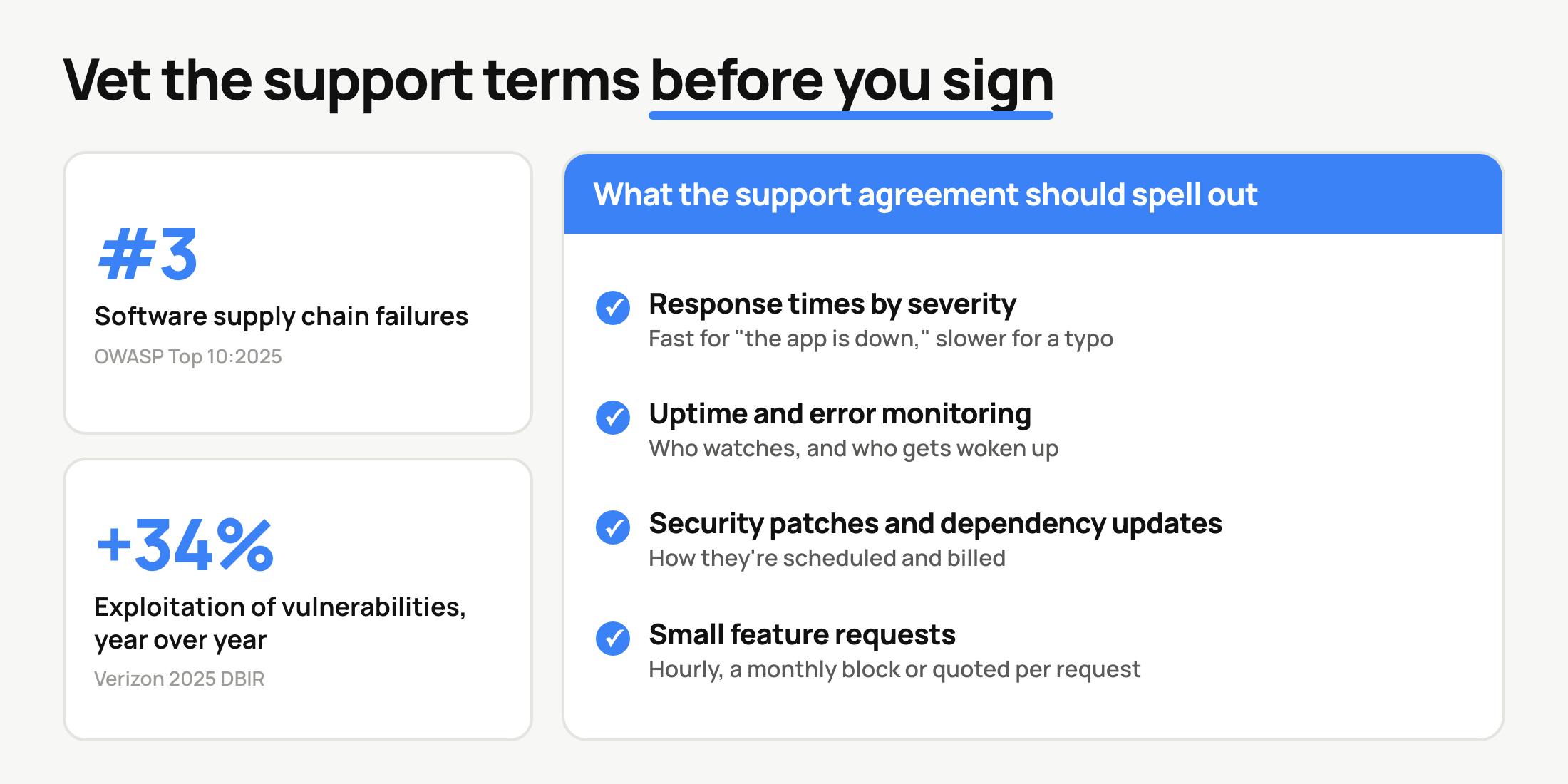
Dependency updates aren't optional housekeeping. Software supply chain failures, meaning risks from the third-party code your app depends on, climbed to number three in the OWASP Top 10:2025. And Verizon's 2025 breach report found that exploitation of vulnerabilities rose 34% year over year. Someone has to apply patches every month. Find out who.
A support agreement should spell out:
- Response times by severity, such as within one hour for "the app is down" and next business day for a typo.
- Who monitors uptime and errors, and who gets woken up when something fails.
- How security patches and dependency updates are scheduled and billed.
- How small feature requests are priced, whether by the hour, from a monthly block or quoted per request.
Hosting and third-party services are a separate monthly line you pay directly. Include them in your budget from day one. Then plan for ongoing development as a recurring cost, not zero. The share varies widely by app, so ask each firm what its existing clients actually spend per year after launch. For build cost ranges by project type, this roundup of custom software firms has the numbers.
Ask one more question: who builds release two? A custom web application development company should answer that without hesitating. Some firms keep the original team on your account. Others move you to a rotating support bench that has never seen your code. Neither is wrong, but you should know which you're buying.
Location changes the math too. A US-based web application development company gives you full workday overlap but usually bills more than a nearshore team. The guide to nearshore vs offshore development breaks down how rates and time-zone overlap trade off.
The red flag: a firm that only quotes the build. It's either hoping you won't ask or planning to price support once you can't easily leave.
What to Do Next With These 7 Checks
Start with an independent shortlist, not a web application development company list written by one of the firms on it. Pick three to five firms whose case studies match your app type. Send every firm the same one-page brief, then score each one on the seven checks. Weigh data design and account ownership most heavily, because those are the hardest to fix later.
The best web application development company for your project is the one that gives specific answers to sections 4 and 6, not the one with the slickest portfolio. Strong directory profiles like LaunchPad Lab and thoughtbot show what good answers look like.
For a web application development company list that no vendor wrote, start with the top software agencies for custom development or the broader software development company rankings, and read how the rankings are built. When you're ready to compare, browse vetted software agencies or put two finalists side by side.
Frequently Asked Questions
What does a web application developer do?
A web application developer builds software that runs in a browser. That includes the screens users log into, the server logic, the database and the integrations with tools like payments or a CRM. A web designer focuses on look, content and marketing pages. Most production web apps need 2 skill sets, frontend and backend, which is why firms staff both.
How much does it cost to build a web application in the US?
It depends on the app type, the number of user roles and the integrations. A simple internal tool and a multi-tenant SaaS product sit far apart on price. The guide to top custom software development companies lists ranges by project type. Budget separately for hosting and at least 12 months of post-launch support.
What are the big 3 of web development?
HTML structures the page, CSS styles it and JavaScript adds behavior. MDN's web standards overview calls them the 3 main technologies used to build for the web. Every firm uses them, so they don't separate one vendor from another. Judge how a firm explains its choices on top of them instead.
Is a US-based web app firm worth the higher rate over a nearshore team?
Hiring a web application development company in the US can be worth it when you need full working-hour overlap, US compliance experience or close collaboration with non-technical stakeholders. Nearshore teams in Latin America often share most of your workday at lower rates. Try a 2-week paid trial sprint before you commit to either. The nearshore vs offshore guide compares the tradeoffs by region.
How do I find the best web app development company for my project?
Start from an independent shortlist like the custom development agency rankings, not a web application development company list a vendor wrote about itself. Filter to 3 to 5 firms with case studies matching your app type. Send each the same brief and score their answers on the 7 checks. The directory's methodology explains how those rankings are built.
How long does it take to build a web application?
A focused MVP (minimum viable product) or internal tool usually takes a few months. A multi-tenant SaaS product or a complex portal takes longer. Timelines stretch most from unclear scope, integration surprises and slow feedback from the buyer's side. Ask each firm for a phased plan with a working release every 2 weeks so you can see progress early.
Which pricing model works best for a web app project: fixed price or time and materials?
Fixed price suits a tightly defined first release. Time and materials, or a dedicated team, suits a product that will keep changing. Either way, start with a paid discovery phase of 2 to 4 weeks so the estimate rests on real scope. The guide on choosing a software development company covers contract detail.
Can I switch to a different company after launch if things go wrong?
Yes. You need to own the repository, cloud account, domain and third-party accounts. The code also needs documentation good enough for a new team to run it locally within 1 day. Switching still costs time. Expect a few weeks while the new web app development company gets up to speed on your codebase.
Should I build a web app or a mobile app first?
For most B2B tools, portals and early products, build the web app first. It's cheaper, works on every device from 1 codebase and updates instantly without app store review. Mobile first makes sense when the product depends on device features like the camera or GPS. The mobile app development companies guide covers that decision.
Top Software Agencies in 2026
Ranked by our editorial score across 1,819 listed software agencies.


Related Articles
Top Custom Software Development Companies by Project Type
Find top custom software development companies matched to your project type. MVP specialists, enterprise modernizers, and AI engineers compared with pricing.
How to Choose a Software Development Company Without Getting Burned
Learn how to choose a software development company with a 5-point framework, real cost breakdowns, and red flags to avoid getting burned.
Best Mobile App Development Companies: How to Choose in 2026
Compare the best mobile app development companies by use case. Covers costs, evaluation criteria, and company recommendations for 2026.
Custom Software vs Off-the-Shelf: How to Choose
Custom software vs off the shelf: compare costs, timelines, scalability, and fit. Learn which approach makes sense for your business in 2026.
More Insights

Top Healthcare Software Development Companies for Every Specialty
Find top healthcare software development companies by specialty: EHR integration, telehealth, FDA-regulated devices, and patient engagement apps compared.

Best Content Marketing Agencies: How to Pick the Right Type
Learn to identify the four types of content marketing agencies and match the right one to your content maturity, budget, and business goals.

What is a Lead Generation Agency? Complete Guide
Discover what a lead generation agency does, how lead generation specialists work, and whether outsourcing lead gen is right for your business in 2026.