
Hiring a Fintech Marketing Agency: Costs, Red Flags, and Top Picks
Hiring a fintech marketing agency? Most retainers start at $6K to $12K a month. See 2026 price anchors, six pitch red flags, and five picks with rates.


You search for a fintech marketing agency and page one hands you four ranked lists. Siege Media ranks Siege Media first. Right Left ranks Right Left first. Mint Studios lists itself as "#0," above everyone it reviewed. None of that is a scandal, but it leaves you with no neutral way to judge anyone. And in fintech a bad hire costs more than a wasted retainer, because every headline still has to clear your compliance review.
This guide is written from the buyer's side of the table. It treats those self-ranked lists as lead sources and judges each fintech marketing agency on fit, price, and how it handles regulated claims. The picks draw on directory profile data scored with a published rating methodology, not on who wrote the list.
In this guide you'll get real 2026 price anchors and six red flags that should end a pitch. You'll also get a five-agency shortlist with rates, minimums, and a clear "skip if" for each.
TL;DR
- Every "best fintech agencies" list ranking on Google was written by an agency, and three of the four put themselves on top. Use them as lead lists, not verdicts.
- Name your segment before you shortlist. A payments API selling to CFOs and a consumer lending app need different agencies.
- Published fintech retainers mostly start between $6,000 and $12,000 a month. Directory hourly rates run from $50 to $300.
- The biggest red flag is a fintech marketing agency that can't walk you through its claims-review workflow.
- Shortlist three, then pay one for a small test brief that goes through your real legal review.
What Kind of Fintech Marketing Agency Does Your Segment Need?
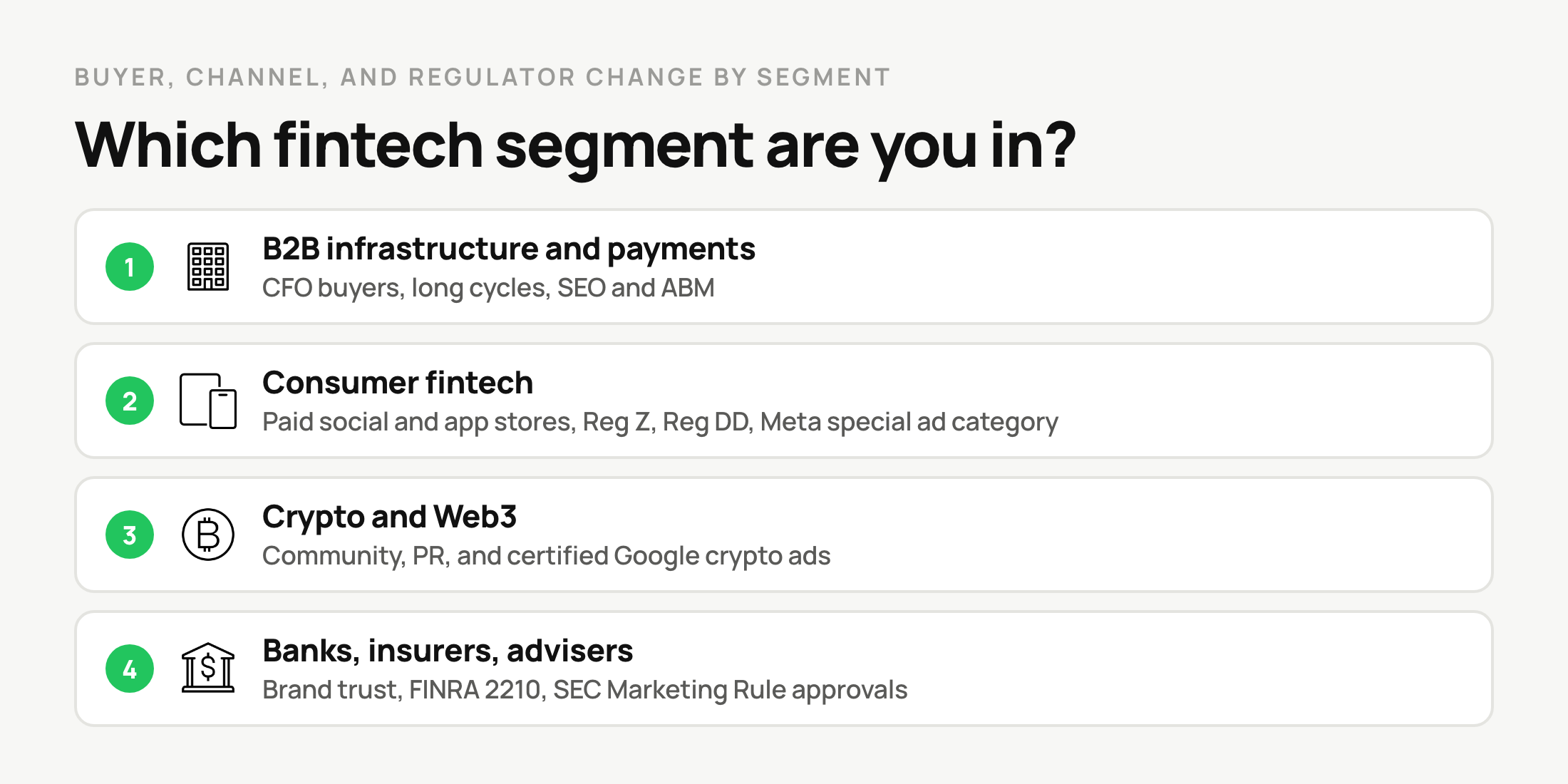
"Fintech experience" means almost nothing until you say which fintech. A fintech marketing agency that grew a crypto wallet and one that sells core-banking software to credit unions share a label and little else. Buyer, channel, and regulator change completely between segments. So decide which of the four segments below you're in, then ask every agency for proof in that segment only.
B2B Infrastructure, Payments, and Embedded Finance
Your buyer is a CFO, a head of product, or an engineering lead. Deals take months and involve a committee. Search and technical content do the heavy lifting. Account-based programs and partner relations fill the gaps. Say you sell card issuing or banking-as-a-service (the plumbing that lets non-banks offer accounts through a partner bank). Your marketing then looks a lot like B2B SaaS.
A good b2b fintech marketing agency writes for a skeptical technical reader and supports sales with account-based marketing when your list of target banks or platforms is short. The compliance load is lighter here. Partner banks still review anything that touches their name, though.
Consumer Fintech: Neobanks, Lending, and Wealth Apps
Consumer fintech runs on paid social and app-store optimization. Referral loops and lifecycle email carry retention. The rules bite hardest here. Mention a payment amount or a repayment period in a loan ad and Regulation Z's triggering-term rule requires you to disclose the APR and full repayment terms. Advertise a savings rate and Regulation DD says it must be stated as an "annual percentage yield."
Deposit products add one more trap. The FDIC's 2024 final rule on misrepresenting insured status (12 CFR Part 328) targets non-banks that imply customer funds are FDIC-insured when they aren't. On Meta, US ads for credit and banking (plus investing and insurance) must run under the Financial Products and Services special ad category (see Jon Loomer's 2025 breakdown). That category removes age and gender targeting. It also blocks ZIP-code targeting.
Crypto and Web3
Crypto growth leans on community and PR. Partnerships and influencers do much of the rest. Paid search is tightly gated. Google's cryptocurrency ads policy requires certification by market, and it bans whole categories such as initial coin offerings. Agencies in this segment, like Bond Finance in the picks below, rarely overlap with agencies that serve regulated US lenders.
Traditional Financial Services: Banks, Insurers, and Advisers
Banks and credit unions usually hire a financial services marketing agency rather than a "fintech" one. So do insurers and wealth firms. The work centers on brand trust, local search, and long approval chains. Broker-dealers live under FINRA Rule 2210, which requires a registered principal to approve retail communications before use. Registered investment advisers follow the SEC's Marketing Rule, published in the Federal Register in 2021, which governs testimonials and performance claims.
A financial services marketing agency that knows these rules builds approval time into every calendar. Healthcare marketers deal with a similar loop, and the healthcare marketing agency guide shows how regulated teams plan around it.
A "Fintech Specialist" Label Is the Wrong First Filter
Match the agency to your buyer first, your channel second, and fintech third. That order sounds backward. It isn't.
Picture a payments infrastructure company selling reconciliation software to mid-market finance teams. Its buyer reads like a SaaS buyer: technical, comparison-shopping, and slow to commit. Now picture a fintech-only shop whose case studies are crypto app installs and neobank referral campaigns. That shop says "fintech" on every page, but it has never sold anything to a CFO. A strong B2B SaaS agency with proof of compliance-reviewed content would likely serve the payments company better.
The picks later in this guide make the same point. First Page Sage and Siege Media aren't fintech-only shops. First Page Sage charges $200 to $300 an hour for thought-leadership SEO aimed at enterprise buyers in any industry. That buyer focus is exactly why it can work as a B2B fintech marketing agency without wearing the label.
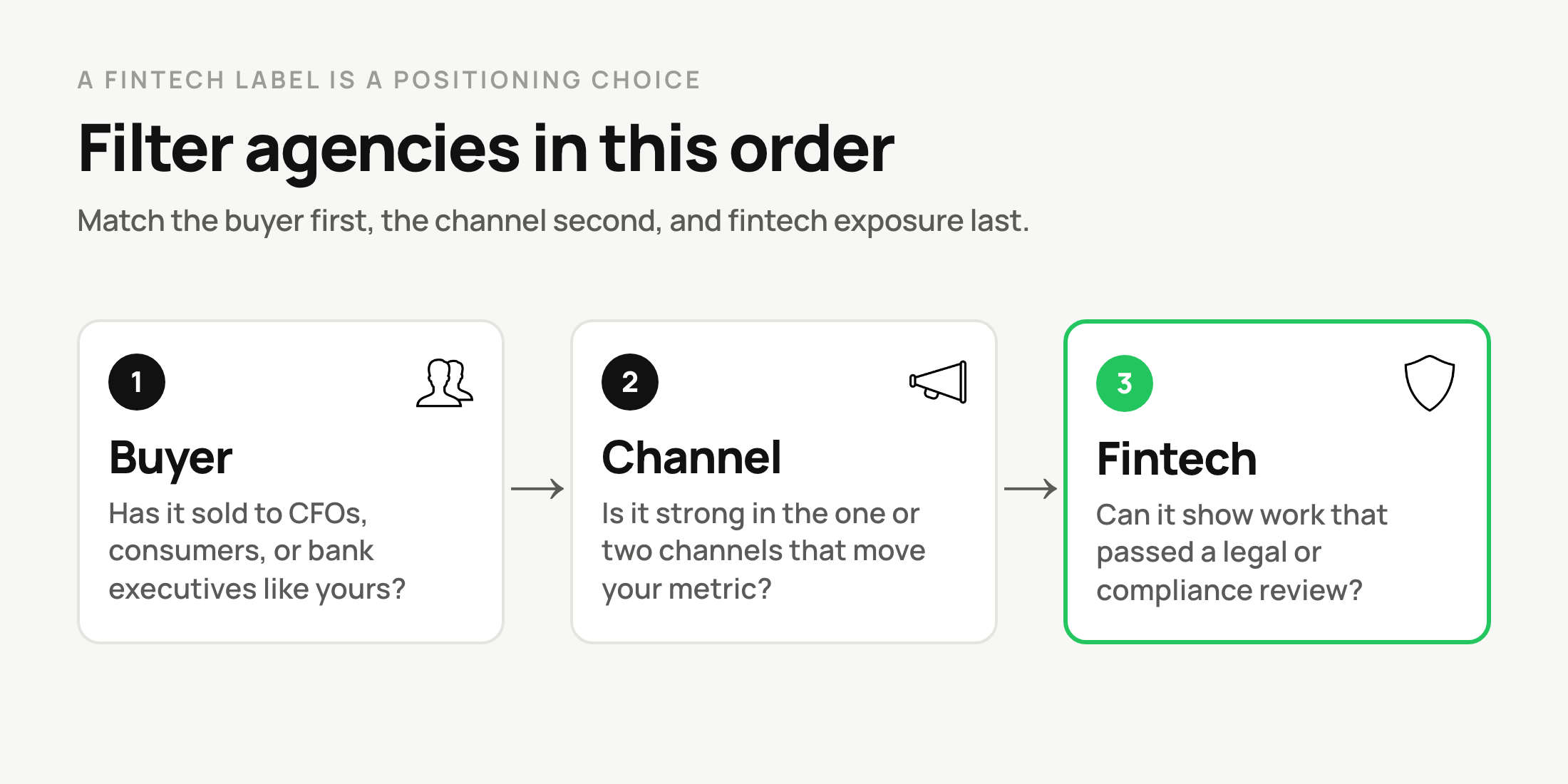
"Fintech" on a homepage is a positioning choice. It isn't a credential, and neither is a spot on someone's best fintech marketing agency list. Run this filter instead:
- Buyer: Has the agency sold to your buyer, whether that's CFOs or consumers or bank executives?
- Channel: Is it strong in the one or two channels that move your metric?
- Fintech exposure: Can it show work that went through a legal or compliance review?
If you sell to businesses, the guide to choosing a SaaS marketing agency and this list of marketing agencies for SaaS companies belong in your search alongside any B2B fintech marketing agency shortlist.
There's one exception. Say you market loans or deposits or brokerage accounts to consumers. Then hands-on regulatory experience moves to the top. A disclosure mistake there isn't a bad week. It's an enforcement risk.
What a Fintech Marketing Agency Costs in 2026
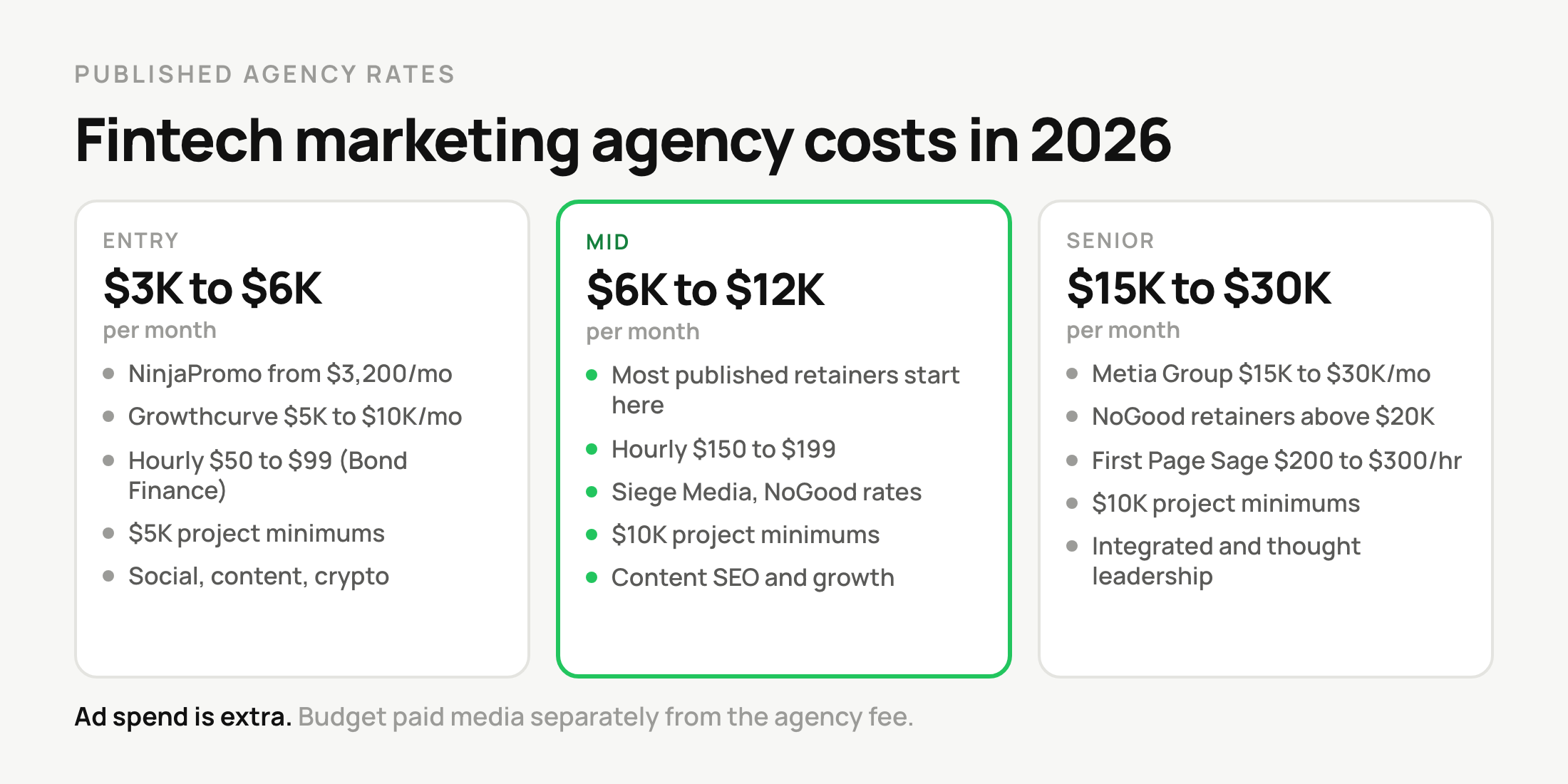
Most venture-backed fintechs should plan on $6K to $25K a month for agency fees. Ad spend comes on top. Few agencies publish prices, so the anchors below come from the two competitor lists that do and from directory profiles.
Typical Retainer and Project Ranges
Right Left's 2026 roundup lists retainers for 14 of the 15 agencies it covers. Mint Position is the exception, marked "Project dependent." Most start between $6K and $12K a month. The highest published ceiling is $30K, for Metia Group. Siege Media's list publishes only two prices out of 14 agencies. Notice that the two lists disagree on NinjaPromo by more than $3,000 a month.
| Source | Agency or tier | Published price | Type of work |
|---|---|---|---|
| Siege Media list | NinjaPromo | From $3,200/month | Social and content |
| Right Left list | Growthcurve | $5K to $10K/month | Growth marketing |
| Right Left list | Most of 15 agencies | Start at $6K to $12K/month | Mixed |
| Siege Media list | NoGood | Above $20,000/month | Growth and paid |
| Right Left list | Metia Group | $15K to $30K/month | Integrated |
| Directory profile | Bond Finance | $50 to $99/hr ($5K minimum) | Crypto and Web3 |
| Directory profile | Siege Media and NoGood | $150 to $199/hr ($10K minimum) | Content SEO and growth |
| Directory profile | First Page Sage | $200 to $300/hr ($10K minimum) | Thought-leadership SEO |
Paid media management is usually billed as a percentage of ad spend or a flat fee on top of it. Budget the media separately and ask how the fee scales as spend grows. Right Left also claims fintechs see "3 to 7x ROI over 12 to 18 months." Treat that as an agency's marketing claim, not a benchmark.
If $15,000 a month buys you less than a senior hire would, compare the two paths with this agency vs in-house breakdown.
The Fintech Surcharge: Compliance Cycles, Subject-Matter Writers, and Ad Approvals
Fintech work costs more than the same channel work in other industries, and three line items drive the gap. Legal review adds rounds. A blog post that takes two drafts elsewhere can take four once compliance redlines it. Writers who understand interchange or credit underwriting also charge more than generalists. A fintech content marketing agency with those writers on staff prices them in. Ad approvals add delay too, since disapproved financial ads sit idle while you appeal.
Say a cheaper fintech digital marketing agency quotes $6,000 a month but needs three review rounds per asset. A $10,000 agency that clears legal in one round can ship twice the work. The cheap retainer loses on cycle time.
Red Flags That Should End the Pitch Meeting
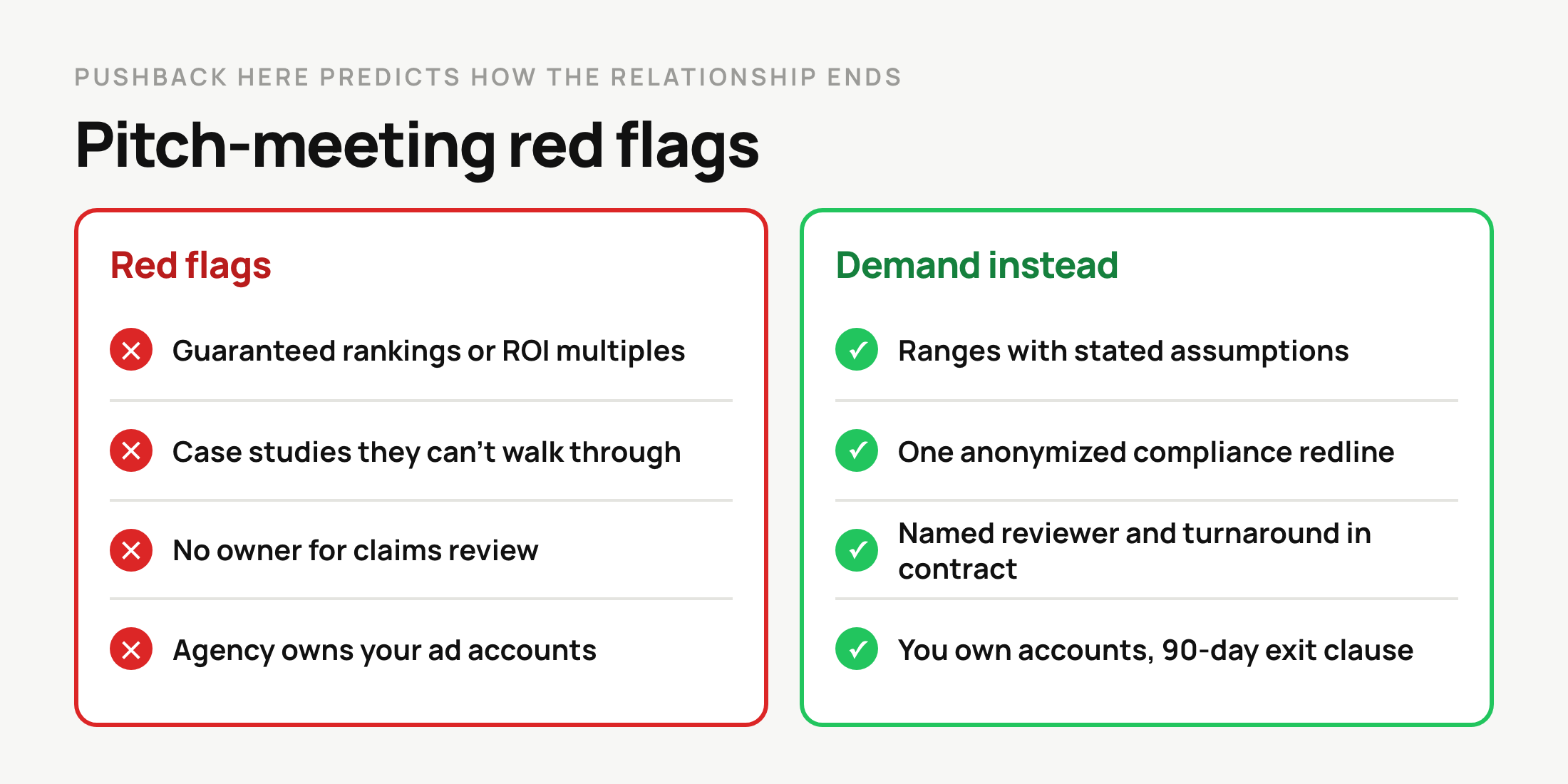
Six warning signs come up again and again when fintech teams describe a fintech digital marketing agency that burned them. Each one has a fix you can demand on the spot.
- Guaranteed rankings, ROI multiples, or "ads approved in 48 hours." No agency controls Google's algorithm or a platform's ad review. Ask for ranges and the assumptions behind them instead.
- Fintech case studies they can't walk through. Logos on a slide prove nothing. Ask to see one anonymized before-and-after redline from a client's compliance team.
- No named owner for claims substantiation. If the plan is "your legal team will approve it," you're paying for drafts, not finished work. Require a documented review workflow with turnaround times written into the contract.
- Citing their own "best fintech agencies" list as proof. A list the agency wrote about itself is an ad. Check third-party reviews and profile data, and read how the directory builds scores in its rating methodology.
- Reporting built on traffic and MQLs. A fintech marketing agency should report on funded accounts, activated users, or qualified pipeline. Agree on one north-star metric in the statement of work.
- They own your ad accounts, or the contract locks you in for 12 months. You should own every ad account, analytics property, and domain. Ask for a 90-day exit clause.
Any agency that pushes back on numbers 3 or 6 has told you how the relationship will end.
How Do You Test an Agency's Compliance Workflow Before Signing?
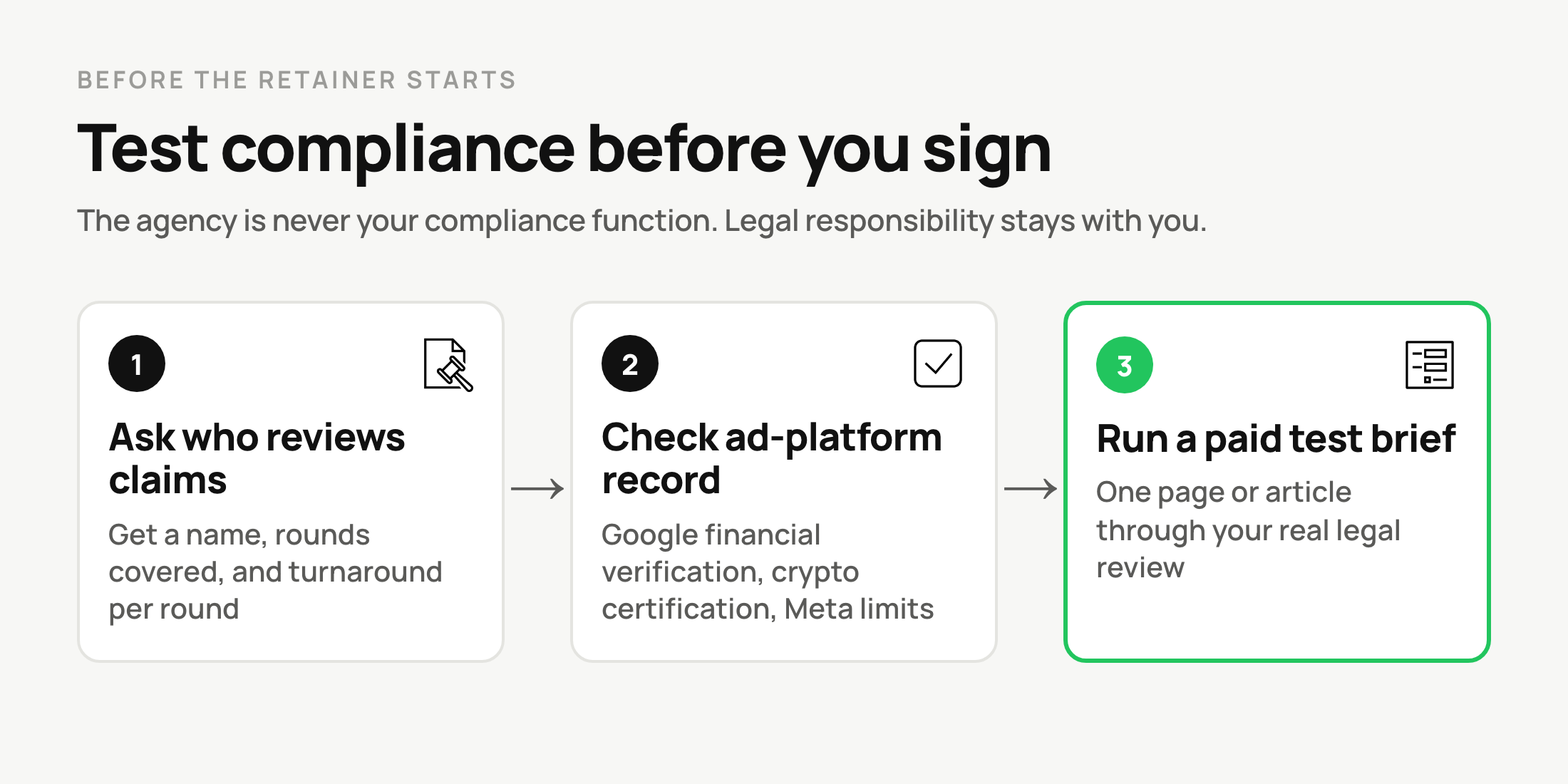
Ask who reviews claims and how fast, check the agency's ad-platform record, and pay for one small test project that goes through your real legal review. Every agency will tell you it "understands compliance." These three tests turn that answer into evidence. Remember that the agency is never your compliance function. Legal responsibility for the claim stays with your company.
Ask Who Reviews Claims, and How Fast
Get a name, not a department. Ask how redlines are tracked and what the turnaround time is for each review round. Then ask how many rounds the retainer covers. A good fintech digital marketing agency answers with a number like "two rounds within five business days" and shows you the tracker it uses.
Check Their Ad-Platform Track Record
Ask which platform certifications they've handled in the last year. Google requires financial services verification in a growing list of countries, and in June 2026 it added third-party verification for 24 European markets. Crypto advertisers also need market-by-market certification. On Meta, ask how they plan reach without age or gender targeting. Then ask about their last disapproval and how long the fix took.
Run a Paid Test Brief Before the Retainer
Think of it as a test drive with your own lawyers in the back seat. Pay for one landing page or one article, roughly a few thousand dollars, and push it through your actual legal review. You'll measure cycle time and product understanding before you commit to six or twelve months. For the rest of the RFP process, follow this guide to hiring a marketing agency.
Top Picks: Five Agencies With Fintech or Financial Services Work
There's no single best fintech marketing agency. There's a best fit for your segment, budget, and channel. The five below have fintech or finance work on their directory profiles. Each comes with a rating, rate, and minimum you can check. They aren't ranked. Siege Media tops its own list and Mint Position appears on Right Left's, so the data below comes from directory profiles instead.
Mint Position: B2B Tech and Fintech SEO and GEO
Mint Position is a 2 to 9 person studio in Barcelona rated 8.2/10, with a minimum project size of $1,000+. Its profile describes it as best for B2B technology and fintech companies. The focus is search and GEO (generative engine optimization, meaning visibility in AI answers from ChatGPT or Perplexity). Think of it as a small fintech content marketing agency built around search. Best for: early B2B infrastructure fintechs that want search depth on a small budget. Skip if: you need paid media or a team in US hours.
First Page Sage: Thought-Leadership SEO for Enterprise Buyers
First Page Sage is based in Silver Spring, Maryland, and rated 8.6/10. It charges $200 to $300 an hour with a $10,000 minimum. Its work centers on thought-leadership content built to rank and to show up in AI answers. It's the most senior option on this list. Best for: B2B infrastructure companies and established financial firms selling to enterprise buyers. Skip if: you're pre-Series A and can't commit to a long content runway.
Siege Media: Content SEO and Digital PR
Siege Media is a San Diego content and digital PR shop rated 8.5/10. It charges $150 to $199 an hour with a $10,000 minimum. It's a strong fit if you want a fintech content marketing agency for high-volume personal finance queries. Note that Siege ranks itself first on its own fintech list. Best for: consumer fintechs competing on terms like "high-yield savings" or "personal loan calculator." Skip if: paid acquisition is your main channel.
NoGood: Growth Marketing and Paid Acquisition
NoGood is a New York growth agency rated 8.4/10, charging $150 to $199 an hour with a $10,000 minimum. Siege's list puts its retainers above $20,000 a month. Best for: neobanks and consumer apps that need paid social, creative testing, and lifecycle work under one roof. Skip if: your total budget sits under about $20,000 a month.
Bond Finance: Crypto and Web3 Marketing
Bond Finance is a UK agency in Poole rated 7.7/10, charging $50 to $99 an hour with a $5,000 minimum. Its profile carries a Financial Services industry tag, and its work is crypto and Web3 growth. Best for: token projects, exchanges, and wallets that need community and PR. Skip if: you're a regulated US lender or bank.
If you're weighing generalist growth shops instead, a head-to-head like Power Digital vs Directive shows how two strong performance agencies differ on pricing and focus.
Your First Week of Vetting
On day one, write a one-paragraph brief. Name your segment and buyer, plus your main channel and monthly budget. Keep it short enough to paste into an email.
By day three, shortlist three firms. Pull them from the picks above and from any fintech marketing agency or financial services marketing agency your peers trust. If you sell to finance teams, make sure at least one is a B2B fintech marketing agency with CFO-facing case studies. Send each one the claims-review questions from the compliance section, and ask the finalist for a paid test brief.
By day five, you'll know which fintech digital marketing agency clears your legal team fastest. That tells you more than any pitch deck. Start with buyer, then channel, then fintech. When you want to see two finalists side by side, browse the agency comparisons.
Frequently Asked Questions
What is fintech marketing?
Fintech marketing is the work of selling financial products where trust and regulated claims shape every channel decision. Unlike generic SaaS or consumer marketing, a single savings-rate ad can trigger Regulation DD disclosure rules. Most teams also add at least one legal review round per asset. The four segments above, from B2B payments to crypto, each need a different playbook.
How is a financial services marketing agency different from a fintech one?
A financial services marketing agency usually serves banks and credit unions. Many also serve insurers and advisers. Expect experience with FINRA Rule 2210, the SEC Marketing Rule, and approval chains that can run several weeks. Fintech-labeled shops lean toward venture-backed growth and digital acquisition. Plenty of firms do both, so judge case studies, not labels.
Do crypto companies need a separate type of agency?
Usually, yes. Google requires crypto advertisers to be certified market by market, and it bans categories like initial coin offerings outright. Crypto growth also leans on community and PR more than search. A crypto shop like Bond Finance, at $50 to $99 an hour, is rarely the right fit for a regulated lender. The reverse is true as well.
Which is the best fintech marketing agency?
No neutral answer exists. The ranked lists in search come from agencies that put themselves at or near the top, in 3 of the 4 cases. The best fintech marketing agency for you matches your segment, buyer, and channel. It should also pass a compliance-workflow test. Start with the 5 picks above and check each profile's rating against the directory methodology.
What services should a fintech marketing agency offer?
Common services include SEO and content plus paid search and social. Digital PR, account-based marketing, and lifecycle email are also standard. Don't buy all of it at once. If content is your channel, a fintech content marketing agency with in-house finance writers is worth the premium. Pick 1 or 2 channels that move your north-star metric, and expand only after those channels hit target for 2 to 3 months.
How long before fintech marketing shows ROI?
Paid acquisition usually gives a readable signal within 4 to 8 weeks once ads clear platform review. SEO and content typically take 6 to 12 months. B2B pipeline lags further because enterprise deals can take two or three quarters to close. Be wary of any agency that quotes an ROI multiple before it has seen your funnel data.
Should a seed-stage fintech hire an agency or a freelancer?
At seed stage with less than about $5,000 a month to spend, a specialist freelancer or small studio often beats a retainer agency. Someone in-house still has to own the compliance review loop. Agencies earn their fee once you have one proven channel to scale. The agency vs in-house guide linked in the pricing section compares both paths.
Can an agency take over our compliance review?
No. An agency can pre-screen claims, flag trigger terms, and manage the redline workflow. Legal responsibility for advertising claims stays with your company. Under FINRA Rule 2210, a registered principal at the firm must approve retail communications. Look for an agency that builds two or more review rounds into its schedule rather than one that claims to "handle compliance."
Who should own the ad accounts and content if we part ways?
You should own all of it. That means ad accounts and analytics. It also covers domains, CMS access, and content rights. Add the agency as a user, never as the owner. Write that into the contract alongside a 90-day exit clause. An agency that resists either term is showing you one of the six red flags above.
Top Marketing Agencies in 2026
Ranked by our editorial score across 1,493 listed marketing agencies.


Related Articles
Healthcare Digital Marketing Agency: HIPAA Isn't a Credential
No one certifies a healthcare digital marketing agency as HIPAA compliant. Sort by four buyer types, then run six questions on your next sales call.
Marketing Agency vs In-House Team: The Math Most Companies Get Wrong
Agency vs in-house marketing compared on real costs, AI impact, and when hybrid actually works. Data-backed framework for 2026.
How to Hire a Marketing Agency: Complete Decision Guide
Learn how to hire a marketing agency the right way. Our guide covers readiness signals, vetting tactics, and costs to avoid costly mistakes.
How to Choose a Marketing Agency: What Actually Matters
Learn how to choose a marketing agency that fits your goals and budget. Covers evaluation criteria, pricing models, red flags, and a pre-hire checklist.
More Insights

Top Healthcare Software Development Companies for Every Specialty
Find top healthcare software development companies by specialty: EHR integration, telehealth, FDA-regulated devices, and patient engagement apps compared.

Best Content Marketing Agencies: How to Pick the Right Type
Learn to identify the four types of content marketing agencies and match the right one to your content maturity, budget, and business goals.

What is a Lead Generation Agency? Complete Guide
Discover what a lead generation agency does, how lead generation specialists work, and whether outsourcing lead gen is right for your business in 2026.