
Manufacturing Marketing Agency: Match It to Your Route to Market
Manufacturing spans four business models with different funnels. Match the agency to your route to market, not to the logos on its site.


You're the only marketing person at a $60M manufacturer. Your VP of Sales thinks marketing means the trade show booth and the line card. Your distributors own the customer relationships. And somebody on the board just asked why the website hasn't produced a single quote this year. So you start calling agencies that say they specialize in manufacturers.
Most guides to hiring a manufacturing marketing agency tell you the same three things. Sales cycles are long, buyers are technical, and you need someone who knows your industry. That advice skips the question that actually decides whether the engagement works. Plenty of shops in the marketing agencies directory can run campaigns for manufacturers. Far fewer will ask how your product reaches the end customer before they propose one.
This guide covers the four business models hiding behind the label, why route to market changes the whole playbook, and what a manufacturing marketing agency costs in 2026.
TL;DR
- "Manufacturing" spans four business models with different funnels. Match the manufacturing marketing agency to yours, not to the word on their homepage.
- If you sell through distributors or reps, settle who owns an inbound lead before you sign. That question kills more programs than bad execution does.
- Engineers finish 62% of the buying journey before they contact you, and 70% pick the better-known brand when two options look technically similar.
- Budget $6,000 to $15,000 a month for a working program. Content production is the line item most manufacturers underestimate.
- Your quotes live in the ERP, not the CRM. Fix that in month one or you'll never prove the program worked.
Why "Manufacturing Marketing Agency" Describes Four Different Jobs
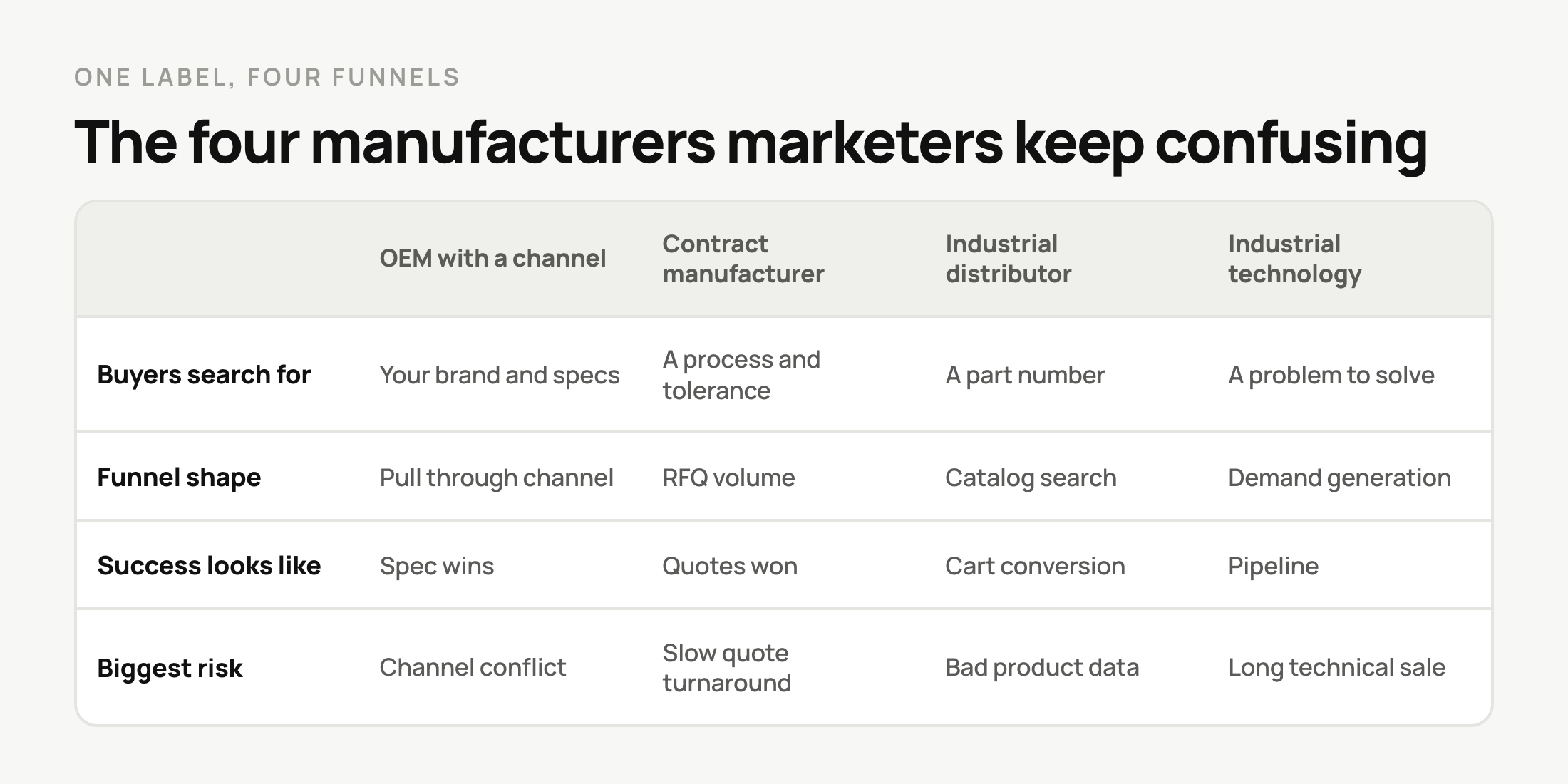
Four distinct businesses share the manufacturing label, and their marketing has almost nothing in common. A manufacturing marketing agency that produced great work for one can be genuinely useless to another. Start by naming which one you are. It changes the funnel, the content and what counts as a good lead.
OEM With a Branded Product and a Channel
You build something that carries your name, and distributors or manufacturer's reps sell it. Marketing's job is creating end-user demand that pulls product through the channel. Leads are complicated, since the distributor owns the relationship and the quote.
Success looks like specification wins and distributor sell-through, not form fills. Co-op funds and channel enablement material matter more than a lead magnet.
Contract Manufacturer or Job Shop
You make what other companies design. Nobody searches for your brand, because they don't know it exists. They search for a process and a tolerance: "swiss screw machining 316 stainless" or "ITAR registered CNC shop."
Your funnel is an RFQ funnel. The whole program lives or dies on capability content and how fast you respond to a quote request. A slow quote turnaround wastes every dollar spent upstream.
Industrial Distributor
You carry other people's products across a catalog of thousands of SKUs. This is closer to ecommerce than to industrial marketing. Part-number search, filtered navigation, and product data quality drive everything.
An agency that has never touched a product information management system will struggle here, no matter how many manufacturers they list as clients. The skills overlap heavily with what a B2B SEO agency does for large catalogs.
Industrial Technology and Industry 4.0
You sell software, sensors, or automation systems into plants. Your marketing looks like B2B SaaS with a longer cycle and a harder technical buyer. Demand generation, free trials and product-led motions apply in a way they never would for a job shop. The distinction between demand generation and lead generation matters more here than anywhere else in manufacturing.
Route to Market Decides Everything Else
Settle this before you evaluate a single agency: who owns the customer relationship, and who is allowed to quote. It's the fastest way to disqualify half the vendors pitching you, and it's the first thing a strong industrial marketing agency will raise on its own.
When Inbound Leads Create Channel Conflict
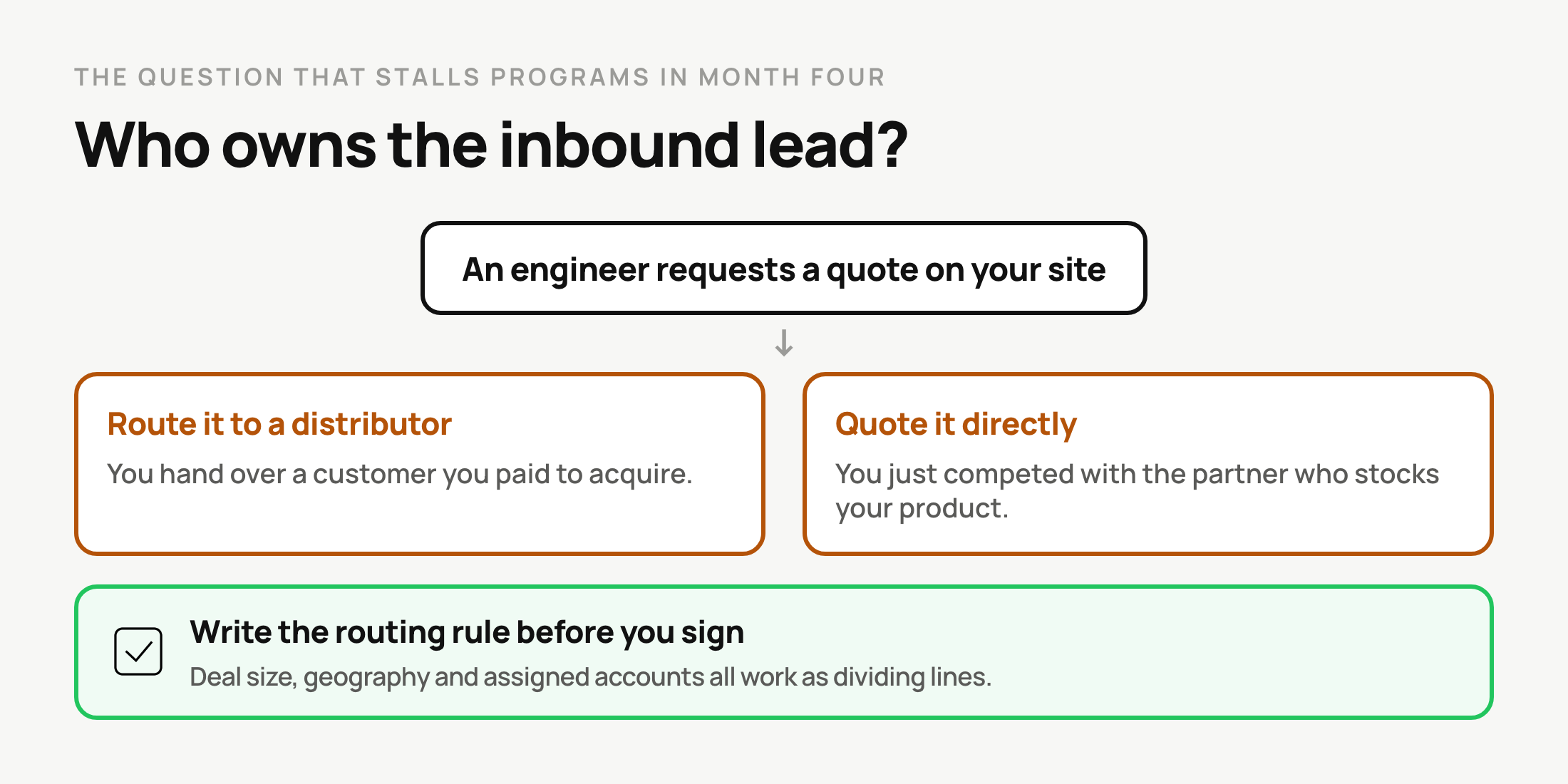
Picture an OEM that sells pumps through 40 regional distributors. The agency builds a great site, ranks it, and inquiries start arriving. Now what? Route the lead to a distributor and you've handed over a customer you paid to acquire. Quote it directly and you've competed with the partner who stocks your product and services it.
Nobody decides this in advance. It surfaces in month four, when the first real opportunity shows up and the VP of Sales and the channel manager disagree in a meeting. The program stalls there. It rarely recovers, because the disagreement isn't about marketing at all.
Settle the Routing Question Before You Sign
Write the rules down. Which inquiries go to the channel, which stay direct, and what the threshold is. Deal size, geography, and whether the account is already assigned all work as dividing lines.
Then tell the agency. A vendor who understands channel dynamics will build for specification demand and distributor enablement instead of promising you a lead count that would be a problem if they hit it.
Engineers Finish Most of the Buying Journey Without You
Your buyers have made up their minds well before a salesperson hears from them, which changes what you should be paying an agency to produce.
62% Happens Before the First Conversation
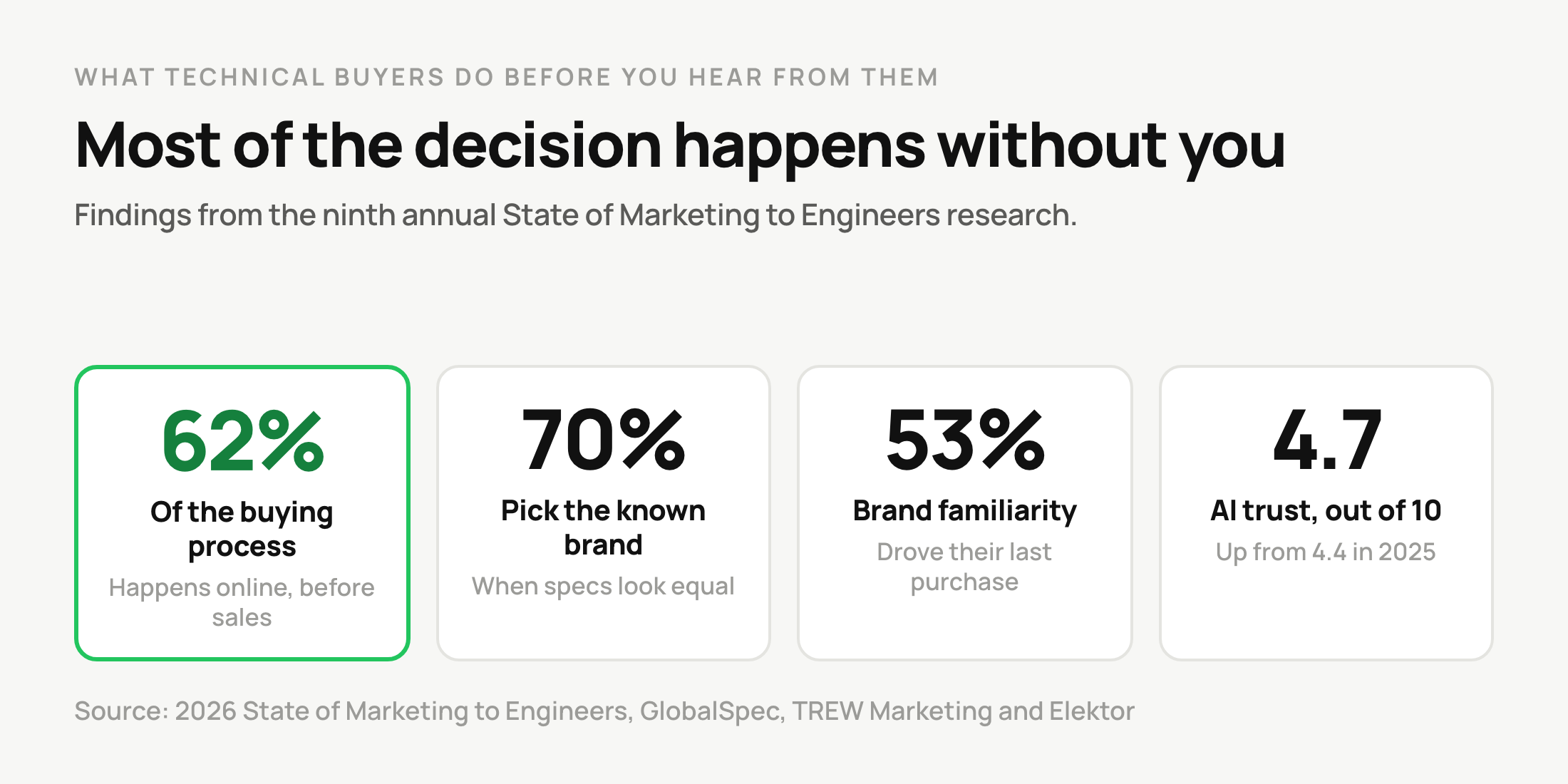
The 2026 State of Marketing to Engineers report from GlobalSpec, TREW Marketing and Elektor, now in its ninth year, found technical buyers spend 62% of the buying process online before engaging sales. Technical publications lead as their research destination, with online publications up 37 percentage points.
That's why datasheets, CAD files, and application notes outperform anything written for a marketing persona. Say your buyer needs a bearing rated for a specific load at a specific temperature. A gated ebook about "five trends in motion control" is worthless to them. A downloadable spec table gets you on the shortlist.
Why Brand Visibility Is Lead Generation Here
The same research found 70% of buyers are likely to choose the better-known brand when two solutions look technically similar, and 53% said brand familiarity influenced their most recent purchase. Those numbers undercut the pure lead-generation retainer that most agencies pitch.
If your buyers won't recognize you at the shortlist stage, no amount of bottom-funnel spend fixes it. Trade publication presence and consistent technical content do work that a paid search budget can't. Worth noting on the AI question: technical buyers rated generative AI answers 4.7 out of 10 for trustworthiness, barely up from 4.4 a year earlier. They're using it and verifying everything it says.
Industry Experience Is the Most Overrated Criterion
Every guide tells you to hire an agency that knows manufacturing. That advice is close to useless, and here's why.
Manufacturing spans the four models above. An agency that tripled RFQs for a contract machine shop learned to rank capability pages and speed up quote response. Hand them an OEM with a rep network and none of that transfers. The funnel runs backwards, the buyer is different, and leads are a political problem rather than a goal.
Meanwhile the thing people screen for, a client list with manufacturers on it, tells you almost nothing. Every industrial marketing agency has logos. Logos don't reveal whether the engagement worked or which model the client ran.
Ask about route to market instead. A manufacturing marketing agency that immediately asks whether you sell direct or through distribution understands the category better than one opening with a case study. The second best question is whether they can produce technically accurate content. Have them show you a datasheet or an application note they wrote, then hand it to one of your engineers. Your engineer will know inside thirty seconds whether a writer understood the subject. That single test screens better than any industry credential.
None of this means experience is worthless. It means it's a weak first filter and a reasonable tiebreaker.
What a Manufacturing Digital Marketing Agency Costs in 2026
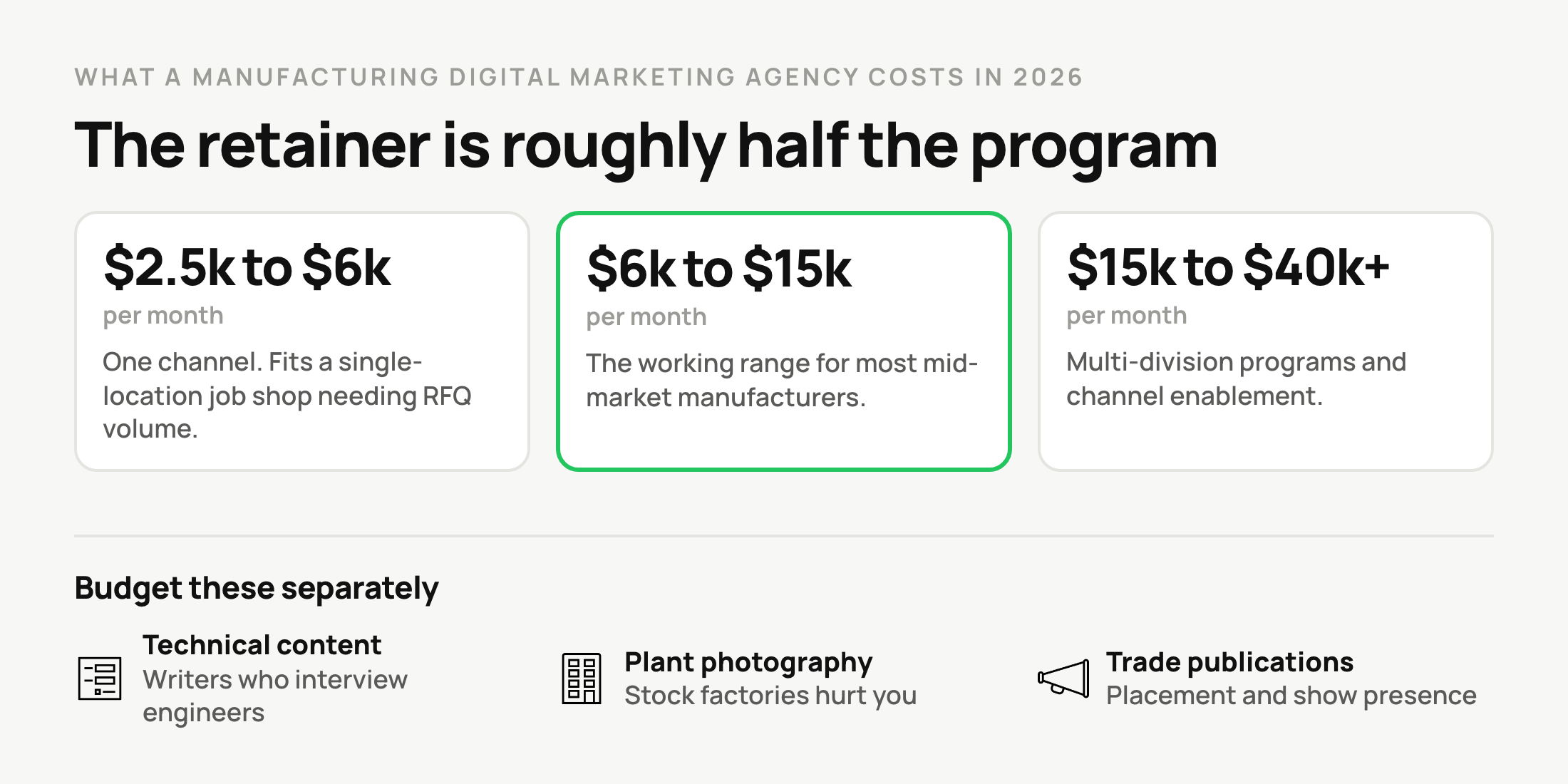
Retainers at a manufacturing marketing agency land in three bands, and the band reflects scope rather than quality.
The Three Retainer Bands
$2,500 to $6,000 a month. One channel, usually SEO or paid search, with light content support. Realistic for a single-location job shop that needs RFQ volume and nothing else.
$6,000 to $15,000 a month. The working range for most mid-market manufacturers. Strategy, technical content, website work and paid media under one roof. A manufacturing digital marketing agency at this level should assign you a named strategist who learns your products.
$15,000 to $40,000+ a month. Multi-brand or multi-division programs, channel enablement, and demand generation across several product lines. Common for OEMs with complex distribution.
Content Production Is the Line Item That Surprises People
Technical content costs more than marketing content, because it needs a writer who can interview your engineers and not embarrass you. Budget separately for it if the retainer doesn't cover production.
Photography and video of your own plant floor is the other underestimated cost. Stock imagery of generic factories actively hurts you with a technical buyer. Add trade publication placement and show presence, and a manufacturing digital marketing agency retainer often accounts for only half of total program spend. The same budgeting gap shows up across agency versus in-house marketing decisions, where the retainer gets compared and the surrounding costs don't.
Your Quotes Live in the ERP, Not the CRM
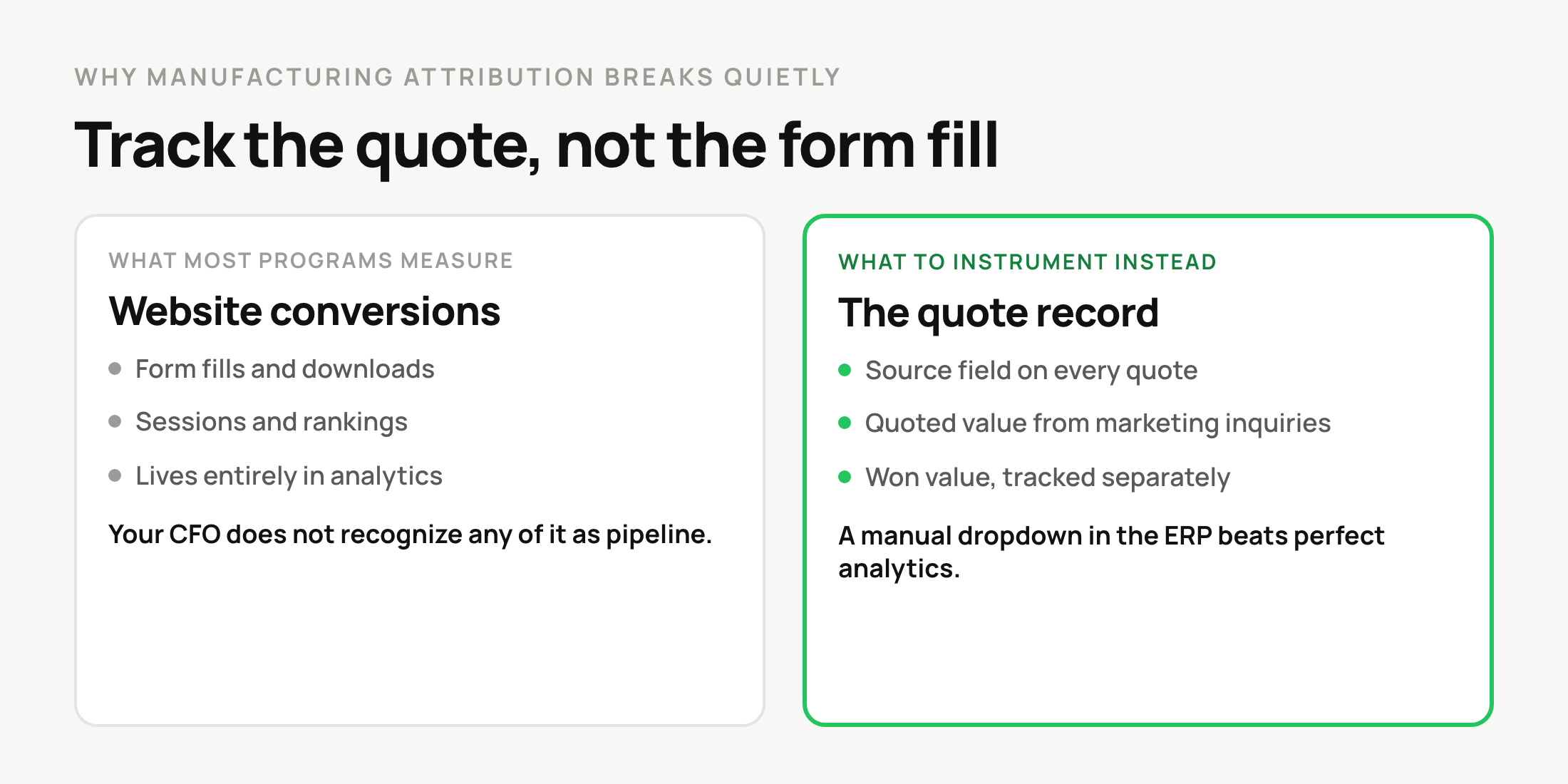
Manufacturing attribution breaks in a specific way, and it breaks quietly. Fix it in month one, because retrofitting it after a year of work is how good programs get cancelled.
Instrument the Quote, Not the Form Fill
A form fill isn't the business event you care about. The quote is. In most manufacturers the quote gets created in the ERP or a quoting tool that never talks to the website, so the connection between a campaign and a job that shipped is invisible.
Get the source field onto the quote record. Even a manual dropdown that inside sales fills in beats perfect analytics with no link to revenue. Then track quoted value and won value from marketing-sourced inquiries, separately from everything the sales team brought in themselves.
Agree on a Review Timeline That Matches Your Sales Cycle
If your average cycle from first inquiry to purchase order is nine months, no program proves revenue in two quarters. That's arithmetic, not agency performance, and it's the same timing discipline that applies when you choose a B2B lead generation agency.
Set the checkpoints up front. Month three reviews content quality and technical accuracy. Month six reviews inquiry volume and quote count. Month twelve is the first honest revenue conversation. Anyone promising quoted work by month three either has a very short cycle in mind or is telling you what you want to hear.
What to Ask on the First Three Calls
Six questions separate agencies that understand manufacturers from agencies that list them as a vertical.
"Do our customers buy from us or from a distributor?" They should ask this before you volunteer it. If it never comes up, they're selling a generic B2B program with your logo on the deck.
"Show me technical content your team wrote." Not a blog post. A datasheet, an application note, or a capability page. Hand it to an engineer on your team and watch their face.
"Who writes it, and do they interview our engineers?" A named writer with a process is the answer you want. An offshore content pool is the answer you don't.
"How will you measure a quote?" Listen for ERP, quoting tools, and a source field. If the answer stops at form conversions, they haven't run a manufacturing program to revenue.
"What did you do when a client's sales team ignored the leads?" Every agency has hit this. The ones who have a real answer have been through it.
"Which of your manufacturing clients sold through channel?" This tests the route-to-market point directly. Ask for the named client and what they built for the channel.
For manufacturers with a small set of very large target accounts, the shape of the work changes again and starts looking like account based marketing rather than broad demand generation. Our ranking methodology explains what the directory weighs when it evaluates agencies.
What to Do Next
Name your business model first: OEM with a channel, contract manufacturer, distributor or industrial technology. Then write down who owns an inbound lead and who is allowed to quote, and get your VP of Sales to agree in writing. Those two decisions eliminate most of the agencies currently on your list and make the rest easy to compare.
Then run the first calls around route to market and technical content rather than industry logos. The right manufacturing marketing agency will ask about your channel before it pitches you a funnel. Get the quote source field into your ERP before the first campaign launches.
When you're ready to build a shortlist, the marketing agencies directory is a reasonable place to start comparing.
Frequently Asked Questions
What is industrial marketing?
Industrial marketing is B2B marketing aimed at technical buyers who purchase components, equipment or manufacturing services for their own operations. An industrial marketing agency is a firm that specializes in reaching those buyers. It differs from general B2B mainly in the buyer and the content. Engineers and procurement teams evaluate specifications before they evaluate vendors, so datasheets and capability documentation carry more weight than brand storytelling.
How much does a B2B agency typically cost?
A single channel runs $2,500 to $6,000 a month for manufacturers. A full mid-market program costs $6,000 to $15,000. Multi-division or channel-heavy work starts around $15,000 and can pass $40,000. Content production, photography and trade publication placement often sit outside the retainer. Plan for total program spend to reach roughly double the retainer.
What does a manufacturing marketing agency actually do?
The common scope covers technical content production, website and SEO work, plus paid search. Trade publication placement and sales enablement material are often included too. Stronger engagements add channel enablement and quote-level reporting. Confirm which of those are in scope, because content production is the piece most often excluded and the piece that matters most to a technical audience.
How long before marketing produces quoted work?
A manufacturing digital marketing agency will usually move inquiry volume in three to six months. Quoted work follows your sales cycle, so a nine-month cycle means the first meaningful revenue conversation lands around month twelve. Capability and RFQ-driven programs at contract manufacturers tend to move faster, sometimes producing quotes within a quarter, because the buying process is shorter.
Should we hire an agency that has worked with our competitors?
It cuts both ways. Direct competitor experience means faster ramp and a writer who already understands the technology, but it also raises real questions about what they can reuse and who they'll pitch next. Ask about exclusivity in your category and get the answer in the contract. Adjacent experience in your route to market is usually more valuable than experience with a direct rival.
Do we need an agency if we sell entirely through distributors?
Yes, though the goal changes. You're building end-user demand that pulls product through the channel and giving distributors material that helps them sell, rather than generating direct leads. Measure specification wins, distributor sell-through, and co-op program participation. An agency that only knows how to produce form fills will struggle with this model.
What is the difference between an industrial marketing agency and a general B2B agency?
The meaningful difference is whether they can produce technically accurate content and whether they understand long, multi-stakeholder buying processes. Many capable general B2B agencies handle manufacturers well. Many self-described industrial specialists just have manufacturing logos. Test the capability directly instead of trusting the label.
Can a manufacturer run this in-house?
A single marketing person can run a focused program, usually SEO and content for one product line or one capability. What breaks in-house is technical writing volume and paid media management, which both need dedicated time. Most mid-market manufacturers land on a hybrid: an internal owner who knows the products, with an agency supplying production capacity and channel expertise.
Top Marketing Agencies in 2026
Ranked by our editorial score across 1,493 listed marketing agencies.


Related Articles
Account Based Marketing Agency: Which Tier You Actually Need
ABM comes in three tiers. Which one your revenue math supports decides whether an account based marketing agency is worth the retainer at all.
What a Performance Marketing Agency Is vs PPC or Growth
A performance marketing agency is paid for incrementality and MER, not last-click ROAS. How it differs from PPC or growth, plus a 30-day proof.
Marketing Agency vs In-House Team: The Math Most Companies Get Wrong
Agency vs in-house marketing compared on real costs, AI impact, and when hybrid actually works. Data-backed framework for 2026.
More Insights

Top Healthcare Software Development Companies for Every Specialty
Find top healthcare software development companies by specialty: EHR integration, telehealth, FDA-regulated devices, and patient engagement apps compared.

Best Content Marketing Agencies: How to Pick the Right Type
Learn to identify the four types of content marketing agencies and match the right one to your content maturity, budget, and business goals.

What is a Lead Generation Agency? Complete Guide
Discover what a lead generation agency does, how lead generation specialists work, and whether outsourcing lead gen is right for your business in 2026.