
What an Inbound Marketing Agency Is vs SEO or Content
An inbound marketing agency is paid for pipeline, not blog volume. How it differs from SEO or a content shop, plus a 90-day proof for the contract.


You've already paid for a HubSpot-certified retainer that shipped 12 blog posts and a dashboard of "MQLs." Sales ignored the form fills. Pipeline didn't move. Now the next pitch is selling you the same Attract-Convert-Close slide, and you're the one who has to explain sessions to finance. A wrong inbound marketing agency can burn two quarters of content before you've run a real test.
Vendor pages still own this search, and they rank themselves first. This article exists so you can hire an inbound marketing agency with a real filter instead of another HubSpot leaderboard. Use the marketing agencies directory when you're ready to inspect live profiles, not a self-ranked partner list.
This guide walks you through a three-way taxonomy (inbound vs SEO vs content), a filter for partner badges, and a 90-day proof you can write into the contract. You'll leave knowing whether you even need the hire.
TL;DR
- An inbound marketing agency is accountable for a system: content plus capture, nurture, and a sales handoff. Blog volume is the easy part of the brief.
- A content marketing agency makes assets. An SEO agency makes you findable. Neither owns pipeline unless you add the rest.
- A HubSpot (or equivalent) partner badge is often a sticker on a retainer. Platform setup is not growth strategy.
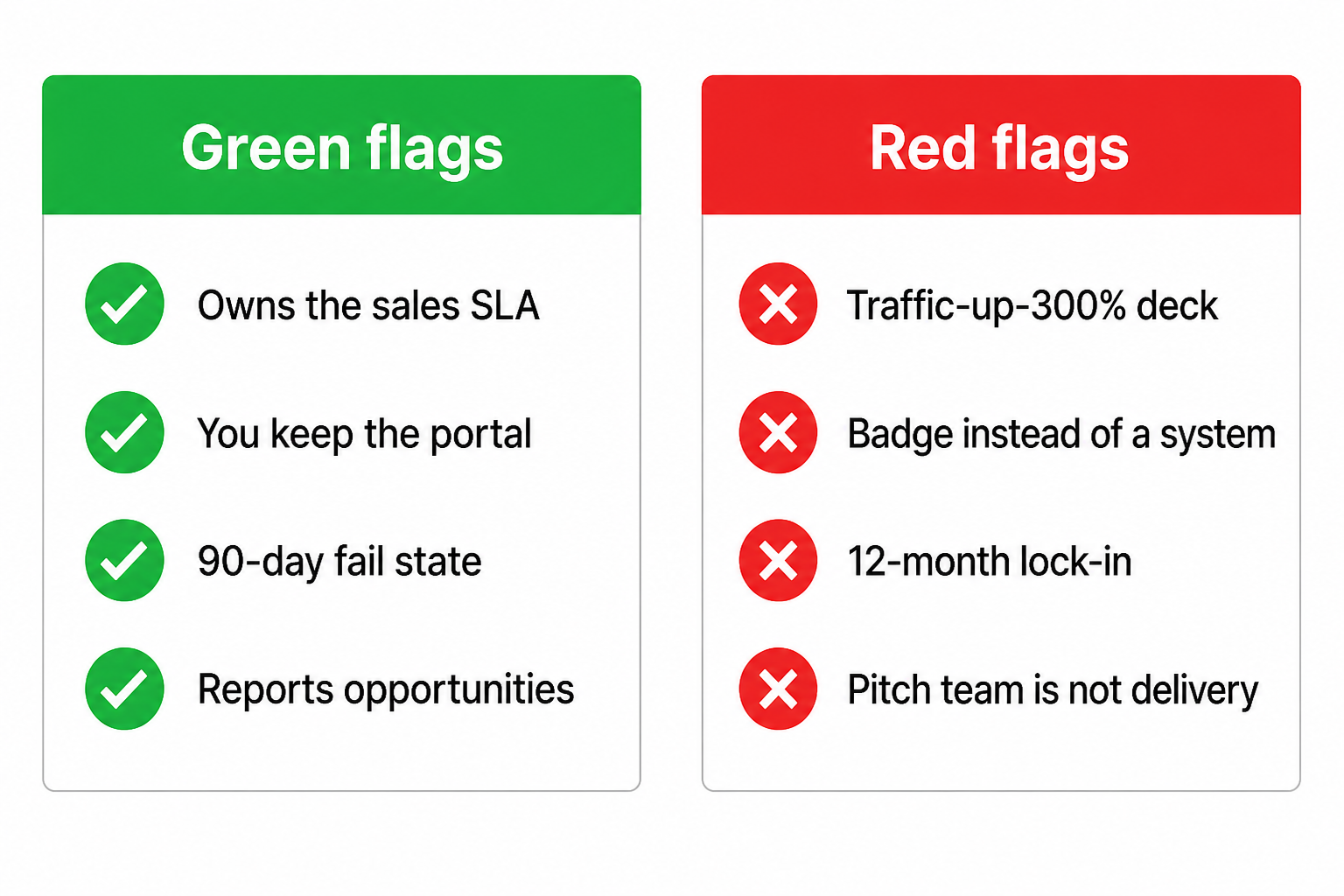
- Vet CRM access, lead-to-opportunity conversion, and who sits on the account on Tuesday. Traffic-up-300% decks are theater.
- Don't trust a self-ranked inbound list. Shortlist from the directory and side-by-side comparisons instead.
The Mandate an Inbound Marketing Agency Is Paid to Own
An inbound marketing agency is a demand operator with a content loop and a conversion loop. You hold it to qualified pipeline, not to whether someone published this week. That's the definition the title asked for. Hold it against every capabilities slide you see.
A generic digital marketing shop will also sell ads, social calendars, and brand. Fine. Different mandate. Inbound work starts with useful content and search visibility, then has to end in a number your CRO (chief revenue officer) will sign. Marketing-qualified leads (MQLs) are a diagnostic. They aren't the scoreboard.
HubSpot's 2026 explainer draws the same line: content is a tactic, inbound is the methodology that includes capture, nurture, automation, and conversion. Steal the distinction. You don't have to buy their stack.
The process skeleton is boring on purpose. Audit the site and CRM. Map topics to buying stages. Publish. Capture. Score. Nurture. Hand off. Report against a pre-agreed pipeline metric. If a pitch skips tracking or the sales SLA (service-level agreement), you're buying a blog assistant.
If you need the adjacent-type explainer for paid-media shops, read what a performance marketing agency is vs PPC or growth. Paid incrementality isn't this article's job.
What sits in the brief?
Content and SEO sit in the core. That's the usual inbound marketing services bundle, and it has to include the handoff, not just the posts. Topic clusters and on-page work. Landing pages and forms. Email nurture and marketing automation. Conversion-rate optimization (CRO) usually travels with that bundle. CRM hygiene and lead scoring should too. Paid search or paid social can sit in the mix as an accelerant. They don't have to.
What they don't automatically own: brand films and Super Bowl creative. Out-of-home. A six-month organic social calendar with no capture path. Full-funnel product growth experiments. Those belong to other hires. An inbound marketing agency will still try to stretch into all of them. Ask what they actually staff. Ask who is on the account on Tuesday, not who is on the website.
Think of the brief like a kitchen ticket. Content and search are the dish. Capture and nurture come with it. A brand film is a different restaurant.
Which numbers is the agency actually on the hook for?
Most inbound decks list traffic, rankings, and form fills. Decode that. Sessions and keyword positions are platform-easy. Pipeline influence, opportunity rate, and closed-won need CRM access and time. If the statement of work (SOW) only names organic sessions, the shop is on the hook for a dashboard that can't lose.
Ask which number they will defend in month three. Qualified opportunities for B2B. Demo requests that sales accepted. Revenue influenced, if your cycle is short enough to see it. Pick one primary. Secondary diagnostics can live in the appendix. If they won't pick, they want the metric that moves after the fact.
Where a Content Shop Stops and an SEO Agency Starts
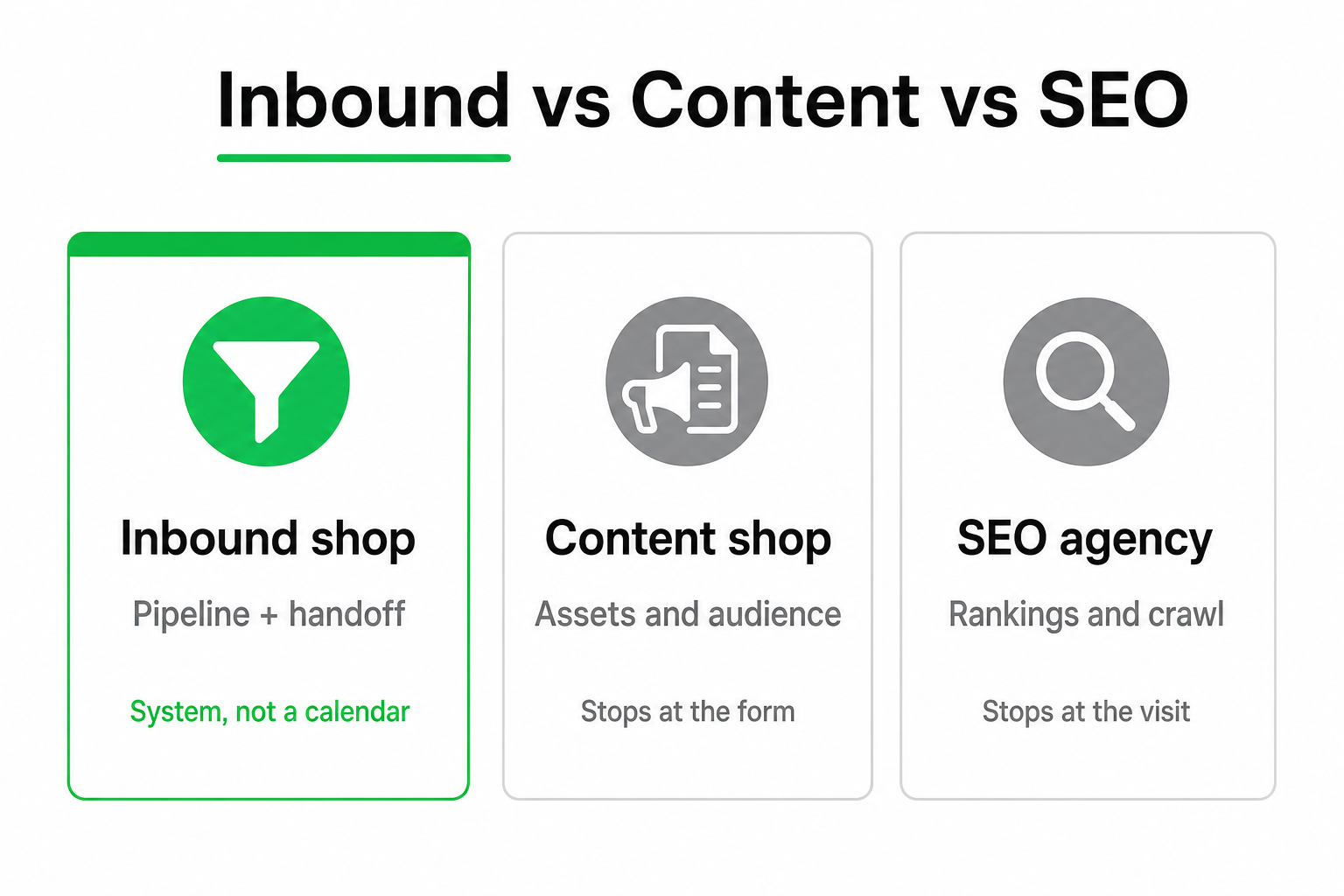
The failure mode isn't "SEO is bad" or "content is fake." It's buying the wrong label. An inbound marketing agency owns demand across owned channels. Content, capture, and nurture sit in-scope. Success language is pipeline or revenue. The other two models are the right hire for someone else.
| Inbound shop | Content shop | SEO agency | |
|---|---|---|---|
| Who you hire | Operators plus automation | Writers and producers | Technical search specialists |
| What they optimize | Pipeline and conversion | Assets and audience | Rankings and crawl health |
| Where they stop | Brand TV and pure media buying | The form, unless you add ops | The visit, unless you add conversion |
| Typical buyer | Team that needs a system | Team that already converts | Team with content nobody finds |
Treat Single Grain as an inbound-leaning example in the directory, not as a ranking. Directive and Wpromote show up on public marketing shortlists too. They are useful profiles to open. They are not "the top three inbound shops." We won't order them. If you want a head-to-head on paid-leaning firms, use Directive vs Disruptive Advertising. An inbound marketing agency list that ranks the publisher first is a brochure.
How is a content marketing agency different in practice?
A content marketing agency lives in briefs, drafts, and distribution. The work is articles and guides. Video and thought leadership sometimes sit next to that. It stops at "we shipped the asset." That's useful when you already own capture, scoring, and the sales handoff. You need production, not a revenue operator.
Picture an in-house demand lead who already runs HubSpot workflows and already owns the MQL definition. They don't need an "inbound" wrapper. They need writers who can survive a technical buyer. If that's you, start with how to pick the right type of content marketing agency. Don't hire an inbound shop to fill a calendar.
HubSpot is blunt on this: you can publish content without a full inbound system. You can't run inbound without content. If the shop only sells posts, you're buying fuel with no engine.
What does an SEO agency own that inbound does not?
An SEO agency works a narrower surface. Technical health and intent mapping sit in the core. Internal links and digital PR sit next to that. Sometimes on-page copy. It is measured on visibility. Tenpoint Labs' 2026 comparison puts it cleanly: SEO brings people to the door. It rarely builds the thing that convinces them to walk through.
That's the right hire when you already have assets and a conversion path, and nobody can find them. If buyers stall before they ever hit the site, specialist SEO is the faster lever. If they hit the site and vanish, you have a demand problem. An inbound marketing agency is built for the second case. A standalone SEO shop is built for the first.
If you need the SEO-only explainer, use what an SEO agency actually does and costs. Don't rebuild that decision here.
HubSpot Partner Is a Badge, Not the Invoice
"Inbound" on a homepage is often a sticker on a retainer. Many firms still bill monthly. They ship a content calendar, configure a few workflows, and call it inbound. If they can't explain lead scoring or the sales SLA, they're a content vendor in an inbound costume. Same if they can't explain what happens when form fills never become opportunities.
You're allowed to feel naive in the pitch. A prior glossy partner badge probably trained that reflex. Ask for the contract exhibit. Skip the case-study reel until the handoff mechanics are on one page.
Ryesing's 2026 hiring guide names this the HubSpot Trap: Diamond-tier configuration is not a growth methodology. Steal the test. You don't have to hire them. Platform expertise is table stakes. It isn't the product.
Once you strip the badge, what actually matters in choosing a marketing agency is the same boring stack. Measurement. Access. Commercial alignment.
Why platform certification rarely describes the work
The badge sounds like they will run your revenue engine. In practice the invoice is still a retainer for hours, posts, and tool admin. The "inbound" part is a partner logo or a homepage adjective. We won't invent a percentage of shops that still bill that way. The pattern is qualitative and loud.
Picture a deck that says "we're aligned to your funnel." Then the SOW bills for 8 blog posts regardless of opportunity rate. That's not alignment. That's rent. Ask them to walk the system on a whiteboard. Topic and capture. Score, SLA, and a kill-clause. If they can't, the badge did the selling.
What should you ask instead of partner tier?
Ask who owns the portal and the lists. Ask who defines an MQL. Ask what happens when sales rejects the leads. Partner tier does not answer those. The whiteboard walk does.
What Inbound Retainers Actually Cover
An inbound marketing agency almost never publishes a single public rate card that maps to your ICP (ideal customer profile). What they will describe, if you push, is the commercial structure.
Ryesing's Seed-to-Series B ranges are the only scrape-backed tiers we'll cite: $2,500 to $5,000 per month for foundational SEO, a few content pieces, and light nurture. $5,000 to $15,000 for full-funnel strategy, higher velocity, some paid, and pipeline reporting. Above $15,000, often $25,000-plus, for RevOps-heavy partnership. Ad spend and software licenses sit extra. That's their framing for growth-stage SaaS. Don't treat it as a US average. Don't copy the numbers into your budget as if every shop bills that way.
Tenpoint's B2B spread lands in the same neighborhood: $2,500 to $12,000 for smaller companies, $10,000 to $25,000 for mid-market. Same caveat. Two vendor pages agreeing is still not a census.
What the fee must include, or the inbound marketing services package is incomplete: strategy and measurement. Content production. On-site conversion work. Automation and CRM access. Reporting time against the primary metric. If creative, web, or RevOps weren't in the PDF, you'll meet them as change orders.
Contract terms that change the real price include notice period and 12-month minimums. Who owns the CMS, the lists, and the HubSpot (or Marketo, or Pardot) portal matters. So does a kill-clause after a failed 90-day proof. Push those in writing before legal gets a redline dump.
Pipeline vs a Dashboard Full of Sessions
Hire on pipeline, not on a dashboard full of sessions. Pipeline means: would this opportunity have shown up without the program? Last-click "content sourced" and raw MQL counts are the theater. If you want the wider hire process, use the 2026 marketing-agency hiring guide. This section is the filter that guide doesn't specialize in.
Ryesing's useful questions are the right ones: average engagement length, a case study that includes sales (not just marketing), success beyond traffic, paid as accelerant or as the actual product, and who is on the account day to day. Steal the questions. You don't have to buy the agency.
Picture a B2B SaaS team whose blog traffic doubled while sales still says "the leads are junk." Sessions look healthy. Opportunity rate didn't move. A shop that brings a 4-week traffic screenshot into that room is selling theater. A shop that proposes a 90-day proof with a written fail state on accepted opportunities is selling work.
What does a real 90-day proof look like?
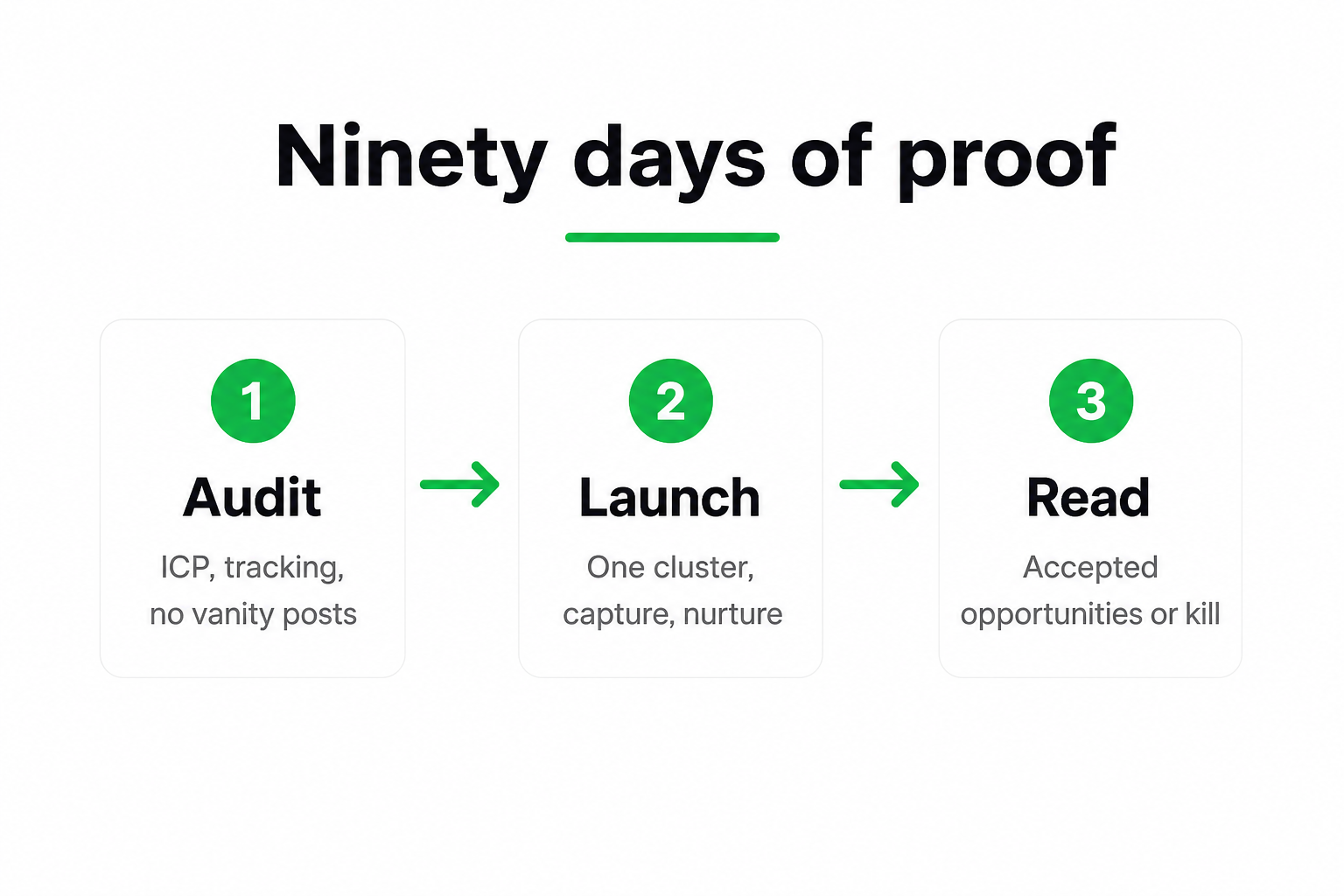
A real test names the method before kickoff. Month one is audit, ICP, and tracking. No vanity publishing. Month two: a small cluster live, capture working, one nurture sequence. Month three: sales SLA and a read on accepted opportunities. Pre-register the success metric. Don't harvest a winner after the fact.
We won't invent lift percentages. If a shop quotes a magic "3x pipeline" number from a named study they can't link, treat it as a pitch prop. Your test is the evidence. Write the method in the SOW. Write the date you'll read it. Write who can kill the program if it misses.
Which reported metrics are easy to game?
Sessions, ranking screenshots, and raw form fills are easy because the tools want you to see them. Time on page can be gamed with a wall of text. Email open rates can be gamed with dark-mode pixels. None of those prove an inbound marketing agency earned an opportunity.
Accepted opportunities are harder to fake. So are lead-to-opportunity conversion and closed-won with a documented content assist. They need CRM access and a sales partner who will tell the truth. That's why shops avoid putting them in the SOW. If the weekly PDF leads with organic sessions, ask where opportunity rate went. If they can't show it, they aren't in the books.
You Might Not Need an Inbound Marketing Agency
Don't sign twelve months of hope. Buy ninety days of proof, or one full buying cycle if your sales cycle is longer. Name the cluster. Pre-agree one pipeline proxy. Set a content volume expectation you can actually edit. Put portal ownership on day one.
Write the kill-clause before kickoff. "Fail" has to be a number, a date, and an exit. Imagine a 90-day program with two topic clusters, a working score, and a written fail state if sales-accepted opportunities don't beat the prior 90 days. That's a test. A 12-month SOW with "we'll compound" is a lease.
You may not need an inbound marketing agency. Stay in-house if a marketing lead already owns strategy and you only need production. Don't hire if you have no ICP yet. We won't invent a dollar cutoff. If the real gap is paid incrementality, that's a performance problem. If the real gap is crawl health and you already convert, go back to an SEO shortlist rather than an inbound wrapper.
Alternatives: a specialist SEO shop, a content marketing agency, a fractional demand lead, or stay in-house and buy a RevOps consultant for the handoff. No vendor pitch. A consultant who only owns scoring and SLA design can be cheaper than a retainer you don't need.
If the math is agency vs a hire, use agency vs in-house marketing. If you're still choosing the parent category, use how to choose a marketing agency. SaaS buyers who need a partner that speaks product-led vs sales-led should read how to choose a SaaS marketing agency.
Shortlist From the Directory, Not Another HubSpot Leaderboard
An inbound marketing agency is a demand operator you hold to pipeline, not to a busy blog. A content shop stops at the asset. An SEO agency stops at the visit. A clean retainer with a 90-day proof can beat a partner-badge rider the vendor can hide behind.
Skip another best inbound marketing agency roundup that sells inbound marketing services as a ranked catalog. Skip another inbound marketing agency list that ranks its author first. Browse the marketing agencies category and verify profiles in the directory. That's how you shortlist an inbound marketing agency without another leaderboard. For a broader marketing shortlist, use top marketing agencies for SaaS. Ranking methodology lives on the methodology page if you want to see how we build ratings. Head-to-heads live in the comparisons hub.
Frequently Asked Questions
What does an inbound marketing agency do?
It plans and runs a system that attracts buyers with useful content, captures them, nurtures them, and hands qualified opportunities to sales. The usual inbound marketing services bundle is content plus SEO, landing pages, automation, and reporting against pipeline. A shop that only "runs the blog" is a content vendor.
How is an inbound marketing agency different from an SEO agency?
SEO is a channel. Inbound is the system that includes that channel. An SEO agency is measured on visibility. An inbound marketing agency is measured on leads, pipeline, and revenue. Hire SEO when strong content is invisible. Hire inbound when people find you and still don't convert. Tenpoint's 2026 table is a clean version of that split.
How much does an inbound marketing agency cost?
Vendor pages in 2026 cluster around $2,500 to $15,000 per month for most B2B retainers, with $15,000 to $25,000-plus for RevOps-heavy work. Ryesing and Tenpoint both land there. Those are their ranges, not a census. Ad spend and software sit extra. Price the kill-clause, not just the retainer.
Do I need HubSpot to hire an inbound marketing agency?
No. HubSpot popularized the methodology. It isn't the methodology. Ask whether they can work in the portal you already own. If they only staff HubSpot and you run Marketo or Salesforce plus Pardot, you're buying a migration, not inbound. Partner tier is a badge. Portal ownership should stay yours.
How long before inbound marketing shows results?
Plan on 90 days for the first honest signal, and that signal should be sales-accepted opportunities, not traffic. Content published in month one often doesn't compound in search until months four to six. Shops that promise pipeline in week two are selling a different product.
Is inbound the same as content marketing?
No. Content marketing creates and distributes useful assets. Inbound uses those assets inside a full journey: capture, nurture, close, and retain. HubSpot's 2026 piece treats content as fuel and inbound as the engine. You can have content without inbound. You can't have inbound without content.
Should a small team hire an inbound marketing agency or just an SEO shop?
Name the bottleneck. Good content that nobody finds is an SEO problem. Thin content and a stalling pipeline is an inbound problem. A tiny team with no ICP yet should not buy either. Fix the customer first.
What questions are worth asking before you sign?
Ask who owns the portal, the lists, and the MQL definition. Ask for one case that includes sales, not just marketing. Ask the 90-day fail state. Ask who writes and who you'll talk to on Tuesday. Five questions beat a 40-page deck.
What is the plan when content doesn't convert a month in?
A real partner can describe the conversion work. Offer and form. Page, score, and SLA. They can kill a cluster that attracts the wrong reader. Volume without a handoff is a blog shop. Walk.
Top Marketing Agencies in 2026
Ranked by our editorial score across 1,481 listed marketing agencies.


Related Articles
What a Performance Marketing Agency Is vs PPC or Growth
A performance marketing agency is paid for incrementality and MER, not last-click ROAS. How it differs from PPC or growth, plus a 30-day proof.
Best Content Marketing Agencies: How to Pick the Right Type
Learn to identify the four types of content marketing agencies and match the right one to your content maturity, budget, and business goals.
What Is an SEO Agency? What They Actually Do, What They Cost, and Whether You Need One
What an SEO agency does in 2026, what they charge, how AI search changed the job, and a framework for deciding if you need one.
How to Choose a Marketing Agency: What Actually Matters
Learn how to choose a marketing agency that fits your goals and budget. Covers evaluation criteria, pricing models, red flags, and a pre-hire checklist.
More Insights

Top Healthcare Software Development Companies for Every Specialty
Find top healthcare software development companies by specialty: EHR integration, telehealth, FDA-regulated devices, and patient engagement apps compared.

What is a Lead Generation Agency? Complete Guide
Discover what a lead generation agency does, how lead generation specialists work, and whether outsourcing lead gen is right for your business in 2026.