
Digital Marketing Agency Pricing: How to Decode Any Quote
Digital marketing agency pricing runs $500 to $15K+ a month. Learn to decode any quote into hours, pricing-model risk and a true 12-month total.


You've got three proposals open for "digital marketing," priced at $1.5K, $4.5K and $12K a month. The deliverable lists look almost identical, and nothing on any of them explains the gap. Digital marketing agency pricing is supposed to help you decide. But every price page you find was written by an agency with something to sell, and the published ranges stretch from $500 to well past $15K a month.
A range that wide can't tell you whether one specific quote is fair. So this article skips the range-hunting and teaches you to read the quote itself, before you ever open the marketing agencies directory to compare options.
This guide shows you how to convert any fee into hours and people. It explains how each pricing model shifts risk onto you or the agency. It also flags the line items that quietly change what digital marketing agency pricing really costs you over a full year.
TL;DR
- Divide the monthly fee by the agency's blended hourly rate, its senior and junior rates averaged into one number. That's how many hours of work you're actually buying.
- Read the pricing model before the price. It decides who pays when the work runs over or the results don't show up.
- Setup fees, ad-spend percentages and pass-throughs (tool or media costs the agency bills on to you) sit outside the headline number. Compare 12-month totals, never monthly stickers.
- A small retainer spread across four channels buys too few hours for any one of them to work.
- Published digital marketing agency pricing ranges are a sanity check. They aren't a target.
How Much Do Digital Marketing Agencies Charge Per Month?
Most agencies charge somewhere between $500 and $15,000 a month in management fees, before a dollar of ad spend. That's the spread Clicksgeek found across nine agencies in February 2026. InfluenceFlow's October 2026 cost guide breaks it down by channel. Here's the short version, with named agencies where their pricing is public.
| Channel | Typical monthly fee (InfluenceFlow, 2026) | Published agency example (Clicksgeek, 2026) |
|---|---|---|
| SEO | $1K to $10K | Straight North starts around $3K |
| PPC management | $800 to $5K, plus 10% to 20% of spend | Disruptive Advertising charges 10% to 15% of spend |
| Social media management | $500 to $5K | LYFE Marketing starts at $750 |
| Content marketing | $2K to $8K | Custom quotes only |
| Email marketing | $500 to $3K | Custom quotes only |
| Multi-channel retainer | $2K to $5K (boutique) up to $25K+ (enterprise) | Ignite Visibility starts at $5K to $10K |
| Hourly work | $75 to $400+ per hour | Softtrix lists $50 to $500+ |
Those agencies all have profiles in the directory if you want to see the work behind the price: Straight North, Disruptive Advertising, LYFE Marketing and Ignite Visibility. Softtrix's own pricing page supplies the hourly row.
So why is the range so wide? Because the label stays the same while everything under it changes. Even digital marketing agency pricing packages with the same name diverge. An "SEO package" at $500 a month can mean an automated audit and two short blog posts. At $5,000 it can mean a senior strategist, a technical fix list and real link acquisition. Both show up on a price page as "SEO." Digital marketing agency pricing per month tracks scope and seniority far more than it tracks the channel name.
That's why "How much do digital marketing agencies charge?" is only half the question. The number tells you whether a quote sits inside the market. It can't tell you whether that quote is fair for your scope. Even Ahrefs' 2024 survey of 439 SEO providers found the most common retainer band was just $501 to $1,000 a month, which sits far below most agency proposals for the same channel.
If you'd rather start from a budget and work backward, the guide to digital marketing for small business sets that up. For SEO specifically, the explainer on what an SEO agency does and costs fills in the detail. To judge one quote, though, you need to convert it into something you can compare. Hours.
Turn the Retainer Into Hours Before You Read Anything Else
Divide the monthly fee by the agency's blended hourly rate, and you'll know how much work you're buying. Everything else in a proposal is packaging.
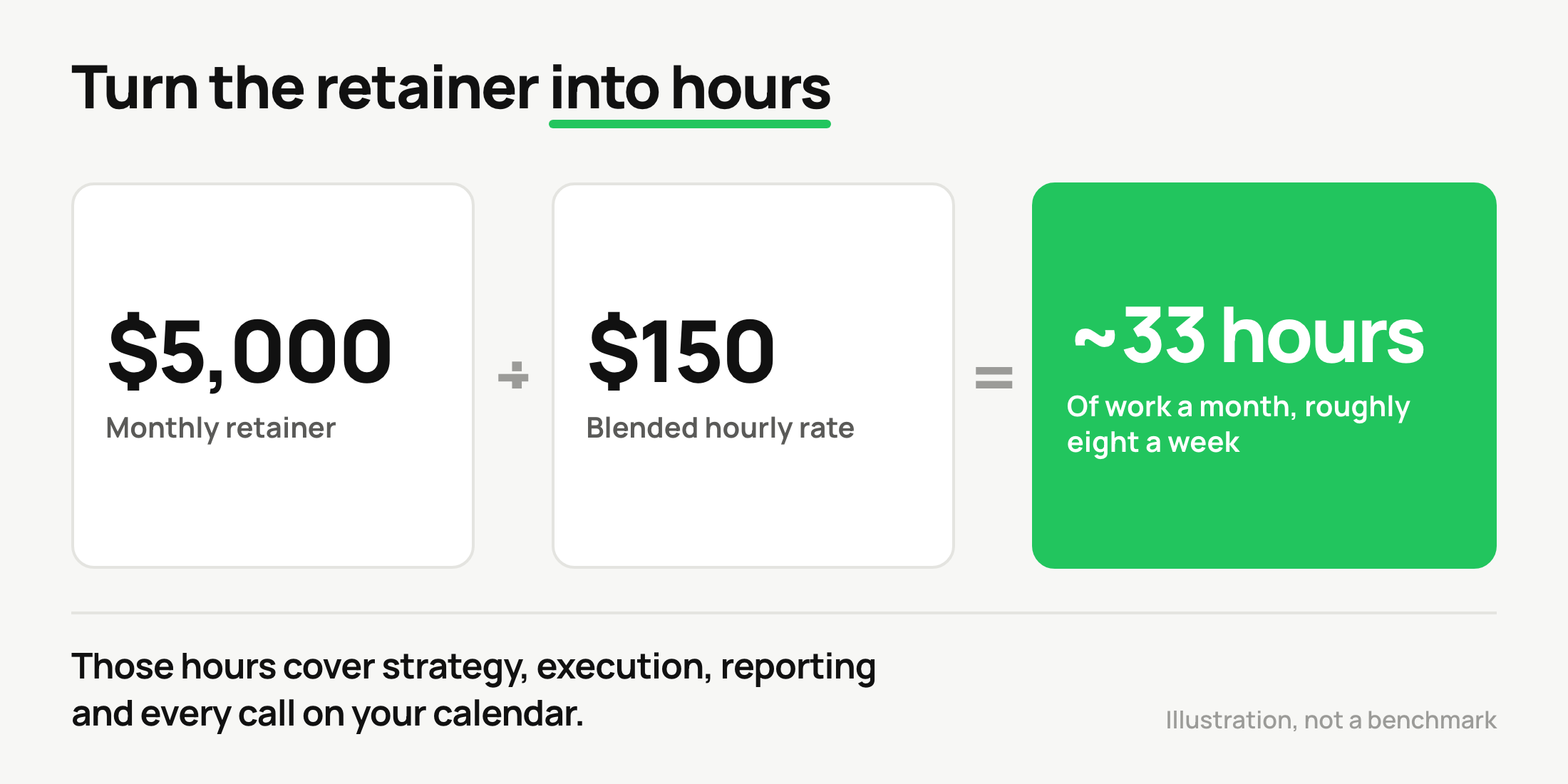
Here's an illustration, not a benchmark. A blended rate is the agency's average hourly rate across its senior and junior staff. A $5,000 monthly retainer at a $150 blended rate buys about 33 hours a month. That's roughly eight hours a week. Those eight hours have to cover strategy, execution, reporting and every call on your calendar. The $150 figure isn't pulled from thin air: InfluenceFlow's 2026 data puts SEO work at $100 to $250 an hour and PPC at $125 to $300.
Now subtract the overhead. Account management, the monthly review call and the report itself all come out of those 33 hours before anyone touches a campaign. How big is that slice? It varies by agency, so don't guess. Ask.
The same math works across all digital marketing agency pricing models, not just retainers:
- Project fee: divide by the agency's estimated hours. If they won't give an estimate, that's an answer too.
- Hourly quote: ask for the monthly cap. Without one, your budget is a suggestion.
- Percentage of ad spend: multiply the percentage by your planned spend to get a dollar fee. Then divide by the blended rate like any retainer.
Once every quote is in hours, the $1.5K and $12K proposals stop looking like one product at two prices. They're different amounts of labor.
Your action for this section is one email. Send each agency this question: "Roughly how many hours per month does this cover, and by which roles?" A clear answer within a day is a good sign. A vague answer, or "we don't track it that way," tells you how the account will be run.
What Blended Rate Is the Agency Assuming?
A blended rate averages senior and junior time into one number. An agency might bill its strategist at $250 and its coordinator at $75, then quote you a blended $140. That's normal and fine. What matters is the mix behind it.
A low blended rate usually means most of the hours go to junior or offshore staff. It's often how an affordable digital marketing agency keeps its fee low. That isn't automatically bad. Plenty of execution work, like building ad variants or scheduling posts, doesn't need a director. It just needs to be disclosed. Ask what the blended rate is and how it was built. If the agency won't share it, divide the fee by the hours they quote and you'll have it anyway.
Whose Hours Are You Buying?
You're buying specific people's time, so ask for names. The fear most buyers carry into these calls is the senior pitch followed by junior delivery: the strategist who wowed you in the meeting never logs into your account again.
Picture a $6,000 retainer where the pitch came from a VP. In the statement of work, ask for the named team, each person's role and the share of monthly hours each one spends on you. If the VP's share is zero, you now know who you're really hiring. If you're weighing that same money against a salaried hire, the agency vs in-house cost breakdown runs the full comparison.
Digital Marketing Agency Pricing Models and Who Carries the Risk
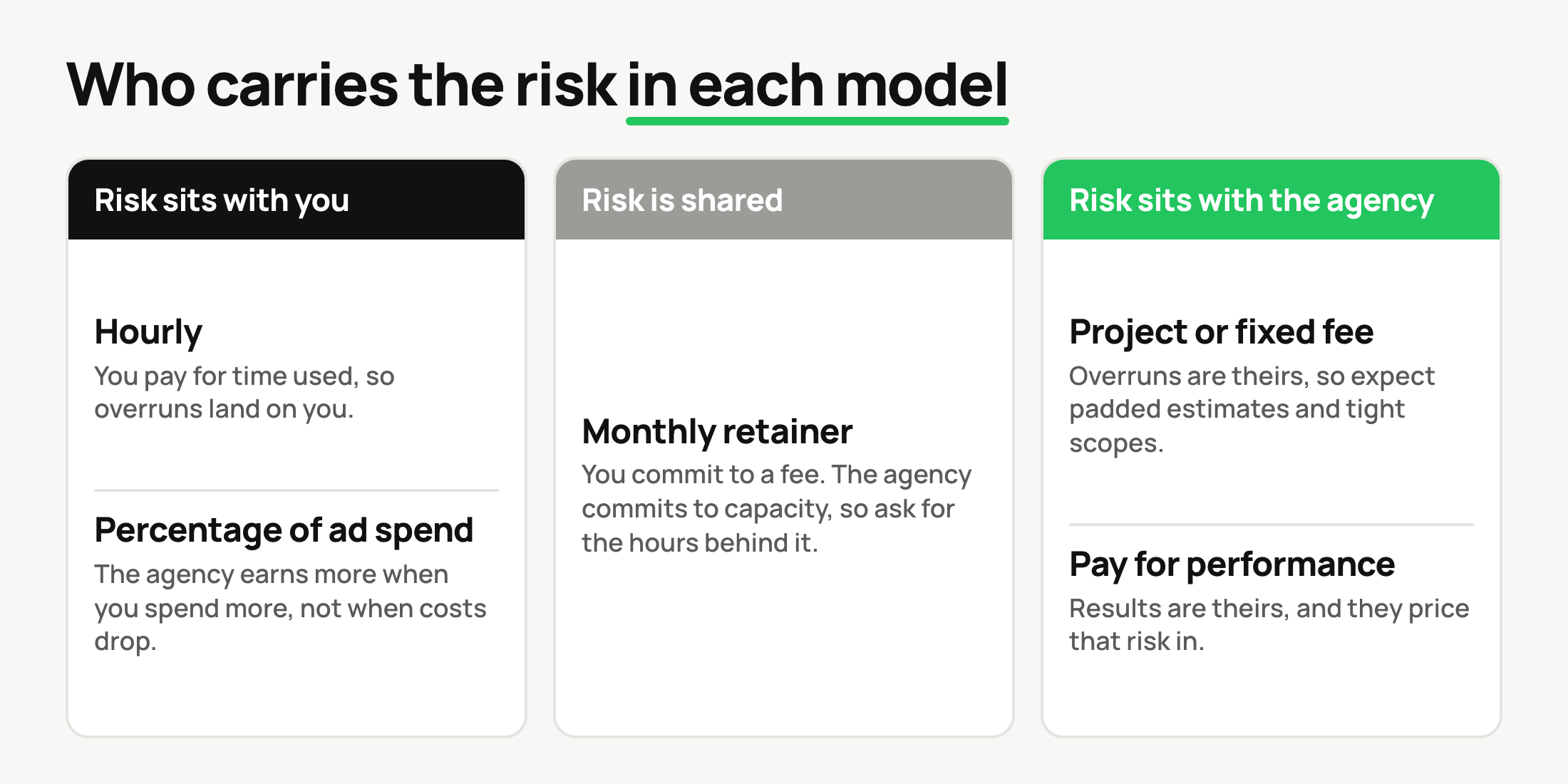
Every pricing model answers one question: when the work runs over or the results fall short, who pays? Read the model before you read the price. Five digital marketing agency pricing models cover nearly every quote you'll see.
| Model | You pay for | Risk sits with | Best fit |
|---|---|---|---|
| Hourly | Time used | You | Audits, small fixes, advisory |
| Project or fixed fee | A defined deliverable | Agency | Site builds, one-off campaigns |
| Monthly retainer | Ongoing capacity | Shared | Continuous channel management |
| Pay for performance | Leads or sales | Agency (priced in) | Clean and trackable funnels |
| Percentage of ad spend | A share of media budget | You, through incentives | Large and scaling paid budgets |
Hourly Billing
Hourly billing charges you for time used, so you carry the overrun risk. If a task takes twice as long as planned, you pay twice. InfluenceFlow's 2026 guide lists $75 to $400 or more an hour depending on the discipline. Hourly works well for audits and short advisory work. For ongoing management, it gets unpredictable. Ask for a monthly cap and itemized time reports.
Project and Fixed-Fee Quotes
A fixed fee moves the overrun risk to the agency. That sounds like a win for you. But agencies know it, so they pad estimates and write tight scopes. The clause that matters most is the change-order clause: what happens, and at what rate, when you ask for something outside scope. InfluenceFlow's cost data puts SEO audits at $5K to $30K as projects. That shows how much "scope" can swing one deliverable.
Monthly Retainers
Retainers are the default, and they're what most digital marketing agency pricing per month refers to. The risk is roughly shared. You commit to a monthly fee. The agency commits to capacity. The problem is that most retainers describe deliverables but not capacity. Ask for the hours behind the fee. Then ask about unused hours: do they roll over, or does the agency keep them?
When Does Pay-for-Performance Actually Work?
Performance pricing only works when attribution is clean and both sides agree on what counts as a result. Attribution is the tracking that ties each lead or sale back to the campaign that produced it. If "a lead" means one thing to you and another to the agency, you'll argue every invoice. Agencies also price the risk in. InfluenceFlow's 2026 guide cites ecommerce performance deals at 5% to 15% of new revenue generated, which can cost more than a flat fee once the program works. The breakdown of what a performance marketing agency is covers when this structure fits.
Percentage of Ad Spend
Paying a percentage of ad spend means the agency earns more when you spend more. It doesn't earn more when your cost per acquisition drops. That's the incentive problem. Clicksgeek's 2026 comparison reports Disruptive Advertising at 10% to 15% of spend with ad-spend minimums of $5,000 to $10,000. At small and mid-size budgets, a flat management fee usually lines up better with what you want. The counterpoint is fair, though. At large budgets that are scaling fast, a percentage can track the real workload. Check for a minimum fee and ask whether the percentage drops as spend rises.
Which Line Items Quietly Move the Number?
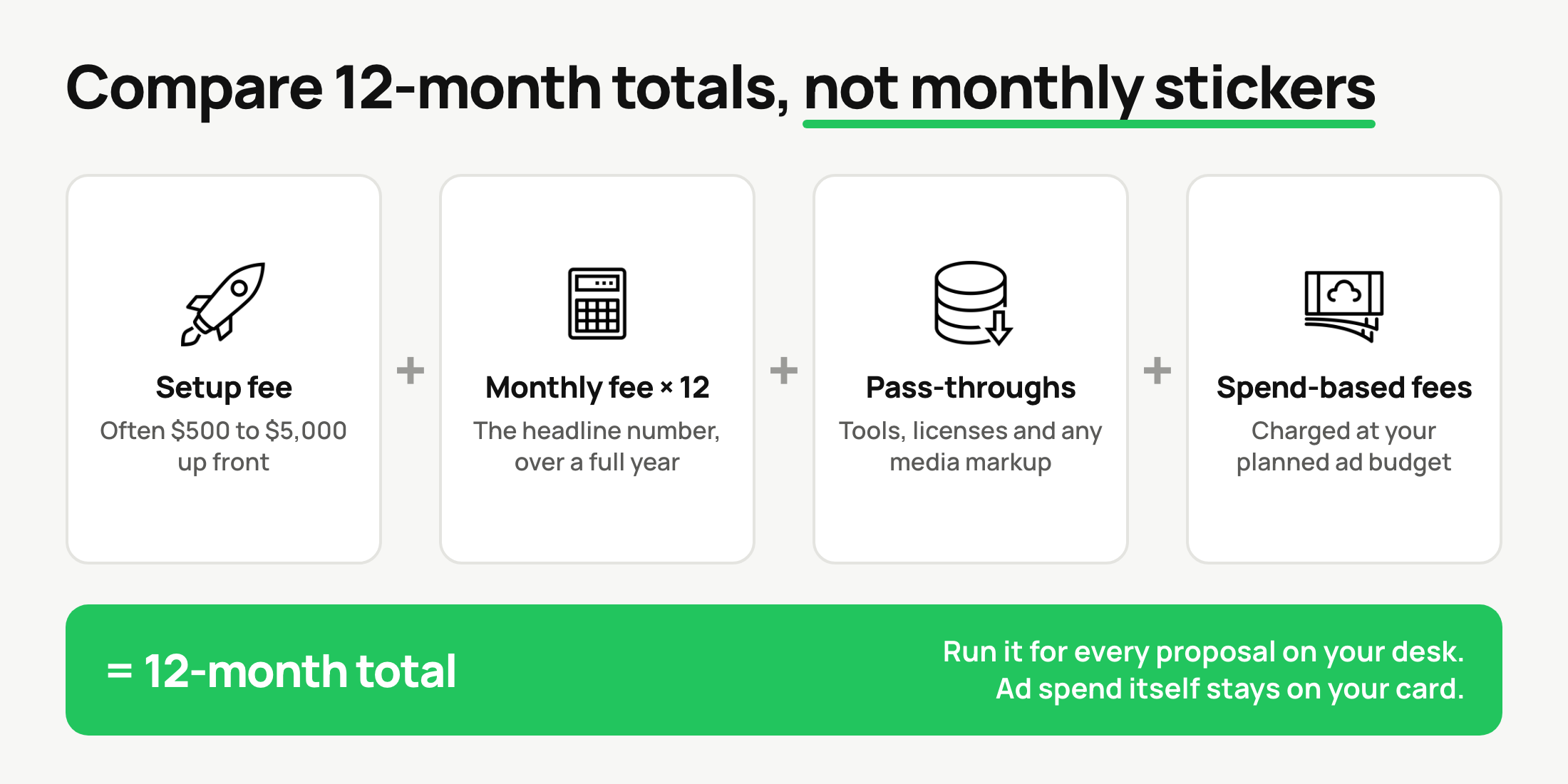
The headline fee is rarely the full cost. Setup charges, pass-through costs and scope details can add a large share on top, so build a 12-month total before you compare anything. Digital marketing agency pricing per month looks clean on a proposal. The year rarely does.
One line first: ad spend is almost always billed separately from the management fee. It should run on your card, inside ad accounts you own. The rest is less obvious.
Setup, Onboarding and Audit Fees
InfluenceFlow's 2026 guide puts setup and onboarding fees at $500 to $5,000. Some are legitimate. Rebuilding broken conversion tracking or restructuring a messy ad account takes real hours up front. Others are padding: an "onboarding fee" that covers a kickoff call and some account access. Ask what the setup fee produces that you can open and keep. If the answer is a slide deck, ask for it to be waived or credited against month one.
Tools, Licenses and Media Pass-Throughs
Agencies pay for tools such as SEO platforms and reporting dashboards. Stock assets and call tracking add more. Some include them in the fee. Others bill them at cost or with a markup. Ask for the tool list and who owns each license. Also ask whether any media runs through the agency's accounts. If it does, ask about markup on that media. And make sure you'll keep the accounts and data if you leave.
Content Volume, Revision Rounds and Reporting
Think about "4 blog posts a month." That can mean four 600-word posts or four 2,000-word guides with original research. Those are wildly different amounts of work under the same line. Ask for word counts, revision rounds and what happens on round three. Reporting needs the same scrutiny. A weekly call plus a custom monthly deck can eat several hours that would otherwise go to campaigns.
Now build the number that matters:
12-month total = setup fee + (monthly fee × 12) + tool and media pass-throughs + spend-based fees at your planned budget.
Run it for every proposal on your desk. Digital marketing agency pricing packages that look identical per month often differ by thousands once you do.
Spreading a Small Retainer Across Every Channel Costs More, Not Less
The cheapest retainer is rarely the cheapest result. A small fee split across four channels buys a few hours each, and a few hours isn't enough for any channel to produce anything. The same money on one channel almost always does more.
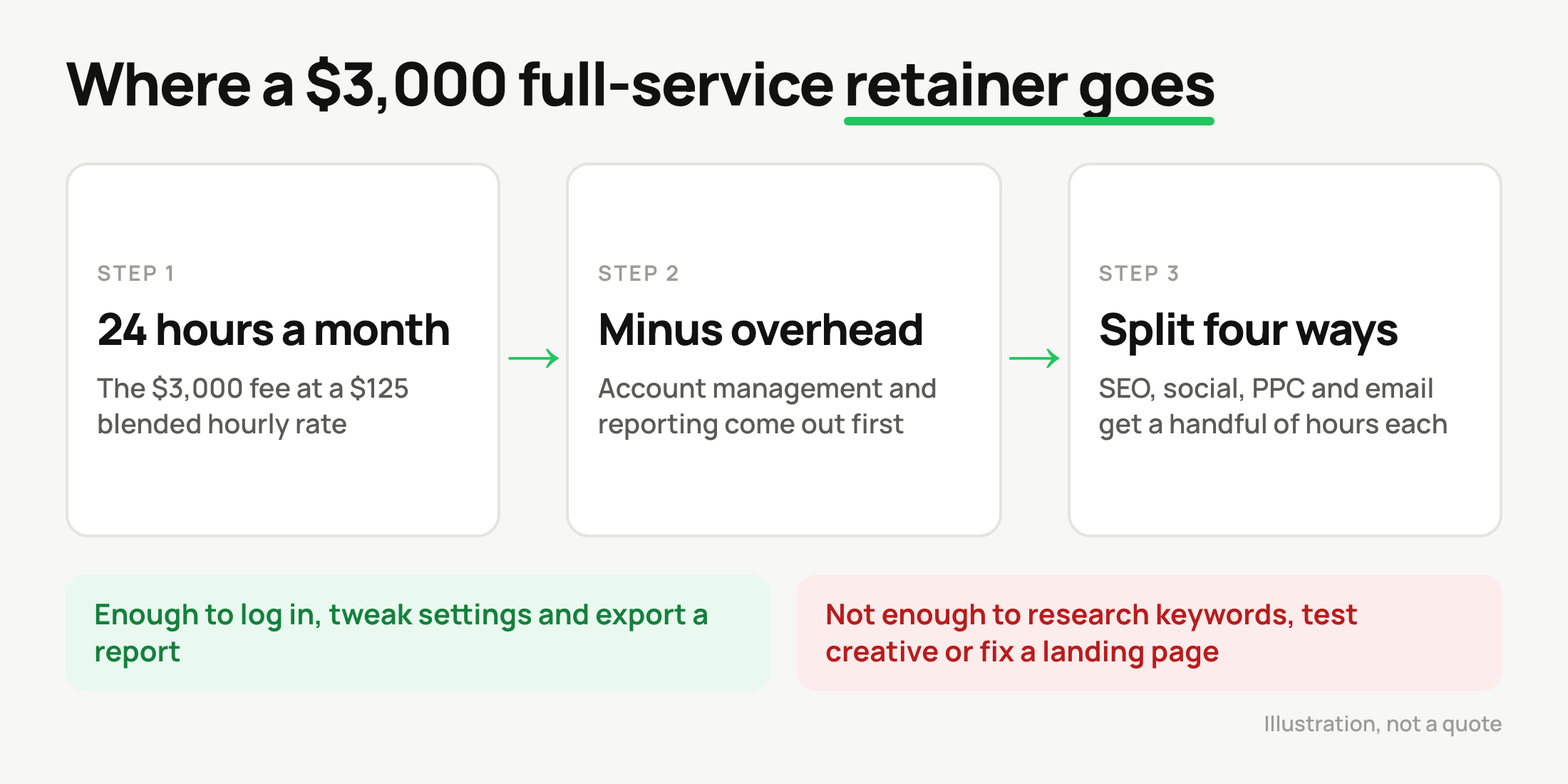
Run the hours math from earlier. Take a $3,000 "full-service" package, which is an illustration and not a quote. At a $125 blended rate that's 24 hours a month. Take out account management and reporting. Then split what's left across SEO, social, PPC and email. Each channel ends up with a handful of hours a month. That's enough to log in, tweak some settings and export a report. It isn't enough to research keywords, test creative or fix a landing page.
So who's to blame when it fails? Nobody, on paper. The agency delivered what it promised. But six months later you're convinced marketing doesn't work for you, when what really failed was the allocation.
How many hours does a channel need before it can work? Don't trust a blog post's number on that, including this one. Ask the agency directly: "What's the minimum monthly hours you'd want on each channel before you'd expect results?" Then check whether the proposal meets its own threshold. Plenty won't.
That's the real test of an affordable digital marketing agency. A quote is only affordable if the hours it buys clear that minimum on the channels you're paying for. Otherwise it's a discount on work that won't produce anything. Digital marketing agency pricing per month means little until you divide it by the number of channels.
If you're unsure which single channel to fund first, the small business channel guide walks through that choice. For the full process of vetting a lower-cost agency, that guide covers the questions. Budget-allocation rules like 70-20-10 (answered in the FAQ below) still apply here. On a small retainer, though, the "70" may need to be one channel.
A Like-for-Like Test for Comparing Two Proposals
Two proposals only become comparable once they're in the same units: total cost over 12 months and hours per channel. Three steps get you there. Then a short question set covers what the numbers can't.
Normalize Everything to 12 Months
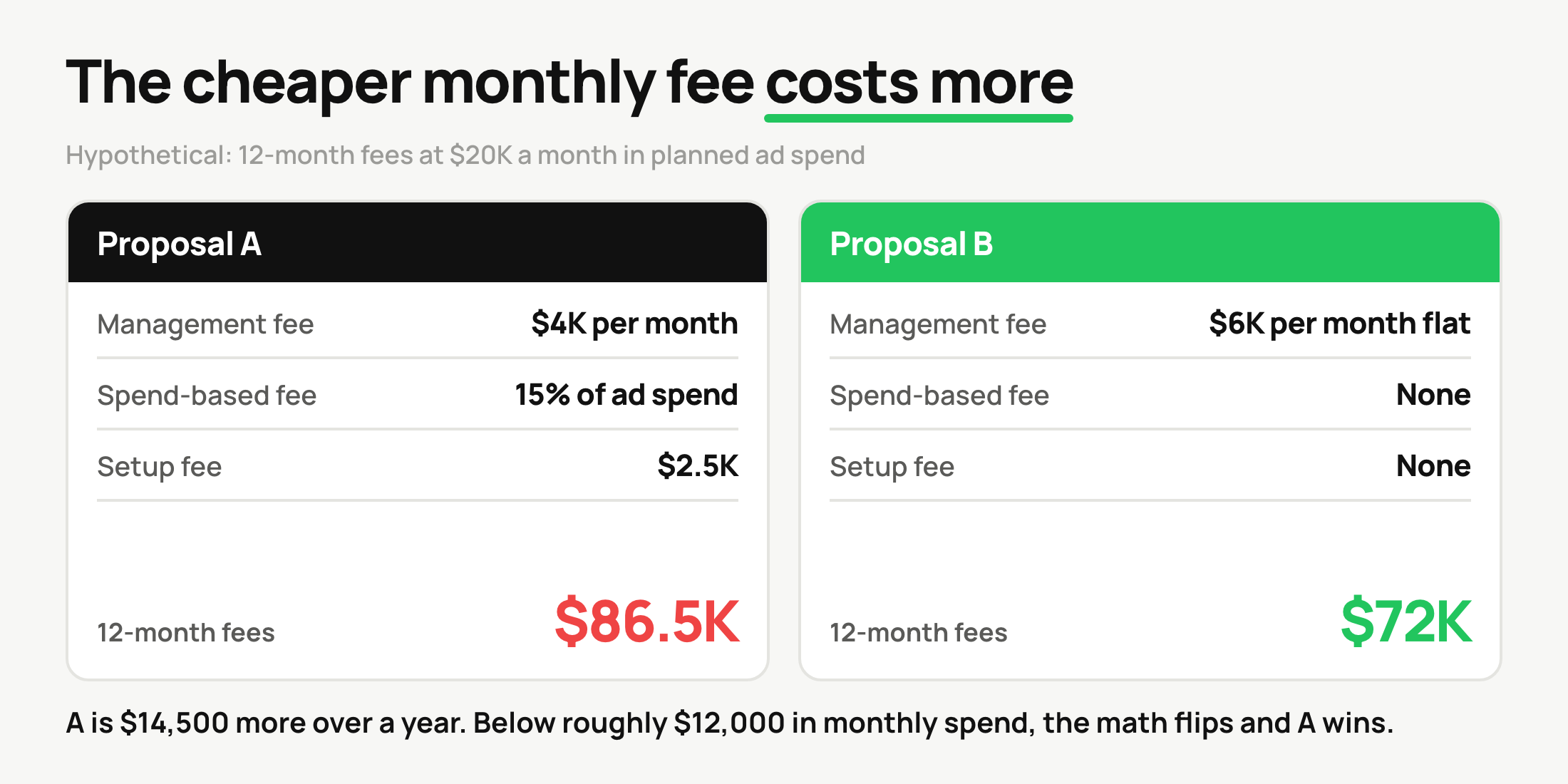
Put setup fees, minimum terms, spend-based fees and pass-throughs into one annual figure. Here's a hypothetical with a planned ad spend of $20,000 a month:
| Proposal A | Proposal B | |
|---|---|---|
| Management fee | $4K per month | $6K per month flat |
| Spend-based fee | 15% of ad spend | None |
| Setup fee | $2.5K | None |
| 12-month fees at $20K monthly spend | $86.5K | $72K |
Proposal A looks $2,000 a month cheaper. Over a year it costs $14,500 more. At lower spend the math flips. A wins whenever monthly spend stays below roughly $12,000. That's the point. Across digital marketing agency pricing models, your spend level decides which quote is cheaper. The headline fee doesn't.
Map Deliverables to Hours, Not Labels
Lay both "what's included" lists side by side. Next to each line, write the hours the agency assigns to it. Proposal A might list eight deliverables and Proposal B five. If B puts 40 hours behind its five and A puts 25 behind its eight, B is buying more work. Digital marketing agency pricing packages hide this by design, since a long list reads as more value. Only the hours tell you the truth.
Want to see how similar-tier agencies differ in practice? The Power Digital vs Directive comparison puts two mid-market shops side by side. The Boostability vs Coalition Technologies vs OuterBox comparison shows how a budget SEO provider stacks up against mid-market agencies. Both make a useful reference point for how pricing tiers map to service.
What Should You Ask Before Accepting Either One?
Ask these before you sign anything:
- Who's on my account by name, and what share of the monthly hours does each person spend?
- How do the hours split across channels, account management and reporting?
- What are the exit terms, and how much notice do I give?
- Do I own the ad accounts, analytics property and all the creative?
- What will I be able to open and use at the end of month one?
Any agency that answers all five in writing has given you something to compare. To browse other options at the same tier, the marketing agencies category lets you filter by service and location.
Red Flags Hidden in the Fine Print
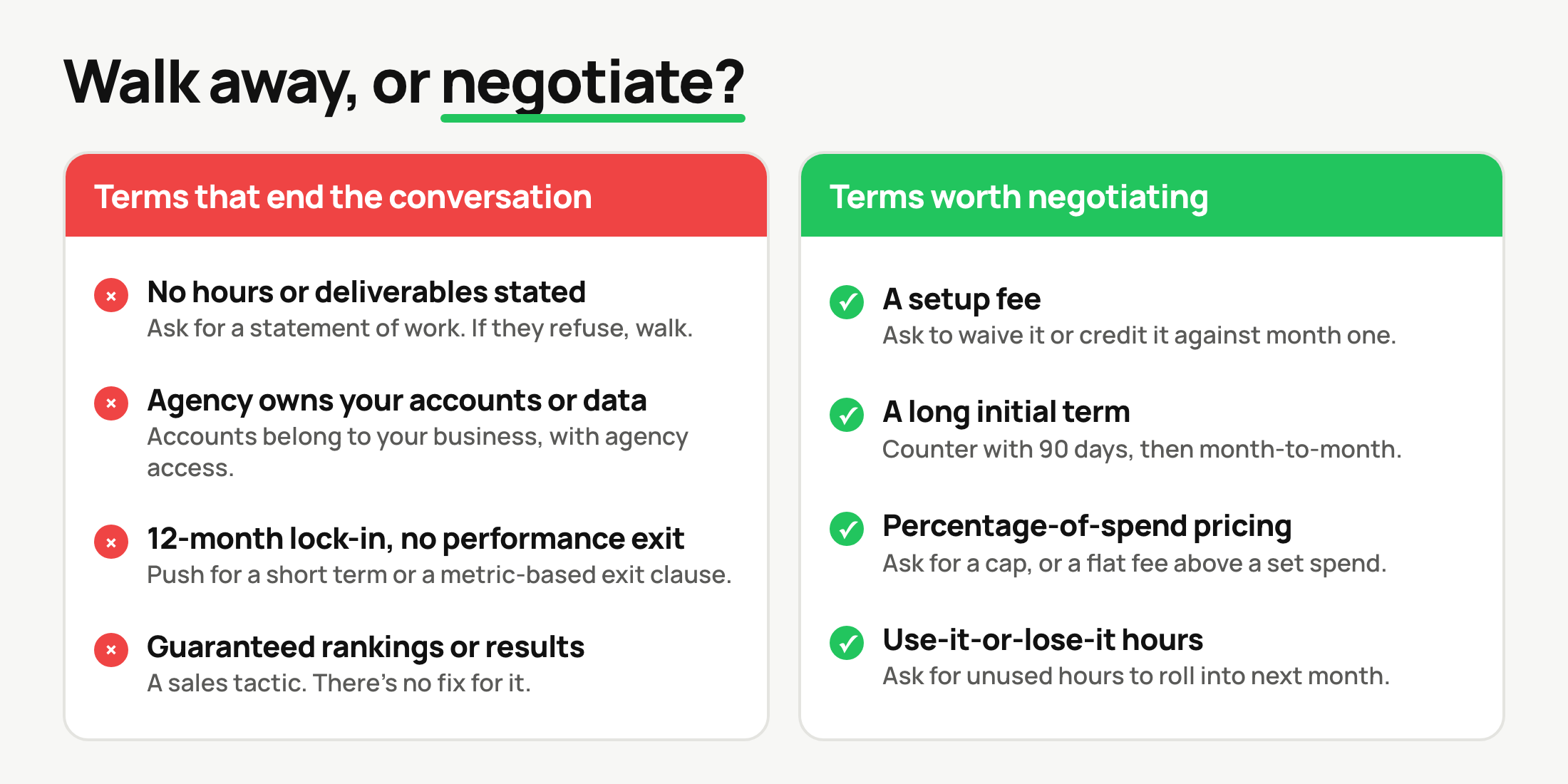
Some contract terms should end the conversation. Others are just a starting position you can negotiate. Knowing the difference saves you from walking away from good agencies or signing with bad ones.
Terms That Should End the Conversation
- No hours or deliverables stated anywhere. If you can't see what you're buying, you can't hold anyone to it. The fix: ask for a statement of work with both. If they refuse, walk.
- The agency owns your ad accounts or data. Leaving then means losing your history. The fix: every account gets created under your business, with agency access granted.
- A 12-month lock-in with no performance exit. The fix: a short initial term or an exit clause tied to agreed metrics.
- Guaranteed rankings or results. Nobody controls Google's algorithm. A guarantee is a sales tactic, and there's no fix for it.
Terms Worth Negotiating Instead
- A setup fee. Ask for it to be waived or credited against month one.
- A long initial term. Counter with a 90-day initial term and then month-to-month with 30 days' notice.
- Percentage-of-spend pricing. Ask for a cap, or a switch to a flat fee above a set spend level.
- Use-it-or-lose-it hours. Ask for unused hours to roll into the next month.
None of these are unreasonable. An affordable digital marketing agency that's confident in its work will usually agree to at least two. One that refuses all four is telling you how the relationship will go.
Bottom Line: Decode First, Then Shortlist
Any quote breaks down into four things: hours, the people behind them, the pricing model's risk and the line items outside the headline fee. "How much do digital marketing agencies charge?" gets you a range. Once you've run all four checks, digital marketing agency pricing stops being a guessing game, and you'll know what you're buying and whether it covers your scope. Don't chase the lowest number. An affordable digital marketing agency is one whose hours actually reach the work, so compare proposals over 12 months, put hours next to every deliverable and negotiate terms rather than rates.
When you're ready to compare agencies like for like, start with the marketing agencies directory. The best digital marketing agencies of 2026 and the best digital marketing agencies for startups are good shortlists, and the rating methodology explains how each score is built.
Frequently Asked Questions
What is the 70-20-10 rule in digital marketing?
It's a budget-allocation rule of thumb: about 70% on channels already proven to work, 20% on promising ones and 10% on experiments. It isn't an industry standard. On a small retainer, the 70% may need to be a single channel. Splitting $3K a month three ways leaves each channel with too few hours to perform.
What hourly rate do digital marketing agencies typically charge?
How much do digital marketing agencies charge by the hour? Quotes run anywhere from $50 to over $500, per Softtrix's pricing page. InfluenceFlow's 2026 data narrows that to $75 to $400 or more depending on discipline. Ahrefs' 2024 survey found SEO agencies averaged $98.90 an hour. The blended rate you pay depends on the seniority mix and specialty, so divide any retainer by it to see your hours.
Are pre-built marketing packages a better deal than a custom quote?
Digital marketing agency pricing packages are easier to compare. But they fix the scope to the agency's template, not your actual bottleneck. Custom quotes fit the problem better and are harder to compare. LYFE Marketing's social packages start at $750 a month, which makes them easy to benchmark. Either way, ask how many hours the package or quote covers and who does the work.
Is AI making agency services cheaper?
For some deliverables, yes. InfluenceFlow's 2026 guide reports content production costs falling by about 35% at agencies using AI tools. Strategy and senior review haven't gotten cheaper, though, and not every agency passes savings on. Ask whether your quote reflects AI-assisted production and who reviews the output before it ships.
Do agencies in major cities charge more?
Usually. InfluenceFlow's 2026 data puts New York agencies at a 40% to 60% premium over national averages. That works out to $5K to $30K a month. But most marketing work now happens remotely, so seniority matters more than the zip code. Pay the big-city premium only if you need people on site or deep local-market knowledge.
Can you negotiate an agency's quote?
Yes, but negotiate terms and scope rather than the hourly rate. A cut in price without a cut in scope usually just cuts hours. Ask for a 90-day initial term, a setup fee credited against month one, a cap on percentage-of-spend fees or fewer channels at the same fee. Most agencies will move on at least one.
How can I tell if my account will be handed to junior staff after I sign?
Ask for named team members and their share of monthly hours in the statement of work. Then ask who attends the monthly review. A $140 blended rate with a disclosed junior executor is perfectly fine. The problem is an undisclosed one, where the senior person from the pitch spends 0% of the hours on your account.
How long should a first contract with a marketing agency be?
Aim for a 90-day initial term, then month-to-month with 30 days' notice. That gives the agency time to set up while capping your downside. SEO and other slow channels need longer to show results, often six months or more. Treat that as a shared plan, not a lock-in written into the contract.
How do I justify an agency's fee to my CEO or finance team?
Present the quote as capacity, not a price: the hours, the roles and the 12-month total including setup and spend-based fees. Then state the payback condition, meaning what result covers the fee and by when. Framing digital marketing agency pricing this way, next to the cost of a salaried hire, makes the decision concrete for finance.
Top Marketing Agencies in 2026
Ranked by our editorial score across 1,493 listed marketing agencies.


Related Articles
Digital Marketing Agency for Small Business: 3 Service Tiers
A digital marketing agency for small business runs $500 to $25,000 a month. The 3 service tiers, what each buys, and when each stops making sense.
How to Choose an Affordable Marketing Agency in 2026
A practical 2026 guide to choosing an affordable marketing agency using pricing benchmarks, risk checks, and a 90-day execution framework.
Marketing Agency vs In-House Team: The Math Most Companies Get Wrong
Agency vs in-house marketing compared on real costs, AI impact, and when hybrid actually works. Data-backed framework for 2026.
What a Performance Marketing Agency Is vs PPC or Growth
A performance marketing agency is paid for incrementality and MER, not last-click ROAS. How it differs from PPC or growth, plus a 30-day proof.
More Insights

Top Healthcare Software Development Companies for Every Specialty
Find top healthcare software development companies by specialty: EHR integration, telehealth, FDA-regulated devices, and patient engagement apps compared.

Best Content Marketing Agencies: How to Pick the Right Type
Learn to identify the four types of content marketing agencies and match the right one to your content maturity, budget, and business goals.

What is a Lead Generation Agency? Complete Guide
Discover what a lead generation agency does, how lead generation specialists work, and whether outsourcing lead gen is right for your business in 2026.